That alone would be enough to make physicists’ hearts race. Now, add a twist: a coalition of tech billionaires and science philanthropists has just pledged hundreds of millions of euros to help turn that sketch into steel, magnets and 91 kilometres of underground tunnel.
A private jolt for “pure” science
The European particle physics lab CERN is used to relying on governments, not deep-pocketed donors. Its sprawling complex near Geneva runs entirely on public money from 23 member states. Yet this winter, a group of ultra-wealthy benefactors stepped in with an unusually bold promise: around €850–860 million for the Future Circular Collider (FCC), a next-generation particle accelerator that would dwarf the existing Large Hadron Collider (LHC).
The group includes the Breakthrough Prize Foundation, former Google CEO Eric Schmidt and his wife Wendy, Italian industrialist John Elkann of Stellantis, and French telecoms magnate Xavier Niel. None of them expects a commercial product, a patent portfolio or an IPO in return.
 Hygiene after 65 : not once a day, not once a week, shower frequency that keeps you thriving
What they are effectively buying is time, hardware and brainpower to chase questions about matter, energy and the origin of the universe.

For a field that usually battles for incremental budget increases, seeing private money on this scale flow into fundamental physics counts as a cultural shift. The FCC has become a test case for whether very long-term, curiosity-driven research can attract patrons outside national treasuries.
What exactly is the Future Circular Collider?
A ring bigger than Paris
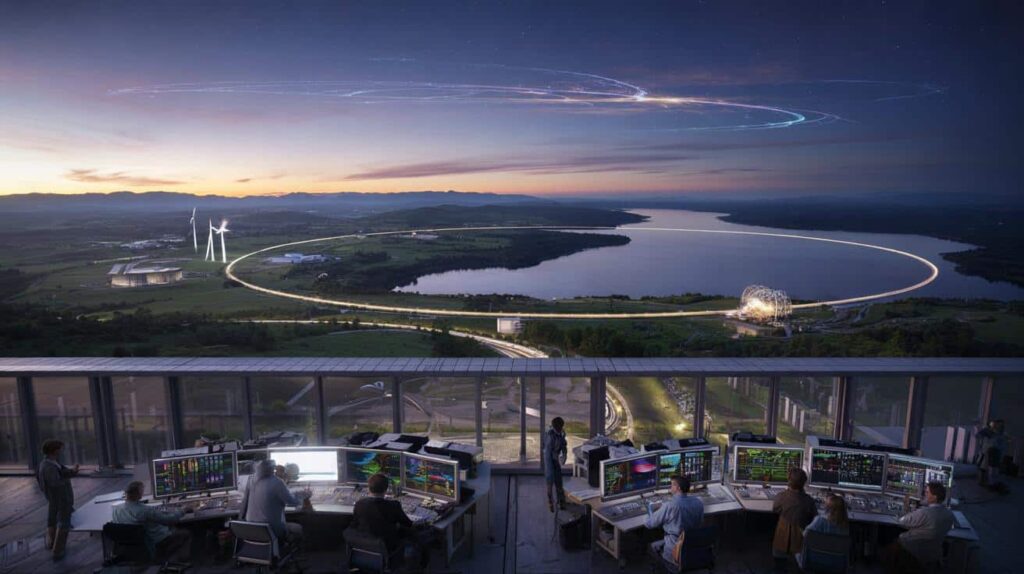
CERN’s current star machine, the LHC, sits in a 27 km tunnel and already accelerates protons to energies close to the speed of light. The FCC proposal multiplies that ambition several times over. Engineers envision a circular tunnel with a circumference of about 91 km, looping under the Geneva basin and parts of France and Switzerland.
Put simply, the FCC would be roughly three times the length of Paris’s ring road and around 15 times longer than the LHC.
The new collider would come in phases. One early concept puts electrons and positrons into the ring, acting as a “Higgs factory” to study the Higgs boson with extraordinary precision. Later, a hadron collider in the same tunnel could smash protons together at energies far beyond the LHC’s 14 TeV design limit.
The flagship goal is to dissect the Higgs boson, discovered in 2012 at the LHC, which plays a key role in giving particles their mass. By measuring its properties in fine detail, physicists hope to detect tiny deviations from the Standard Model of particle physics—the current best description of fundamental particles and forces.
Those deviations could hint at phenomena that remain invisible today: dark matter, new heavy particles, extra forces or even clues towards a quantum description of gravity.
Why scientists care so much
The Standard Model works spectacularly well, yet leaves glaring puzzles. It does not explain the nature of dark matter. It ignores dark energy. It struggles with gravity. And it cannot yet account for why there is more matter than antimatter in the universe.
- Dark matter: invisible mass detected through its gravitational pull on galaxies.
- Dark energy: a mysterious component driving the accelerated expansion of the universe.
- Matter–antimatter asymmetry: the reason ordinary matter survived the Big Bang instead of annihilating completely.
By pushing collision energies higher and gathering enormous amounts of data, the FCC might reveal rare processes or new particles that shed light on these problems. Even a single unexpected bump in the data—a sign of a new particle—could reshape modern physics.
CERN: from post-war pact to global physics hub
To grasp the weight of the FCC project, it helps to look at CERN’s track record. The lab was founded in 1954 by 12 European countries trying to rebuild scientific and political ties after the Second World War. It has since become one of the most successful international collaborations in science.
| CERN key figures | Values |
|---|---|
| Year founded | 1954 |
| Member states | 23 |
| Scientists involved | ≈ 17,000 |
| Current collider circumference (LHC) | 27 km |
| Scientific papers per year | 3,000+ |
| Annual budget | ≈ €1.35 billion |
| Underground tunnels | ≈ 50 hectares |
Beyond the landmark Higgs discovery, CERN’s influence spreads through several breakthroughs. It hosted key evidence for the Standard Model in the 1970s and 80s, produced the first antihydrogen atoms in the 1990s, and kept them trapped long enough for study in the 2010s. It also gave the world the World Wide Web, invented by Tim Berners-Lee while working at CERN in 1989 to help physicists share information.
Over time, technologies developed for accelerators and detectors seeped into hospitals, data centres and industry. Advances in imaging, radiation therapy, superconducting magnets, large-scale computing and even cybersecurity practices all trace some roots back to high-energy physics labs.
Major CERN discoveries since 1973
| Year | Discovery | Impact |
|---|---|---|
| 1973 | Neutral currents | First major evidence for the Standard Model’s electroweak theory |
| 1983 | W and Z bosons | Confirmed the unified description of electromagnetic and weak forces |
| 1995 | Antihydrogen | Opened precision tests of antimatter behaviour |
| 1999 | High gluon density effects | Improved understanding of the strong nuclear force |
| 2010 | Trapped antihydrogen | Allowed long-term studies of matter–antimatter symmetry |
| 2012 | Higgs boson | Confirmed the mechanism that gives mass to elementary particles |
| 2015 | Hints of dark matter-related phenomena | Guided new lines of theoretical and experimental research |
| 2021 | Meson B anomalies | Suggested possible cracks in the Standard Model’s predictions |
When could the FCC actually happen?
Despite the eye-catching headlines, the FCC remains a proposal. It currently sits in the preparatory phase of the European Strategy for Particle Physics. A political and scientific decision on whether to proceed is expected around 2028.
The European Commission has placed the FCC concept among its so-called “moonshot” projects for the late 2020s and early 2030s—high-risk, high-ambition programmes intended to mark a clear before-and-after moment for European science and technology.
If greenlit, construction would likely take a decade or more. Early estimates put the overall bill at around €20 billion. The current private pledge, although headline-grabbing, would cover perhaps 4–5% of that amount. The rest would still have to come from member states and partner countries.

The real signal here is less the raw cash and more the message: long-term physics can attract allies beyond ministries and parliaments.
What private donors think they are funding
CERN director-general Fabiola Gianotti welcomed the pledge as a recognition that “basic” research shapes society far beyond academic journals. Her argument: every time humanity builds a machine that pushes physical limits, spin-off benefits eventually ripple through medicine, computing, engineering and training.
Eric Schmidt has framed the FCC as a pressure cooker for technologies in computing, modelling and energy management. Handling torrents of data at unprecedented speeds, orchestrating massive sensor networks and cooling vast superconducting magnets all demand new solutions. Those solutions rarely stay inside the tunnel.
Pete Worden, who heads the Breakthrough Prize Foundation, casts the project in more philosophical terms. For him, funding a collider is a way to back a shared human quest: understanding what matter is, where the universe came from, and how humans fit into that story.
Environmental and practical questions
Building a 91 km tunnel is not a trivial decision for the Geneva region. Before anyone starts drilling, geologists need to map rock layers, fault lines and water flows. Local authorities will weigh noise, traffic, and land use. European regulators will scrutinise environmental impact and energy consumption.
CERN already runs some of the largest cryogenic systems on the planet to keep magnets at temperatures colder than outer space. The FCC would push this further. Plans under discussion include using more efficient superconducting materials, drawing electricity from low-carbon sources and recycling waste heat for surrounding communities.
One striking element in early studies is the sheer volume of rock to be removed: around nine million cubic metres. Engineers are investigating ways to repurpose this material in construction projects or ecological restoration, rather than simply dumping it.
Jargon that actually matters
Several physics terms keep surfacing around the FCC debate. Understanding a few of them helps clarify what is at stake:
- Collider: A machine that accelerates beams of particles and then smashes them together, so detectors can analyse the debris.
- TeV (tera-electronvolt): A unit of energy used in particle physics. Higher TeV means more violent collisions and access to heavier, rarer particles.
- Higgs boson: A particle associated with a field that gives mass to many other particles. Measuring how it interacts may reveal unknown physics.
- Standard Model: The leading theory describing known particles and three of the four fundamental forces, excluding gravity.
A useful mental picture: a collider acts like an enormous microscope, but instead of using light, it uses energy. The more energy you pack into each collision, the finer the details you can probe inside matter, and the more likely you are to create new particles briefly from pure energy, according to Einstein’s E = mc².
What happens if the FCC never finds “new physics”?
Some critics argue that pouring tens of billions into a single machine is too risky. There is no guarantee the FCC will find new particles or give a dramatic headline discovery. Yet even a “null result” would reshape theory, by ruling out entire classes of speculative models and forcing physicists to rethink their assumptions.
On a more tangible level, the process of designing, building and operating such a facility usually leaves a thick trail of innovations: faster electronics, better superconductors, more accurate sensors, new software algorithms and training for thousands of engineers and technicians. These people often move into industry, healthcare or climate-related technologies later in their careers.
There are also risks to manage. Very large projects can slip in cost and schedule. Political backing can fade across election cycles. Public trust can erode if local communities feel sidelined or if benefits appear too abstract. CERN’s leadership will have to navigate these tensions while keeping the scientific case clear and grounded.
How this could change the relationship between money and physics
If the FCC goes ahead with a solid block of philanthropic funding, other research fields will watch closely. Long-duration astronomy missions, advanced fusion prototypes or climate intervention studies could all look for similar private backers.
That raises new questions: who sets the research agenda when billionaires sit beside ministers? How transparent should funding negotiations be? What safeguards keep scientific priorities from drifting towards fashionable topics at the expense of steady, less glamorous work?
For now, the FCC pledge sits in a delicate middle ground. It is large enough to accelerate planning and signal confidence, but small enough that governments still hold the steering wheel. The next few years—through design studies, political debates and environmental reviews—will reveal whether this uneasy partnership between public science and private fortune can actually bore a 91 km circle under Europe and give physicists a new window on the universe’s first moments.