
On a typical grey afternoon, when the lawn is still damp, you suddenly notice it: a dense, dark-green carpet replacing the grass. You press your shoe into it, feeling a soft, almost springy texture—strangely satisfying… until you realize that a quarter of your garden has turned into a sponge.
The kids slip when they run. The mower clogs. You begin to avoid that patch because it always looks cold and wet, even in June.
And a tiny thought nags at you: maybe the moss isn’t the problem. Maybe it’s just a symptom.

Why Moss Appears on Your Lawn
Moss doesn’t simply appear by accident. It creeps in quietly when grass is tired, shaded, or starved, and the ground stays damp for longer than it should. In other words, it thrives exactly where your lawn has given up the fight.

If you look at a mossy lawn after the rain, you’ll see water just sitting on the surface, shining. There are no air pockets, no crumbly soil—just a compact mass. Grass roots struggle in that kind of environment, while moss thrives. That contrast alone shows you who’s winning under your feet.
Once you see it this way, the lawn stops being just a green carpet and becomes a living system out of balance.
Take Anna’s Experience
Anna, who had recently moved into a semi-detached house on the edge of town, faced this dilemma. The first spring, she bought a new mower, posted photos of her “garden makeover,” and dreamed of barbecues with friends. By autumn, the north side of her lawn was almost completely moss-covered, with the grass looking thin and defeated.
Her neighbor suggested a chemical moss killer. Overnight, the moss turned brown, but so did most of the weak grass roots underneath. The next rain washed away the dead moss, leaving bare soil. In just a few months, the moss returned, thicker than before.
That’s when she realized she had only fought the symptom, not the conditions that invited it.
The 3 Conditions Moss Thrives In
Moss thrives under three simple conditions: shade, moisture, and compact or acidic soil. Remove just one of those conditions, and the moss starts to lose its grip. Change two, and grass can reclaim the space almost on its own.
This is why quick-fix products are tempting yet often disappointing. They may burn the moss and provide an immediate visual improvement, but the ground underneath remains heavy, poorly aerated, and nutrient-deprived. Grass roots don’t suddenly grow stronger just because the label says “fast-acting.”
Natural Methods to Tackle Moss Effectively
Let’s be honest: no one has the time to manage a pristine lawn every day. Most of us want a lawn that survives our real lives—kids, pets, and busy weeks—not a sterile green carpet maintained with lab precision. The good news is, when you work with the soil and light, nature helps you.

Start with Aeration
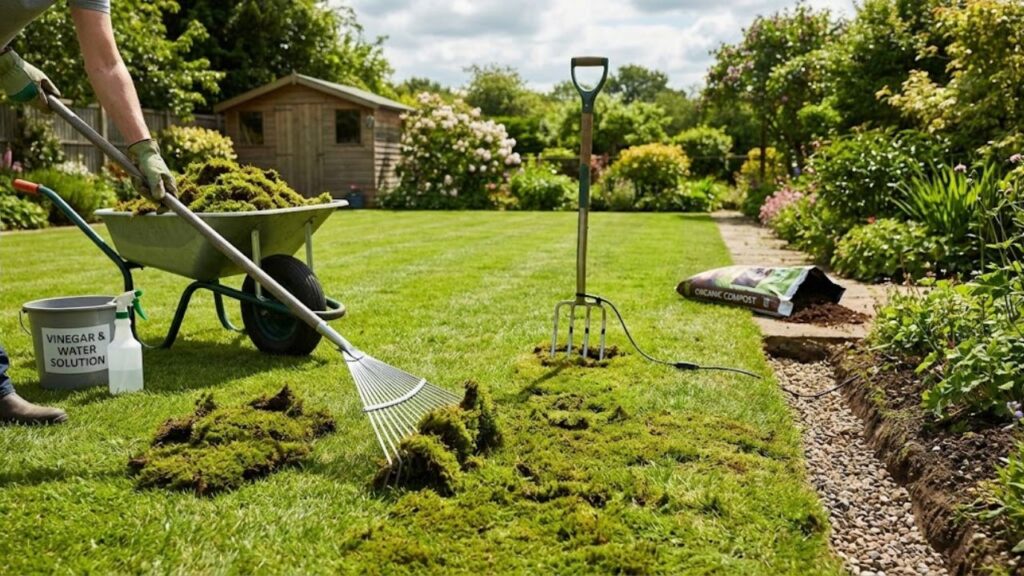
The simplest, most underrated solution to moss is aeration. If your lawn squelches underfoot or feels rubbery, it’s crying out for aeration. Use a garden fork and push it into the ground every 10–15 cm, rocking it gently to create channels. If you have a larger area, consider using a manual aerator.
This may not look glamorous, but it works. Those holes change everything: water drains better, roots breathe, and microorganisms finally have space to thrive. After aerating, lightly spread a mix of compost and sand or fine topsoil. This slips into the holes and slowly transforms the ground into something crumbly and alive. *This is where moss starts losing its territory.*
Raking Away Moss
One of the most common and effective natural methods to tackle moss is using a simple spring-tine rake. Wait for a dry day, let the moss dry out a bit, then pull the rake through the lawn. The sound of moss lifting away in clumps is oddly satisfying. Work in sections, cross-raking to loosen more moss without scalping the grass.
Don’t rush it. Go lighter than you think and repeat every couple of weeks. Think of it like exfoliating, not sanding. You’re allowing light and air to reach the grass, not punishing it for being tired.
Adjusting the Soil’s pH
A quiet, low-tech solution many gardeners swear by is adjusting the soil’s pH naturally. Moss thrives in slightly acidic soil, while grass prefers neutral conditions. Instead of using harsh chemicals, consider spreading **garden lime** in late autumn or early spring when the soil is moist but not soaked. Over time, this shifts the pH balance toward grass. Always test a small area first, especially if you have acid-loving plants nearby.
Fertilizing with Organic Compost
Feeding your lawn with organic compost serves a dual purpose: it nourishes the grass and improves the soil structure, allowing water to drain more effectively. A light dressing of **well-rotted compost** once or twice a year will do wonders.
“Once I stopped fighting moss like an enemy and started feeding the soil, everything changed. I have less moss now and I work less on the lawn,” shared a retired groundskeeper who had maintained sports fields for thirty years.
Simple Actions for a Greener, Healthier Lawn
- Rake out moss gently on dry days, working in sections to avoid tearing healthy grass.
- Aerate compacted areas with a fork or aerator, then brush in compost or sandy topsoil.
- Use organic fertilizers and compost instead of high-salt chemical feeds.
- Consider light pruning of overhanging branches to let more sunlight reach persistent moss patches.
- Overseed bare spots with grass seed to prevent moss from coming back.
Living with a Resilient Lawn
Eventually, you stop dreaming of a magazine-perfect lawn and start desiring one that simply feels good underfoot—a lawn that forgives the dog, survives a forgotten watering, and doesn’t rely on chemicals to thrive. When you tackle moss naturally, you’re not just addressing a cosmetic issue, you’re rebuilding the relationship between soil, roots, light, and water.
This shift has an unexpected benefit: you become more tolerant. A small patch of moss under a shady tree becomes a natural carpet rather than an invasion. You start to read the ground—where it stays soggy, where the grass thrives, and where you could let clover join the mix.
Lawns are more forgiving than we think. Once you work with them, not against them, you might even find yourself proud—not just of how your grass looks but of how quietly alive your soil has become.

Key Points for a Healthy Lawn
- Improve soil aeration: Use a fork or aerator, then topdress with compost or sand to reduce moisture and strengthen grass roots.
- Work with light and shade: Prune branches, accept moss in deep shade, and overseed sunny areas to create realistic zones instead of constant battles.
- Feed the soil, not just the lawn: Use organic compost and balanced nutrition instead of harsh chemicals to build long-term resilience and a healthier, more natural lawn.
