
No loud music, no mirrors, no Lycra. Just seven people over 70 moving slowly between chairs, a wall, and a wooden stick that had clearly lived through many winters.
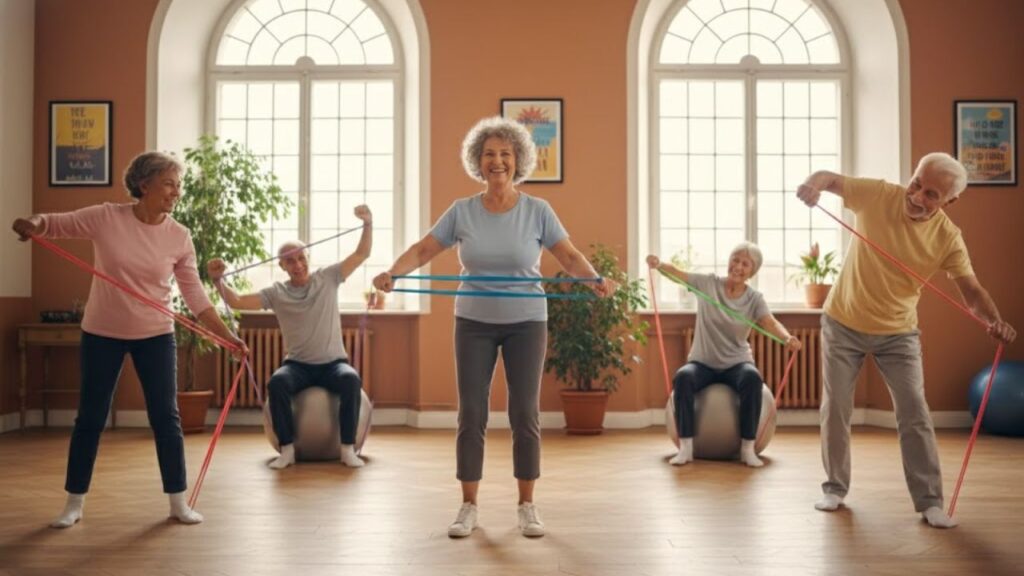
A white-haired man in a navy sweater bent his knees, reached his arms forward, and then—carefully—stood up from his chair without using his hands. The instructor clapped once, soft but proud. A woman in a red cardigan tried the same movement, wobbled, laughed, and tried again. This time, she succeeded.
This wasn’t a workout made for social media. No one checked a smartwatch. No one talked about steps or calories. Yet the room carried a powerful energy: people training to keep their independence, one repeated movement at a time.
And it had nothing to do with a daily walk.

The movement pattern that quietly predicts healthspan
Fitness trends change every decade—Jazzercise, spinning, HIIT, 10,000 steps. After 70, most of that noise runs into one simple truth: the body cares far less about how much you move, and far more about how you move.
The movement pattern that quietly predicts healthspan is easy to name but harder to train: multi-joint, real-life transitions. Think sit-to-stand, floor-to-stand, reach-and-twist, step-and-turn. The clinical term is functional strength. In real terms, it means being able to move your own body through everyday positions without fear.
Walking supports heart health. Occasional gym sessions can build muscle. But research on who stays independent into their 80s and 90s keeps pointing to the same thing: a blend of strength, balance, and coordination during ordinary transitions—the movements your future self will rely on every single day.
This is why many geriatricians focus on one deceptively simple assessment: the sit-to-stand test. How many times can someone rise from a chair without using their hands in 30 seconds? Or how easily can they sit on the floor and stand up again?
These results predict far more than fitness. In some studies, they predict survival more accurately than blood pressure. A well-known Brazilian study on the “sit-rise test” showed that people who could get down and up from the floor with minimal support had significantly lower mortality over the following years. Not because the test is magical, but because it reflects a deep combination of leg strength, hip mobility, core control, and balance.
Think about the last time you saw someone struggle to rise from a low car seat, a sofa, or the ground. That brief struggle is like a headline about their healthspan. It’s not about running a 5K. It’s about whether stairs will still be manageable in five years.
Researchers describe this as intrinsic capacity—the mix of physical and mental abilities that allows you to live on your own terms. And intrinsic capacity depends far more on basic movement patterns than on whether you follow a perfect exercise schedule.
Imagine two 74-year-olds who both walk for 30 minutes most days. One can get up from the floor using a single hand on the thigh. The other needs a solid table and another person’s arm. On paper, their activity levels look identical. In reality, their futures are already drifting apart.
How to train the “get up and go” pattern after 70
The good news is that this kind of training doesn’t require special equipment or expensive classes. You can practice the movements that protect your healthspan right at home, in under 10 minutes, using simple items: a chair, a wall, maybe a cushion.
Start with one of the most underestimated exercises after 70: the hands-free sit-to-stand. Sit on a firm chair with feet flat on the floor. Cross your arms over your chest or reach them forward. Lean slightly, press your feet down, and stand up. Lower yourself back down slowly. That’s one repetition.
Many people can only manage three or four repetitions at first. That’s completely fine. The pattern matters more than the count.
When this feels more comfortable, you can build a short “healthspan circuit”:
 Goodbye Hair Dye for Grey Hair: The Conditioner Add-In That Gradually Restores Natural Colour
- 5 sit-to-stand repetitions
- 10 seconds standing on one leg while holding the chair back
- 5 gentle step-backs on each leg
- 5 wall push-ups
Do the circuit once. On good days, repeat it. Your future body will recognize every element of this sequence.
Let’s be honest: no one does this perfectly every day. Routines slip. Knees complain. Life intervenes. What matters isn’t perfection—it’s steady repetition over months and years. Two or three sessions per week already make a meaningful difference for most people over 70.
There’s also a common mistake of swinging to extremes. Some people move as if they’re fragile, barely bending their knees. Others try to compensate by jumping into deep squats or intense routines their joints don’t trust.
A calmer middle ground works best. Move slowly enough to stay in control, but not so gently that your muscles never work. Mild effort is helpful. Sharp pain is not. If your knees protest during sit-to-stands, raise the seat with a cushion, shorten the movement, or lightly touch the chair for balance.
In practice, consistency beats intensity. A short routine you almost know by heart will always outperform an ambitious plan that stays on paper. It also helps to attach these movements to habits you already have—before lunch, after brushing your teeth, or while waiting for the kettle to boil.
After 70, many people carry a quiet fear: fear of falling, fear of looking awkward, fear of starting too late. That fear can restrict movement more than any stiff joint. Often, one safe experience—standing up without using your hands—is enough to begin changing that story.
“The first time I got off the carpet without my grandson pulling my arm, I cried,” a 79-year-old retired teacher once said. “It wasn’t about the floor. It was about not feeling like a burden.”
Small patterns that protect independence
Her weekly routine isn’t dramatic. It’s a simple set of movements woven into daily life:
- 5–10 hands-free sit-to-stands before breakfast
- Standing on one leg while brushing her teeth
- Practicing floor-to-stand twice a week on a rug
- Wall push-ups while the kettle boils
- A slow walk around her apartment, adding stairs when she feels confident
On paper, this might look almost too basic. In reality, these are the exact movements that allow her to live alone, carry groceries, and sit on the floor to play with her grandson. The value isn’t in the exercises themselves—it’s in the movement pattern they reinforce.
Shifting focus from workouts to future moments
This approach doesn’t come with medals or finish-line photos. There’s no celebration for “stood up unassisted at 83.” But healthspan is defined by quieter moments: rising from a café chair without searching for support, lifting a bag onto a train rack, kneeling in the garden and trusting you can stand again.
The movement pattern that strengthens healthspan is a promise to your future self: to keep practicing the transitions you’ll need most. Not obsessively. Not flawlessly. Just often enough that your legs, hips, and balance don’t panic when life presents a low sofa or an uneven curb.
Most of us have watched an older relative push off a table with both hands, face tightening slightly, and felt a quiet hope: please don’t let that be me. That thought doesn’t have to become fear. It can become an invitation to learn a few simple movements that act like private insurance for independence.
The next time you read about ideal step counts or perfect weekly routines, pause and ask something else: can I stand up from my chair with control? Can I balance on one leg for ten seconds? Can I, with patience and support, practice getting off the floor?
If the answer is no, it isn’t a failure. It’s a starting point. A map that shifts attention from distant fitness goals to the everyday reality of how your body moves through an ordinary day. This is where healthspan truly lives—between the chair, the floor, the stairs, and the quiet courage to keep practicing.

Key takeaways for readers
- Prioritise “get up and go” movements: sit-to-stand, floor-to-stand, balance, and transitions directly support independence after 70.
- Choose short, frequent routines: 5–10 minutes, two to three times per week, is more sustainable than ambitious programs.
- Integrate movement into daily life: linking exercises to habits like brushing teeth or boiling the kettle builds lasting consistency.
