Each winter, as temperatures drop and public transport becomes unreliable, a quiet group of workers continues to commute. Their choice is rarely about bravery. Instead, it reflects a mix of psychology, financial necessity, and social expectations all working together. When trains stall and pavements freeze, staying home often feels less like an option and more like a risk of its own.
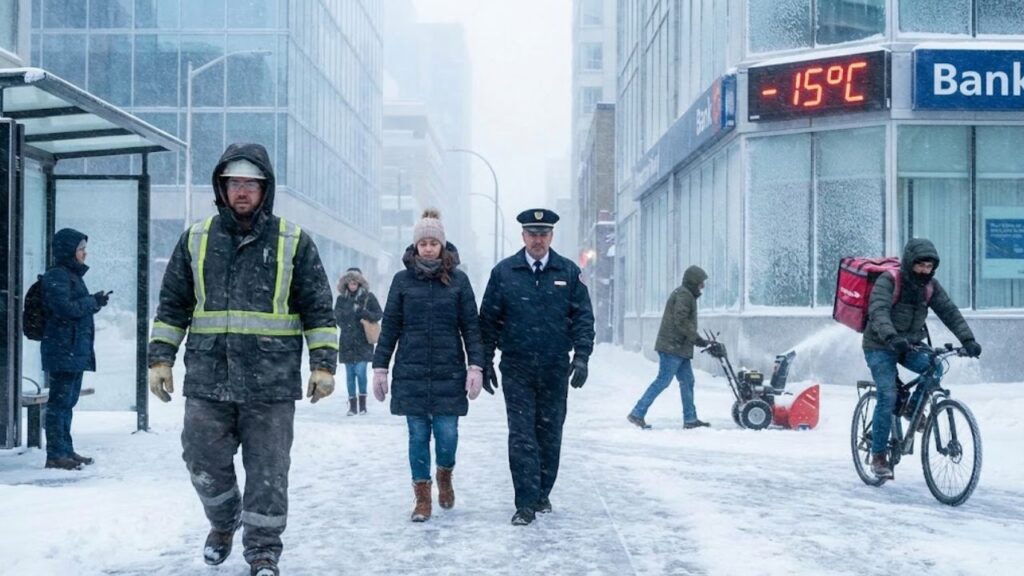
When Facing the Cold Feels Unavoidable
For many employees, leaving the house on an icy morning does not feel like a real decision. Rent still needs to be paid, shifts are fixed, and missing work can mean lost income or problems with a supervisor. Psychologists note that several forces sit behind this seemingly simple choice.
Going to work in harsh weather is rarely about courage alone. It reflects a combination of personality traits, motivation, and very real external pressures. Research into work behaviour often highlights three overlapping layers.

- Individual personality, such as being organised or emotionally steady
- Motivation, including how meaningful and autonomous the job feels
- External pressures, from financial needs to workplace rules
On snowy or icy days, these layers reinforce each other. Someone who is naturally dutiful, highly motivated, and dependent on every hour of pay is far more likely to head out, even when freezing rain lashes sideways.

Personality Traits That Nudge People Out the Door
Conscientiousness: The Inner Push to Show Up
One personality trait appears repeatedly in studies of reliable attendance: conscientiousness. People high in this trait tend to be organised, careful, and guided by a strong sense of responsibility.
Across many professions, conscientious workers show steadier attendance and stronger performance, even when conditions are uncomfortable. Large-scale research suggests they are more likely to:
- Plan ahead for disruptions, such as waking earlier when snow is forecast
- Feel uneasy about breaking commitments, making staying home emotionally difficult
- Connect their self-worth to doing the work they agreed to do
For these individuals, calling in sick due to bad weather can feel more distressing than enduring the cold. Their sense of identity is closely tied to being dependable.
- With This €2.85 Billion Deal, France Gains a Foothold in South Korea’s Booming Ultra-pure Gas Market
- If, between 65 and 80, you still do these 9 things, you’re a true rare gem
- By planting over 1 billion trees since the 1990s, China has slowed desert expansion and restored degraded land
- Bird experts expose the winter fruit trick that turns robins into garden addicts
- 3 signs it’s time to take stock of your life
- “That’s typical of a bipolar person”: 6 signs psychologists spot immediately
- Day set to turn into night as the longest solar eclipse of the century now has an official date
- Psychology shows why emotional restraint can be mistaken for strength
Emotional Stability and Tolerance for Discomfort
Emotional stability, often described as the opposite of neuroticism, also plays a role. People with low levels of neuroticism usually react less strongly to stress, uncertainty, and physical discomfort.
When roads are icy and news reports warn of disruption, emotionally stable individuals may still feel tense, but they are less likely to spiral into worst-case thinking. They see bad weather as a problem to manage, not a danger to avoid at all costs.
This does not mean they enjoy standing at a bus stop in biting wind. Rather, the discomfort remains manageable enough that showing up still feels like the most reasonable option.
Motivation and the Jobs People Endure the Cold For
The Drive to Feel Useful, Skilled, and Connected
Personality alone does not explain why some people reach for thermal layers while others stay under the duvet. Work motivation also matters.
Psychologists distinguish between intrinsic motivation—working because the job feels meaningful or aligned with personal values—and motivation driven mainly by pay, status, or fear of penalties. When people experience genuine purpose at work, they are more willing to tolerate harsh conditions.
Employees who feel autonomous, competent, and appreciated tend to persist even when snow and ice make commuting harder. This might include a nurse aware of staff shortages, a delivery driver proud of keeping households supplied, or an engineer responsible for essential systems. Their inner reasoning is often, “people depend on me,” rather than fear of punishment.
When Motivation Collides With Reality
Motivation does not exist in isolation. Occupational psychology surveys consistently show that financial pressure, job security, and workplace rules often outweigh personal drive when conditions worsen.
For hourly and lower-income workers in retail, care, logistics, or hospitality, the calculation can be stark. No shift often means no pay. In those circumstances, turning up is less about passion and more about covering essentials like food, energy, and housing.
Culture, Climate, and the Idea of “Winter-Hardened” People
When cold snaps disrupt parts of the UK or the US, social media often contrasts local difficulties with images of daily life continuing in places like Finland or Norway. This can create the impression that some societies are simply tougher.
Research into cultural norms suggests otherwise. In countries accustomed to long winters, infrastructure, transport, and buildings are designed for snow and ice. Employers and schools expect routines to continue, and people grow up with those expectations.

In milder climates, rare extremes feel more disruptive because habits and systems are not built around them. Psychologists caution against turning these differences into claims about character. What looks heroic in one place may be routine in another due to preparation and baseline conditions.
Are Winter Commuters Brave, Careless, or Trapped?
Those who head to work in sub-zero temperatures are sometimes praised as heroes and sometimes criticised for taking risks. Both views overlook the complexity of the situation.
Most winter workers are neither fearless nor reckless. They are balancing difficult trade-offs with limited options. Many weigh concerns about angering a manager against fears of icy roads, while also managing childcare, insecure contracts, or worries about reputation.
For some, pride plays a role. Being labelled a “hard worker” for years can make resting feel emotionally costly, even when staying home might be safer. Others were raised with the belief that going to work, regardless of conditions, is a moral responsibility.
The Hidden Health and Safety Costs of Cold Commutes
Behind attendance figures lie quieter health concerns. Regular travel in severe cold can worsen respiratory issues, joint pain, and heart conditions. People with asthma, for example, often find icy air triggers symptoms, especially when rushing between buses and trains.
Safety risks also increase. Slippery pavements before dawn raise the likelihood of falls, while drivers face black ice and poor visibility. Psychological studies show that economic stress and pressure from authority can push people toward riskier choices than they would normally accept.
From a public health perspective, tension exists between keeping services running and preventing accidents. When employers insist on physical presence without flexibility, much of that risk is shifted onto individuals.
How the Same Cold Morning Leads to Different Choices
Consider three workers facing the same bitter January weather.
Sam, an NHS nurse on a salary, scores high on conscientiousness and feels strong loyalty to her team. Knowing patients still need care, she pushes through the snow despite worrying about icy car parks.
Luis, a warehouse picker on a zero-hours contract, feels intense financial pressure. Missing a shift could mean fewer hours next week. Although anxious about the cold commute, overdue rent leaves him little choice.
Amira, a software engineer with a remote option, is highly motivated but works for an employer that actively encourages home working during storms. She logs in from home, where going out would feel unnecessary.
The weather is identical. The responses differ because of personality, meaning, and the surrounding system of rules and rewards.
Key Psychological Ideas Behind Winter Commuting
Several concepts help explain these patterns.
- Conscientiousness: A personality trait linked to organisation, thoroughness, and duty, making broken commitments uncomfortable.
- Neuroticism: A tendency toward strong negative emotions like anxiety. Lower levels usually mean better stress tolerance.
- Intrinsic motivation: Working because the task feels meaningful or aligned with personal values, not just for rewards.
- Social norms: Unspoken rules about what behaviour is considered normal or acceptable on snow days.
When cold waves arrive, these factors interact with pay, contracts, and transport systems. Understanding that mix helps reduce quick judgments. The colleague who arrives exhausted and frozen may not be braver than others; they may simply have fewer choices, a stronger sense of duty, or both.