The idea sounds unreal: a vast underground circular machine, stretching far beyond the size of Paris, where particles collide to expose the deepest building blocks of reality. What once felt like pure imagination has now attracted serious private money. A group of ultra-wealthy donors has committed close to one billion euros of personal funds to help make it real.
A massive private push for fundamental research
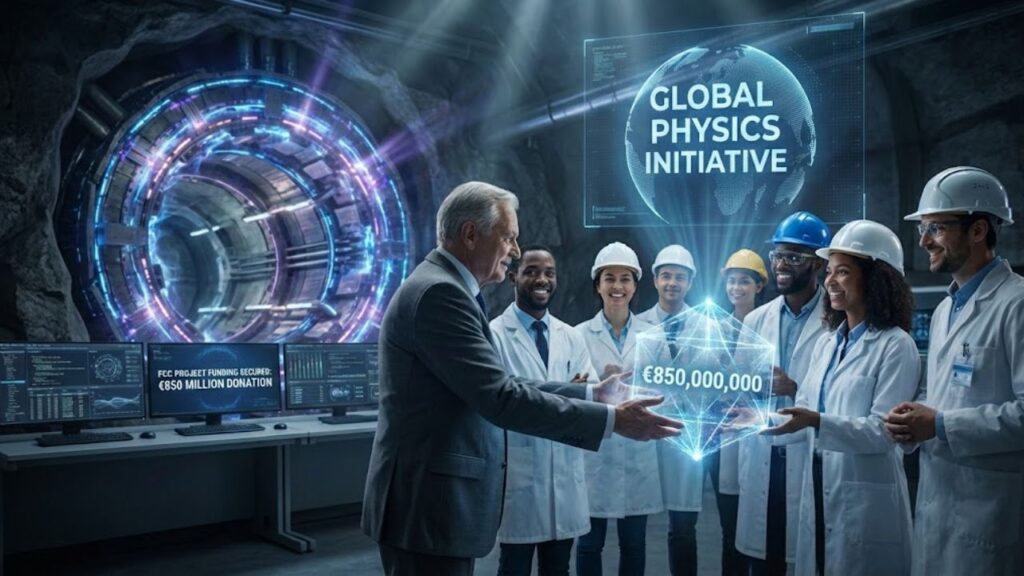
Over the winter months, several well-known figures from technology and philanthropy pledged roughly €850–860 million toward the Future Circular Collider (FCC), a project envisioned as the successor to CERN’s flagship Large Hadron Collider (LHC). Contributors include the Breakthrough Prize Foundation, Eric and Wendy Schmidt of Google fame, industrial heir John Elkann of Stellantis, and French telecom entrepreneur Xavier Niel, among others.
Unlike typical private investments, this funding is not aimed at patents, consumer products, or rapid returns. Instead, it is backing pure scientific knowledge, pursued for its own sake.

This marks a notable shift from the traditional funding model of large physics laboratories, which depend almost entirely on public contributions from member states. While public money still forms CERN’s financial backbone, this influx of private capital sends a clear signal: fundamental science can still inspire billionaires, even without guaranteed commercial rewards.

An underground ring that dwarfs Paris
The proposed Future Circular Collider would be unprecedented in scale. Plans call for a 91-kilometre circular tunnel, buried deep beneath the Swiss–French border region.
To put its size into perspective:
- Current LHC ring: 27 km
- Paris ring road (périphérique): about 35 km
- FCC: nearly three times the Paris ring and around fifteen times larger than the LHC
Inside the tunnel, powerful superconducting magnets would steer particle beams to almost the speed of light before smashing them together. Cathedral-sized detectors would then capture the resulting debris in extraordinary detail.
The primary scientific focus is the Higgs boson. Although discovered at CERN in 2012, its properties remain only partially understood. The FCC aims to transform the Higgs from a landmark discovery into a precision instrument, measured so accurately that even tiny deviations could expose new layers of physics.
Such deviations could point toward dark matter, unknown forces beyond the four currently recognised, potential links between quantum mechanics and gravity, or even entire families of undiscovered particles.
CERN’s legacy: science that reshaped everyday life
The FCC would be built at CERN, the European particle physics laboratory founded in 1954. Created by twelve countries still recovering from the Second World War, CERN was designed as a peace project, forcing collaboration on something too large for any one nation to manage alone.
Today, CERN counts 23 member states, involves scientists and engineers from more than 110 nationalities, and engages roughly 17,000 researchers. Its annual budget is about €1.35 billion, largely funded by European governments.
While CERN is best known for the Higgs boson, its influence reaches far beyond particle physics. The World Wide Web was invented there in 1989 to help scientists share data. Advances in superconducting magnets, data handling, and imaging have flowed into medical scanners, cancer therapies, security technologies, and materials science.
Rather than producing a single device, CERN’s greatest contribution has been a steady stream of ideas, tools, and skilled experts that later surface in hospitals, data centres, and industry.
Private funding enters a public research stronghold
This new wave of private support shows that research without immediate commercial output can still attract wealthy backers, particularly those whose fortunes were built in technology. CERN Director Fabiola Gianotti has described the move as recognition that pure research carries social value, even when its benefits unfold slowly over decades.
Donors have spoken about curiosity, long-term thinking, and leaving behind something more enduring than another product or platform. Eric Schmidt has highlighted the FCC’s potential to drive progress in computing, simulation, and energy management, noting that processing data from a 91 km collider will demand entirely new approaches to algorithms, hardware, and storage.
Others, such as figures linked to the Breakthrough Prize, emphasise the human question at the heart of the project: why anything exists at all, and what matter is truly made of.
A small contribution to a very large price tag
The FCC remains in the study phase. European particle physicists are updating their long-term plans, with a final decision expected around 2028. The European Commission has already identified the FCC as a possible “moonshot” project for the 2028–2034 period.
If approved, construction would likely take around ten years. Current estimates place the total cost at roughly €20 billion, meaning the pledged €850–860 million would cover only about 4–5% of the total. Governments would still need to fund the majority.

Even so, the political message is powerful. When private donors commit large sums with no direct financial return, it becomes easier for public leaders to justify major science spending to taxpayers.
What CERN has already achieved
Since the 1970s, CERN has delivered discoveries that shaped modern physics:
- 1973: Neutral currents, strengthening evidence for the Standard Model
- 1983: W and Z bosons, confirming the electroweak force and earning a Nobel Prize
- 1995: Creation of antihydrogen, opening detailed antimatter studies
- 1999: Insights into gluon density, advancing understanding of the strong force
- 2010: Trapped antihydrogen, enabling matter–antimatter symmetry tests
- 2012: Higgs boson discovery, cementing the Standard Model
- 2015: Potential dark matter hints, suggesting physics beyond current theories
- 2021: B-meson anomalies, pointing to possible cracks in established models
The FCC would represent the next step, shifting from initial discoveries to far more precise tests. If the Standard Model is incomplete, this collider could be where its limits finally become clear.
Engineering, environmental, and energy challenges
Constructing a 91 km underground tunnel presents challenges well beyond physics. CERN’s plans involve extensive geological surveys of the Geneva basin, mapping rock types, fault lines, and groundwater. Engineers would need to route the tunnel carefully to minimise disruption to communities above.
Another major issue is handling the estimated nine million cubic metres of excavated material. Current studies focus on reusing this rock and soil for construction or landscaping, rather than treating it as waste.
Energy consumption is also a critical concern. Large colliders require enormous amounts of electricity, pushing CERN to prioritise low-carbon power, waste-heat recovery, and more efficient magnet and cooling designs.
Why fundamental physics matters beyond the lab
The term fundamental physics can feel distant, yet past collider projects have repeatedly transformed practical fields. Medical imaging is a clear example, with particle detector technology feeding into PET and MRI scanners. Techniques developed for fast data analysis at CERN reshaped how hospitals process scans, while particle-beam therapies now allow more precise cancer treatments.
On the digital side, managing collider data accelerated progress in distributed computing, grid networks, and complex software systems. Many engineers trained in these environments later moved into cloud computing, finance, and cybersecurity.
If built, the FCC is expected to generate similar spillovers in areas such as energy-efficient high-performance computing, advanced superconducting materials, robotics for extreme environments, and new approaches to big-data pattern recognition.
Key concepts explained
Standard Model: The leading theory describing known particles and three fundamental forces—electromagnetic, weak, and strong. It does not include gravity or dark matter.
Higgs boson: A particle associated with the field that gives mass to other elementary particles. Without it, atoms as we know them would not exist.
Dark matter: An unseen form of matter inferred from gravitational effects in galaxies and cosmic structures. It does not interact with light and has not yet been directly detected.
If the FCC finds nothing new
In physics, even a null result has value. If years of ultra-high-energy collisions reveal no new particles or forces, many speculative theories would be ruled out or tightly constrained. Models involving certain types of dark matter or extra dimensions would be forced into narrower limits.
While that may sound anticlimactic, it would still sharpen scientific understanding. History suggests, however, that major leaps in energy or precision almost always uncover surprises. When the LHC was proposed, the Higgs sector was still uncertain. Its discovery reshaped particle physics and earned a Nobel Prize.
Supporters of the FCC believe that pushing the boundaries once again could deliver equally transformative discoveries, only on an even larger scale.