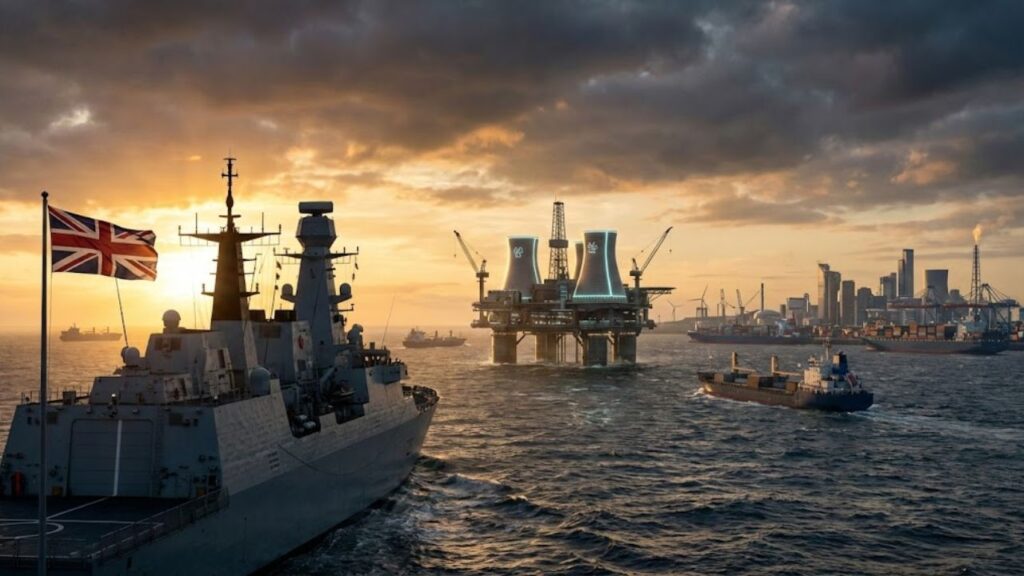
As governments tighten climate regulations and shipping companies exhaust short-term solutions, the United Kingdom is advancing a bold and highly debated proposal: nuclear-powered commercial ships and floating nuclear reactors built for global trade rather than military use. Behind the scenes, policymakers in London are positioning the country to lead what analysts estimate could become a near €3 trillion global market over the long term.
Global shipping faces mounting pressure from climate rules
Commercial shipping consumes roughly 350 million tonnes of fossil fuels annually and accounts for about 3% of worldwide CO₂ emissions, according to data from the IPCC. That output exceeds the yearly emissions of several G20 nations, placing the sector firmly in regulators’ sights.
To curb fuel consumption, many operators have adopted “slow steaming”, reducing sailing speeds to cut energy use. While effective on paper, the approach stretches supply chains, delays deliveries, and prevents vessels from operating at their intended design speed. Emissions are reduced, but not eliminated.

In July 2023, the International Maritime Organization adopted a roadmap targeting net-zero emissions around 2050. For an industry built on low-cost bunker fuel and narrow profit margins, that deadline is approaching quickly. Slow steaming offers breathing room, not a long-term solution, forcing shipping to look beyond hydrocarbons.

Nuclear propulsion returns to the commercial debate
Against this backdrop, nuclear propulsion is re-emerging—not as a Cold War-era concept, but as a potential foundation for long-distance, high-power shipping in a carbon-constrained world.
More than 700 nuclear reactors already operate at sea, primarily within military fleets and a small number of Russian civilian vessels. The technology itself is proven. The challenges today are regulatory, commercial, and political: licensing, insurance, financing, and acceptance by coastal states and the public.
London-based classification society Lloyd’s Register has chosen to confront these issues directly. It has launched a UK-led maritime nuclear consortium focused on adapting nuclear power for commercial shipping and developing standards that other countries could eventually follow.
- Social Security 2026 new monthly payment figures: Social Security payment boost for 2026 confirmed: New monthly amounts for retirees, spouses, survivors, and disabled beneficiaries explained
- HVAC pros explain why closing vents in unused rooms actually increases heating bills
- Officials issue warning after spotting first-of-its-kind sight in place it doesn’t belong urging immediate action
- I learned it at 61: few people know the difference between white eggs and brown eggs
- Amazon: A 7.5-metre giant anaconda never seen before is found during a Will Smith documentary shoot
- French foreign trade booms in this Chinese region with +32.7% exports in a year to €432 million
- Bad news for gardeners: a 135 fine may apply if you use collected rainwater without proper authorization starting February 31
- Psychology explains why emotional awareness can initially increase inner tension instead of relief
The consortium’s stated goal is clear: establish a workable framework for nuclear-powered merchant ships that are safe, insurable, and economically viable.
Advanced modular reactors designed for maritime use
The technical focus of the initiative is a new generation of advanced modular reactors (AMRs). These compact units are designed for factory production, standardisation, and replication, rather than bespoke, one-off construction.
Installed deep within a vessel’s hull, an AMR could operate for years without refuelling. Propulsion would generate no direct CO₂ emissions, with safety systems integrated into the reactor design from the outset rather than added later.
This approach addresses a long-standing trade-off in shipping: speed versus climate performance. Nuclear propulsion would allow ships to maintain design speed and cargo capacity while dramatically reducing fossil fuel dependence.
A broad coalition spanning engineering, law, and insurance
The UK-led effort brings together a notably diverse group of participants, reflecting the complexity of approving nuclear-powered commercial vessels.
- Rolls-Royce contributes expertise in naval reactors and nuclear life-cycle engineering.
- Babcock International provides naval architecture, integration, and support services.
- Global Nuclear Security Partners focuses on safeguards and security.
- Stephenson Harwood addresses maritime and nuclear regulatory issues.
- NorthStandard evaluates insurance, liability, and risk management.
For a nuclear cargo ship to operate, it must be classed by a recognised authority, approved by regulators, and backed by insurers. Financial institutions and charterers will also require clarity on liability in the event of an incident.
Ultimately, shipowners need answers to three fundamental questions: who certifies the reactor, who insures it, and who carries liability if something goes wrong.
A structured five-step technical roadmap
The consortium’s initial programme follows a defined, five-point plan:
- Demonstrate that a generic modular reactor design can be licensed across multiple jurisdictions.
- Develop a certification system combining nuclear safety and maritime regulations.
- Define a security and guarantees structure aligned with international standards.
- Establish viable insurance pathways for nuclear-powered commercial vessels.
- Create operational guidelines covering design, operation, and decommissioning.
The focus is not on launching a prototype immediately, but on clearing regulatory bottlenecks to enable serial production during the 2030s.
The UK’s strategic bet on maritime heritage
The initiative reflects a broader strategic calculation. The UK sees an unusual alignment of three long-standing strengths: maritime tradition, nuclear engineering, and financial services.
Historically, Britain projected influence through seafaring institutions such as the Royal Navy and trading companies. In the twentieth century, it became an early adopter of naval nuclear propulsion and remains a major player in submarine reactor design.
Combined with London’s continued role as a global centre for shipping finance, marine insurance, and maritime law, nuclear shipping could activate a wide ecosystem of shipyards, regulators, designers, financiers, and insurers centred in the UK.
From a policy perspective, shaping the rules for nuclear shipping would allow Britain to influence how future fleets are built and operated, potentially locking in demand for British technology and expertise for decades.

A market estimated at nearly €3 trillion
A joint report by Core Power, NorthStandard, and Lloyd’s Register, titled “Advanced Maritime Nuclear: A unique opportunity for the UK”, estimates the long-term market potential at around £2.5 trillion, close to €3 trillion at current exchange rates.
The estimate spans two main areas:
- Nuclear-powered shipping: cargo vessels, tankers, and potentially cruise ships, representing hundreds of billions of pounds.
- Floating nuclear power plants: offshore and barge-based reactors supplying coastal grids and industry, exceeding £1 trillion over several decades.
While the timeline extends across decades, the authors argue that early movers can shape international standards to their advantage.
International competitors are already active
The UK is not acting in isolation. Across Europe and Asia, multiple partnerships signal rising interest in maritime nuclear technology.
One example is the collaboration between Franco-Italian start-up newcleo and Italian shipbuilder Fincantieri. Their concept centres on a lead-cooled fast reactor known as TL-40, designed specifically for modern cargo ships.
This fourth-generation reactor uses liquid lead coolant and targets high fuel efficiency in a compact format, aligning closely with AMR principles. In the partnership, newcleo leads reactor development, while Fincantieri ensures safe integration into ship design and operations.
Similar studies are underway in China, South Korea, and Japan, covering both ship propulsion and offshore nuclear power.
Floating nuclear power plants gain traction
Alongside propulsion, floating nuclear power plants are attracting growing attention. These vessels or barges house compact reactors that remain largely stationary, supplying electricity to coastal grids or industrial facilities.
The most advanced example is Russia’s Akademik Lomonosov, which has provided around 70 MW of power to Arctic communities and industry since 2019.
Western projects are following suit. Core Power and Westinghouse are developing barge designs using microreactors or molten salt technologies for ports, desalination, and hydrogen production. In Norway, projects in the 200–250 MW range are under review, while Indonesia is examining designs from Seaborg and Copenhagen Atomics ranging from 100 MW to 500 MW.
The appeal lies in flexibility: barges can be built in shipyards, towed to demand centres, and relocated or refurbished as needs evolve.
Key concepts, benefits, and fault lines
An advanced modular reactor is defined by small size, factory construction, and advanced cooling technologies such as molten salt, gas, or liquid metal. Output typically ranges from tens to a few hundred megawatts.
For shipping, modularity allows a single certified design to be installed across multiple vessels, with refuelling and maintenance handled at specialised ports.
However, challenges remain. Reactor designs must account for collisions, fires, and groundings. Spent fuel management, international waste rules, security risks, and potential port restrictions all shape operational viability.
On the other hand, the benefits are significant. A nuclear-powered container ship could operate for years without refuelling and reduce direct propulsion emissions to near zero. For companies under pressure to decarbonise supply chains, that proposition is difficult to ignore.
If the UK consortium can demonstrate a credible, certifiable model by the mid-2030s, pilot vessels may emerge on agreed routes between ports with aligned safety and liability rules. These early corridors would act as proving grounds before wider adoption.
This explains the urgency in London: those who define the technical and legal foundations of nuclear shipping are likely to shape access to a future €3 trillion market.