Scientists aboard a British research vessel unexpectedly encountered a violent underwater surge caused by collapsing glacier fronts. The discovery revealed a powerful and largely unseen force that drives ocean mixing, potentially accelerating Antarctic ice loss and influencing climate systems across the globe.
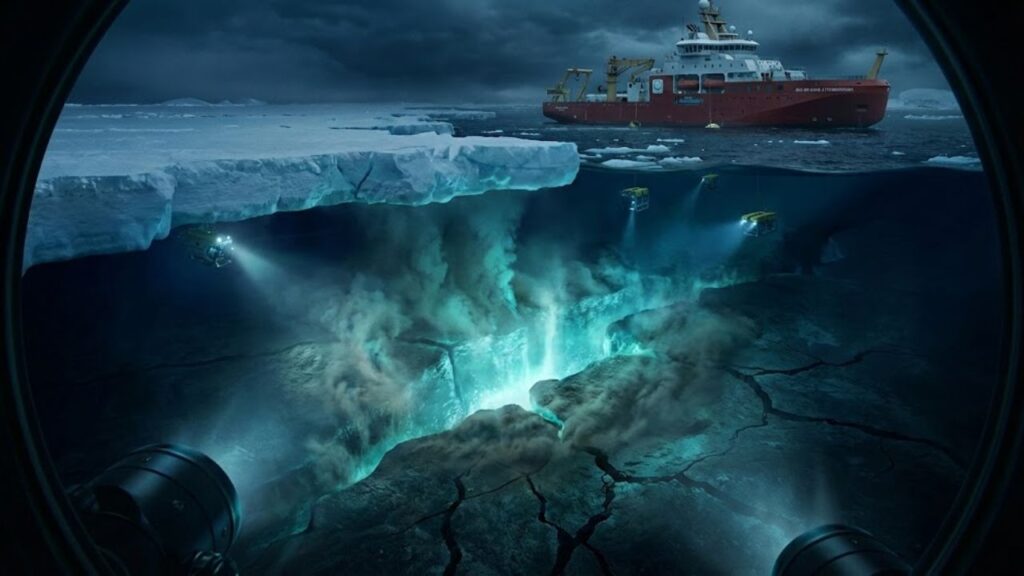
Invisible tsunamis created by breaking ice
When a glacier releases an iceberg, the spectacle appears brief. Ice crashes into the sea, water splashes upward, cameras click, and the surface soon settles. Beneath that calm exterior, however, the ocean remains in turmoil.
Researchers have now shown that these calving events can unleash intense underwater waves with energy comparable to small tsunamis. These waves travel for kilometres through the Southern Ocean, remaining hidden from view while rising several metres high below the surface.

Rather than racing toward shorelines, these waves move within the ocean itself. They pull warm, salty water upward from the depths while forcing colder, oxygen-rich surface water downward. Nutrients locked deep below surge toward sunlight, and heat reaches the undersides of nearby ice shelves. This previously underestimated process may strongly influence how fast Antarctic ice melts and how the global ocean stores heat and carbon.
 Many people don’t realise it, but cauliflower, broccoli and cabbage are varieties of the same plant
An accidental breakthrough at sea
The discovery emerged almost by chance. A scientific team aboard the British research ship RRS James Clark Ross was tracking ocean conditions near a calving glacier when nature provided a rare opportunity.
Their instruments captured measurements from before, during, and after a major calving event. As massive ice blocks broke free, sensors recorded abrupt changes that standard explanations could not account for.
Shifts in wind failed to match the timing. Tidal forces were too weak. Surface heat loss could not explain the intense turbulence and temperature changes observed at depth. The evidence instead pointed to powerful waves generated by falling ice, spreading outward like ripples from a stone dropped into water, but in three dimensions and on a far larger scale.
Although the vessel has since entered Ukrainian service under the name Noosfera, the data it collected in Antarctic waters continues to reshape scientific understanding of polar ocean dynamics.
A mixing force rivaling polar winds
For decades, climate and ocean models assumed that Antarctic mixing was driven mainly by wind, tides, and surface heat loss. New findings suggest a fourth force deserves serious attention.
Early estimates indicate that calving-generated underwater waves can rival the mixing power of strong polar winds and, at times, exceed the effects of tides.
This mixing is far from harmless. It can carry relatively warm deep water directly against the bases of floating ice shelves, thinning them and weakening their ability to hold back glaciers on land. As glaciers accelerate, they calve more frequently, and each new impact produces additional waves. The result is a self-reinforcing cycle where ice loss creates conditions that encourage even more melting.
Antarctic bases and a new research vessel take focus
To better understand this process, scientists are turning Antarctica into a natural laboratory. A central hub is Rothera Research Station, a British base on the Antarctic Peninsula.
From there, research teams deploy the UK’s newer polar ship, the RRS Sir David Attenborough, to observe active glacier fronts where ice fractures daily and drops directly into the Southern Ocean.
Each calving event becomes a live experiment. Instruments are timed to capture the exact moment ice hits the water, track the resulting waves, and measure how the surrounding ocean structure shifts in response.
Capturing unseen waves with advanced technology
Because underwater tsunamis leave almost no surface trace, scientists rely on a suite of advanced tools to detect them:
- Satellite imagery and remote cameras to monitor glacier cracks and break-offs
- Drones flying low over ice edges to film calving events and map glacier geometry
- Autonomous underwater vehicles sampling water along wave pathways
- Seabed instruments recording pressure, currents, and turbulence
- Machine-learning systems scanning satellite data for overlooked calving events
- Numerical models simulating how falling ice transfers energy into ocean mixing
Researchers stress that the goal is not merely to describe an unusual phenomenon, but to ensure these processes are fully represented in climate models. Doing so could significantly improve projections of sea-level rise and global ocean circulation.

Sheldon Glacier as a real-world test site
One of the most valuable study locations is Sheldon Glacier, a coastal glacier that serves as a natural physics laboratory. Here, autonomous submersibles repeatedly patrol the waters in front of the glacier face.
They measure temperature, salinity, current speed, and nutrient levels in fine detail. When a large slab of ice collapses, the vehicles follow the resulting wave as it spreads outward and downward.
The data reveal how quickly the water column overturns, how far heat rises, and how long turbulence persists. Biologists then examine how plankton respond when nutrients stored at depth suddenly reach sunlit waters. Because plankton form the base of the marine food web, these mixing events can influence ecosystems far beyond the glacier front.
A global collaboration with worldwide implications
This research forms part of POLOMINTS, an international project led by the British Antarctic Survey with partners from the United Kingdom, the United States, and Poland. Institutions such as the Scripps Institution of Oceanography and the University of Southampton contribute expertise in field observations and advanced modelling.
Support from the UK’s Natural Environment Research Council reflects the broader importance of the work. Understanding Antarctic ocean mixing helps refine projections of sea-level rise, storm tracks, and the ocean’s capacity to absorb atmospheric carbon dioxide.
Why Antarctic waves matter globally
The Southern Ocean plays a critical role in regulating Earth’s climate. It absorbs a large share of excess heat and a significant portion of human-generated carbon dioxide.
Changes in how this ocean mixes can have far-reaching effects. Stronger mixing near Antarctica can deliver more heat to ice shelves while also altering how deeply heat and carbon sink. These shifts influence upper-ocean warming and can affect weather patterns in regions as distant as the North Atlantic and the Indian Ocean.
- Calving-driven waves: more heat at glacier bases, leading to faster ice melt and higher long-term sea levels
- Enhanced nutrient mixing: short-term increases in plankton growth, affecting carbon uptake and food webs
- Altered deep-water formation: changes in water density that can reshape global ocean circulation
Key concepts behind the science
Two ideas lie at the center of this research: calving and internal waves. Calving refers to the moment when ice breaks away from a glacier or ice shelf and falls into the sea. Internal waves move within the ocean, not on its surface, traveling along boundaries between water layers of different temperature or density.
When a large ice block strikes the ocean, it can generate powerful internal waves that shift these layers up and down. Energy from the falling ice transfers into the surrounding water, driving the mixing that reshapes ocean structure.
While the process may sound abstract, its effects are tangible, influencing future sea levels, storm patterns, and the frequency of coastal flooding later this century.
What scientists are still trying to learn
Looking ahead, researchers are testing scenarios where calving becomes more frequent as air and ocean temperatures rise. In these models, underwater tsunamis appear not as rare events but as persistent drivers of ocean mixing in key Antarctic regions.
Important questions remain unanswered. How large must ice blocks be to produce the strongest waves? Does seafloor shape amplify or weaken the effect? And how do storms, sea ice changes, and long-term warming interact with this process over time?
Teams working at Rothera, Sheldon Glacier, and other Antarctic sites aim to fill these gaps with longer and more detailed records. Their findings feed directly into global climate models, helping policymakers and coastal planners better understand risks that may emerge from waves generated in one of the planet’s most remote environments.