
At 7 a.m., just as the coffee machine started brewing, Mia received a text message: “Deposit: $2,000 – U.S. Treasury.” For a moment, she thought it might be a scam. But after checking her bank app, she saw it: $2,000 deposited directly into her checking account. Suddenly, paying rent wasn’t a worry, and groceries seemed more manageable. She stared at the number, stunned by the relief it brought.
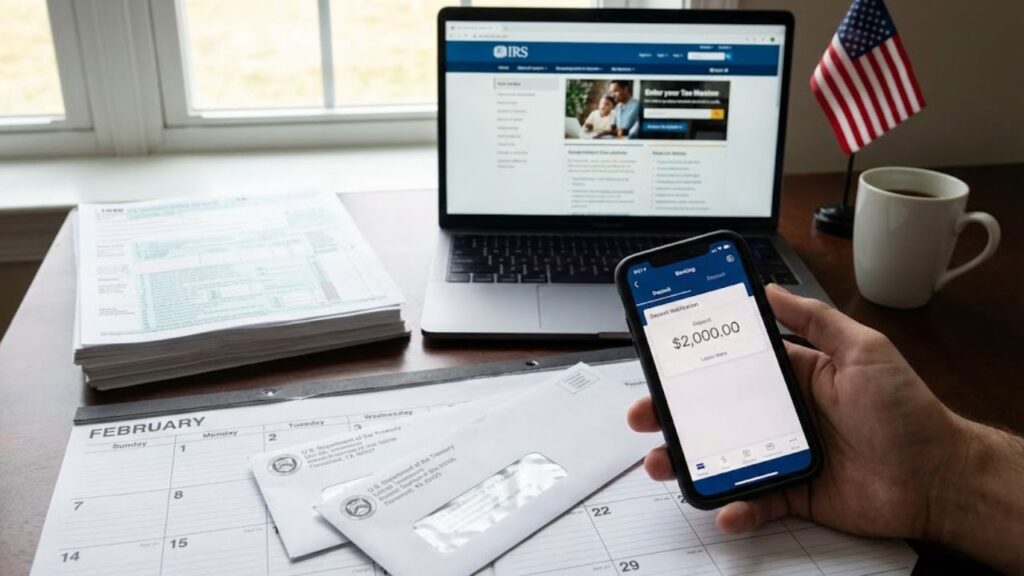
Across the U.S., many people are refreshing their bank apps, wondering if a promised $2,000 deposit in February is real, who qualifies for it, and how the IRS is involved.
The money arrives quickly, but the rules behind it? Not so much.

Is the $2,000 February Payment Really for Everyone?
Scroll through social media right now, and you’ll likely come across posts about a “$2,000 February payment for all U.S. citizens.” It sounds almost too good to be true: the IRS sending a flat $2,000 to everyone right when holiday debt and heating bills start stacking up. People are clicking, sharing, and debating in the comments.

But there’s a more complex reality beneath the surface. While some Americans will receive checks or direct deposits of around $2,000 in February, these payments are linked to specific factors, such as their 2024 tax return, state relief programs, or Social Security adjustments. The promise of “$2,000 for everyone” isn’t how federal payments truly work.
Take Jason, a 34-year-old warehouse worker from Ohio. He saw a TikTok video about a “$2,000 IRS payment” and started planning to pay down his maxed-out credit card. When his paycheck arrived without the extra money, he spent an hour on hold with his bank and the IRS. Only later did he realize that the $2,000 being talked about was actually an estimate of what low-to-moderate-income filers could receive from tax credits and refunds—not a new program, not a surprise stimulus. Just the regular tax system working its way through the fine print.
The Reality Behind February Payments
What’s happening in February is a convergence of several things. Tax season is here, and early filers with direct deposit are starting to receive refunds, which include refundable credits that can easily exceed $2,000, especially for families with children or lower wages. Additionally, some states are still distributing targeted rebates or inflation-relief checks, and seniors and disabled Americans are receiving slightly higher Social Security payments due to the 2025 cost-of-living adjustment (COLA).
So when someone says “$2,000 is coming in February,” they’re often combining all these factors. The federal government isn’t rolling out a universal $2,000, but many people are indeed receiving that amount—or close to it—from existing programs, provided they meet specific eligibility criteria.
How the $2,000 Payment Actually Appears: Eligibility, Dates, and IRS Steps
If you’re wondering whether a $2,000 direct deposit is realistic for you this February, think of it as a combination of different sources. Start by looking at your 2024 federal tax return. Did you work in 2024 and have federal taxes withheld? Are you eligible for the Earned Income Tax Credit (EITC) or Child Tax Credit? These two credits alone can push your refund into the $2,000 range, especially for workers and parents.
To get that refund, file electronically, choose direct deposit, and file early. The IRS started accepting 2024 returns in late January. For simple, accurate returns filed online, refunds can land in your account in just 7–21 days. For many, this puts their refund squarely in February, especially for those who already have their W-2s or 1099s in hand.
Then, there are state benefits and one-off relief programs. Some states are issuing rebates tied to 2023–2024 surpluses or inflation adjustments. These payments are often added on top of state tax returns, so a few hundred dollars from your state rebate, combined with a federal refund and credits, could easily total $2,000.
Finally, fixed federal payments such as Social Security and SSI benefits are deposited on specific Wednesdays of each month, based on your birth date. A retiree, for example, who’s receiving a slightly higher benefit after the COLA adjustment, plus a tax refund via direct deposit, might wake up to find an extra $2,000 in their account. To them, it might feel like the viral $2,000 promise finally arrived—even if it came in pieces.

Understanding IRS Rules for February Payments
The IRS is actually pretty clear about the rules once you look past the noise. You need a valid Social Security number for employment, an accurate 2024 tax return, and income that qualifies you for refundable credits. The IRS won’t text or email unexpected $2,000 offers. Instead, it calculates your refund based on the information you file.
Let’s be honest: many people don’t read every IRS line before clicking “submit,” which is why so many misunderstand what they’re eligible for. But the IRS makes it clear: EITC amounts depend on your income and number of children, the Child Tax Credit can add hundreds or even thousands, and any over-withholding from the year gets refunded. The big February deposits aren’t magic—they’re math.
How to Maximize Your February Deposit
If you want that February deposit to be as close to $2,000 as possible, start with a clean, accurate 2024 tax return. Use reputable tax software or a trusted preparer, especially if you qualify for credits. Double-check your direct deposit routing and account numbers—this is your payment pipeline. A single wrong digit could send your money into delay mode.
Then, check the IRS refund timing. The agency publishes typical processing windows, and there are known delays for returns that claim the Earned Income Tax Credit or Additional Child Tax Credit, as extra checks are applied to combat fraud. This doesn’t mean you’re ineligible—it just shifts your deposit date to late February or early March.
Many people get emotional about this. They mentally budget for a flat $2,000 based on viral rumors, only to feel disappointed when their refund is much smaller. We’ve all experienced that feeling of “spending” money before it’s real. To avoid this, use the IRS refund estimator tools or your tax software’s preview to estimate your actual refund. Then, plan your February bills around that, not around a rumor with no footnotes.
Carla, a single mom from Arizona, said, “Once I stopped chasing that ‘$2,000 payment’ and focused on filing early and accurately, I ended up with $2,187 in my account by February 20. It didn’t feel like a miracle—it felt like I finally understood the game.”
Important Steps to Align with IRS Rules
- File electronically with direct deposit: This is the fastest route to an IRS refund-based February payment.
- Confirm credit eligibility: Make sure your income and family situation qualify for the Earned Income Tax Credit or Child Tax Credit.
- Track actual dates, not rumors: Use the IRS “Where’s My Refund?” tool to check your deposit date.
- Look for state money: Check if your state is issuing rebates or tax credits that could contribute to your February total.
- Avoid scams: The IRS won’t ask for your bank details by phone or social media to release a $2,000 payment. Hang up, delete, and report any such request.
The Bigger Picture Behind the $2,000 Promise
Beneath all the viral posts and eager comments, a quieter story is unfolding. For many Americans, a $2,000 direct deposit in February feels like a lifeline. It’s not just about tax policy—it’s about rent that eats half a paycheck, daycare costs bigger than car payments, and groceries that no longer fit the weekly budget.
The spread of this rumor speaks to something deeper: trust. Many people trust TikTok creators more than IRS press releases because the creators seem relatable, living in the same struggle. When they talk about $2,000, they’re really talking about the same thing: breathing room.
So maybe the key shift is this: stop waiting for a mysterious $2,000 windfall and start understanding how your own numbers can get you there. For some, that means tax credits plus state rebates. For others, it’s a thoughtful filing strategy and adjusting withholding so next year’s refund doesn’t disappear. For many, February may not bring $2,000, but that doesn’t mean you’ve done anything wrong. It simply means your financial story follows different rules than the algorithm’s. The real power comes from understanding those rules well enough that no viral post can knock you off course.

Key Takeaways
- Refund-based $2,000: Comes from a mix of tax refunds and credits like EITC and Child Tax Credit.
- Timing of Payments: Electronic filing with direct deposit usually takes 7–21 days, longer with certain credits.
- IRS vs. Rumors: The IRS never promises a universal $2,000; eligibility is rule-based.
