The atmosphere at NASA’s Jet Propulsion Laboratory was oddly still, considering the magnitude of the discovery. A dozen researchers sat before their glowing screens, stale coffee cups scattered around, eyes glued to a jagged line on the monitor—an anomaly that should not have moved in that way. On one screen, a faint spike appeared in the data, barely distinguishable from digital noise. Another screen showed a timer: just ten seconds. That was it. Ten seconds of signal, hidden deep within the cosmic background, like a whisper in a storm.
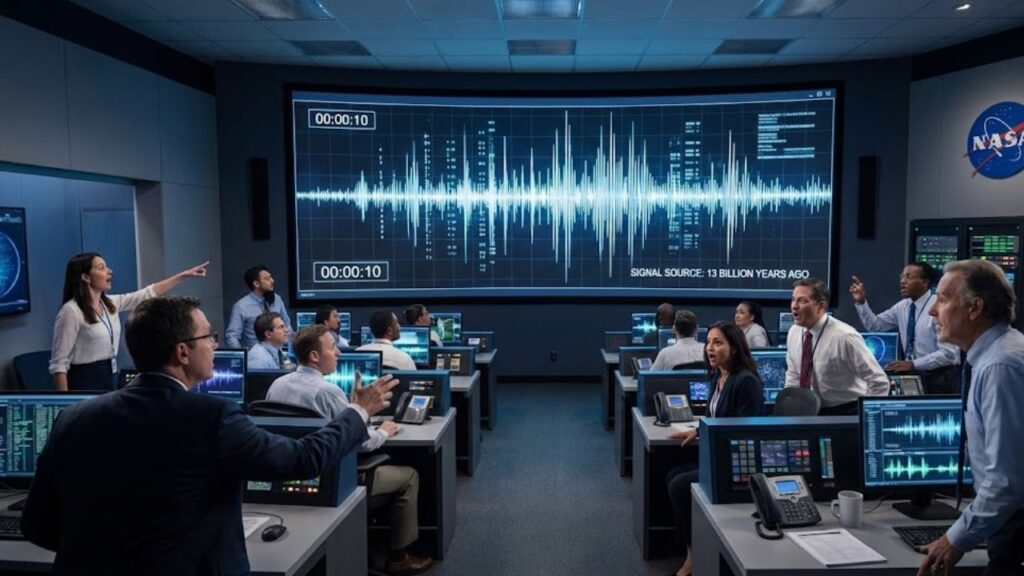
Then, someone quietly voiced what was on everyone’s mind: “If this is real, it started its journey before our galaxy even formed.” For a moment, no one breathed.
The Signal That Flew Under the Radar
The signal didn’t arrive in dramatic fashion or with a thunderous “ping.” Instead, it entered NASA’s data stream quietly, appearing as a thin spike embedded in a routine sky survey from a deep-space radio array. At first glance, it seemed like just another glitch—something that would be dismissed after a long night’s work. However, something didn’t add up: the timing, frequency, and direction of the signal didn’t match any typical causes like satellites, solar flares, or terrestrial interference.

It was akin to a ghostly footprint in fresh snow, and it refused to vanish.

Early Findings: A Message from the Past?
The signal lasted just over ten seconds, pulsing irregularly, reminiscent of a distorted Morse code stretched by the expansion of the universe. Early analysis suggested the origin was approximately 13 billion light-years away, a time when the first galaxies were barely beginning to form. This “hello,” if we can call it that, reached us from a universe still in its chaotic infancy, filled with newborn stars and violent black holes.
One scientist humorously remarked that if the source had planets, they probably didn’t even have stable crusts yet.
Cosmic Events or Something More?
Initially, the leading theory was a rare type of cosmic explosion: a fast radio burst or a collapsing star in a dense, early galaxy. These events are brief, flashing for milliseconds or seconds before disappearing forever. But this event didn’t fit the usual patterns. The spectrum was narrower than expected, the pattern more structured, and the drift caused by cosmic expansion was almost too perfect. Some researchers at NASA began to whisper a term in private: **non-random anomaly**. While this didn’t suggest aliens, it was certainly something worth losing sleep over.
The Challenge of Listening to a 13-Billion-Year-Old Message
Before the story hit the press, NASA’s first priority was to eliminate all possible earthly explanations. Engineers meticulously combed through ground station logs for any sign of interference. They cross-referenced with observatories not linked to NASA, hoping to find another trace of the signal. Some researchers pointed their antennas back to the same section of the sky night after night, almost as if retracing their steps at a crime scene.
The rule was simple: you don’t call it a deep-space signal until you’ve ruled out every possible alternative.
Delving Deeper into the Mystery
Meanwhile, a small team treated the ten-second transmission like a crime scene photograph. They stretched, filtered, and dissected the data, looking for any patterns. Was there a rhythm to the energy fluctuations? Could there be structure within the noise? One postdoc reportedly stayed up for 36 hours, running pattern-matching algorithms on the pulses. Most tests returned negative results—until one routine test, designed to spot artificial satellite echoes, revealed a faint but repeating sub-pattern. It wasn’t a language, but it resembled something close—a heartbeat.
We’ve all been there—when your mind wants to believe in the impossible simply because it feels more exciting.

Reality Check: A 13-Billion-Year-Old Message?
To keep the team grounded, senior scientists reminded everyone that a 13-billion-year travel time didn’t imply a civilization was involved. It only meant the light or radio waves had stretched during their long journey. The early universe was different—denser, darker, and filled with hot hydrogen fog. Any powerful event from that era would be distorted by the cosmic medium. So, the “signal” we see today might be a warped version of something far more ordinary. *Space has a way of transforming simple events into mysterious art when viewed from such great distances.*
Yet, one factor was harder to ignore. The probability of such a narrow, persistent frequency emerging randomly from the chaotic early universe seemed low. Not zero, but low enough that researchers began archiving screenshots of the data on their phones.
The Tension Between Science and Public Desire
Inside NASA, there’s an unspoken survival skill: learning to live with groundbreaking data you can’t yet talk about. The ten-second signal is a prime example. Before any public announcement, the team drafts multiple “what if” scenarios. What if it’s just a rare cosmic event? What if the origin was miscalculated and it’s closer than anticipated? What if another telescope confirms it from a different angle? Their method is painfully slow: repeat the observations, week after week, month after month, and wait for even a hint of a second signal.
For the public, the temptation is different. We hear “13 billion years” and our minds leap to sci-fi—distant intelligence, cosmic beacons, or some sort of universe-scale GPS pinging our planet. Let’s be honest: not many people read the technical papers before they retweet the sensational headline. This gap between scientific understanding and the internet’s imagination is often vast. It’s also why NASA’s communications team works like crisis managers, preparing clear, factual explanations before rumors spiral out of control.
The Fine Line Between Hope and Hype
Researchers working on the signal have already begun cautioning against over-romanticizing it. One senior astrophysicist put it simply in an internal meeting:
- “Every time we see something strange in the sky, there are two stories: the rigorous, scientific one, and the one people wish were true. Our job is to protect the first, while understanding the emotional pull of the second.”
A Scientific Miracle: The Long Journey of a 10-Second Signal
Step back from the lab monitors for a moment and consider the timeline. Thirteen billion years ago, Earth didn’t exist as we know it. There were no oceans, no trees, no phones buzzing with news about NASA’s latest detection. The Milky Way was still under construction. Yet, something out there generated enough energy to leave behind a trace that our delicate species can now detect using sophisticated instruments. That alone feels like a quiet miracle.
This is not a Hollywood miracle. It’s a scientific one—born of equations, patience, and a healthy dose of skepticism.
What’s Next for the 10-Second Signal?
What happens next will unfold slowly. More telescopes will turn their lenses toward this distant corner of the cosmos. Papers will be written, debated, and revised. The most likely outcome is a new subtype of cosmic phenomenon added to textbooks, a deeper piece of the puzzle about the early universe. Yet, that doesn’t diminish the feeling that we’re eavesdropping on something ancient. A universe that old, still sending us surprises, has not run out of stories.
Everyone reading this story will project their own hopes into it. Some will see the possibility of distant minds, others a greater understanding of physics, and still others simply a cool space mystery to share. For NASA’s teams, it’s another reminder that the sky is more than a backdrop. It’s an archive. Every flicker, every spike, every ten-second anomaly is a page written billions of years ago, now delivered to our inbox. Whether it turns out to be a cosmic accident or a radically new discovery, it has already done one powerful thing: it made us look up and listen more carefully to the dark.