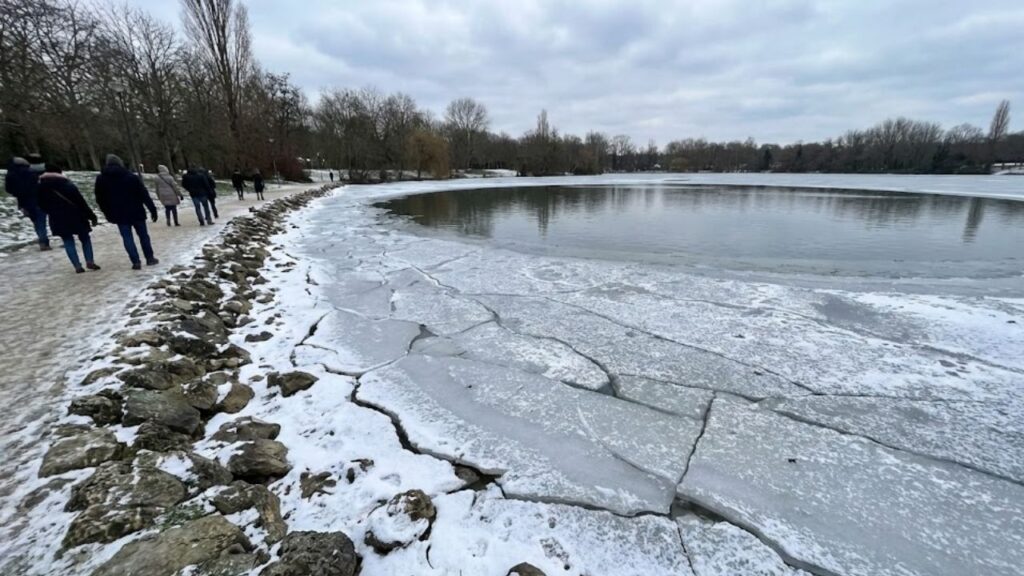
On a cold winter afternoon in France, many visitors to Lake Créteil notice a curious sight: solid ice clinging to the shoreline while the center remains visibly liquid. This contrast often sparks questions, especially during sharp cold snaps when temperatures stay low all day. The explanation lies in simple but fascinating lake physics involving depth, heat movement, and wind exposure. Understanding why the lake freezes unevenly helps explain not only what happened at Créteil, but also why similar patterns appear on ponds, reservoirs, and lakes across the country during winter.
Why the Créteil lake shoreline froze first
The edges of Lake Créteil froze while the middle stayed open largely because of depth differences. Near the shore, water is much shallower, meaning it cools down faster once air temperatures drop. Shallow areas lose warmth quickly through shallow edge water, especially during long winter nights with clear skies. This rapid cooling encourages ice to form early along the banks. In addition, these areas experience stronger nighttime heat loss since there is less water volume to retain warmth. Because there is also limited water mixing near the shore, cold water stays in place instead of blending with warmer layers, allowing ice to persist even when daytime temperatures rise slightly.
Why the middle of Créteil lake stayed unfrozen
The center of Lake Créteil behaves very differently due to its greater depth. Deeper water holds more heat and releases it slowly, preventing surface freezing during short cold spells. Wind also plays a key role by creating wind-driven circulation, which constantly moves surface water and disrupts ice formation. This movement supports thermal stratification, where slightly warmer water from below mixes upward. As a result, the lake’s center benefits from stored heat energy accumulated over previous milder days. Even when air temperatures remain below freezing, this combination of depth and motion keeps the middle visibly ice-free while the shoreline remains frozen.

Local conditions affecting frozen edges at Créteil lake
Environmental factors around the lake also contribute to this uneven freezing pattern. Urban areas surrounding Lake Créteil can create a subtle urban heat influence, slightly warming the air above the central water. Meanwhile, the shoreline is often sheltered by trees and embankments, increasing shoreline vegetation cover that blocks wind and promotes colder, still air. This calm environment favors earlier ice formation timing along the edges. Additionally, human activity near the banks can compact snow and ice, making frozen sections appear thicker and more persistent compared to the constantly shifting surface at the lake’s center.
Understanding the frozen-shore, open-center effect
The contrast seen at Lake Créteil is a classic example of how lakes respond to winter weather. A clear temperature gradient effect develops between shallow and deep zones, shaping where ice can survive. When cold conditions persist without strong storms, weather pattern stability allows shoreline ice to remain intact for days. Over time, these differences repeat as part of natural seasonal freeze cycles, making this phenomenon both predictable and temporary. Once sustained cold reaches deeper layers, the center may eventually freeze too, restoring a uniform winter surface.
| Lake Area | Average Depth | Heat Retention | Freezing Speed |
|---|---|---|---|
| Shoreline | Very shallow | Low | Fast |
| Near-shore zone | Shallow | Moderate | Moderate |
| Mid-lake | Deep | High | Slow |
| Central basin | Deepest | Very high | Very slow |
Frequently Asked Questions (FAQs)
1. Is it normal for a lake to freeze unevenly?
Yes, depth and water movement often cause shorelines to freeze before the center.

2. Does wind prevent ice from forming?
Strong wind keeps water moving, which makes ice formation harder.
3. Can the middle of the lake freeze later?
Yes, prolonged cold can eventually freeze deeper central areas.
4. Is shoreline ice safe to walk on?
No, ice thickness varies and can be dangerous without proper checks.