A remarkable new release of spacecraft imagery has given scientists and space enthusiasts a rare look at the interstellar comet 3I ATLAS, captured with stunning precision. These images, drawn from advanced space observatories, highlight how far astronomical imaging has come and why such discoveries matter. For readers in India, where interest in space science continues to grow alongside missions like Chandrayaan, this event underscores humanity’s expanding ability to study visitors from beyond our solar system and better understand the broader cosmic neighborhood we live in.
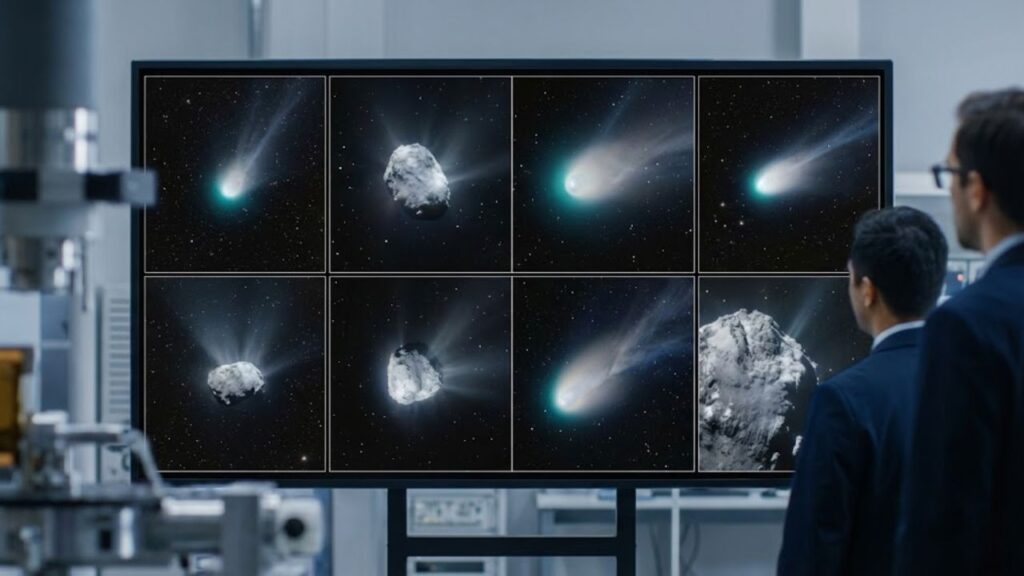
Interstellar comet 3I ATLAS captured in unprecedented detail
The latest images of 3I ATLAS stand out because of their remarkable sharpness and scientific value. Each frame reveals fine dust structures around the comet, offering clues about its composition and behavior. Researchers are closely examining trajectory anomalies to understand how the object moves through space after entering our solar system. The images also highlight surface brightness changes, which can signal how the comet reacts to solar radiation. Together, these observations help astronomers reconstruct the comet’s long journey between stars and compare it with objects formed closer to home.
Why spacecraft images of interstellar comets matter
High-quality spacecraft images play a crucial role in modern astronomy, especially when studying rare interstellar visitors. With 3I ATLAS, scientists can analyze chemical composition hints that are difficult to detect from Earth alone. The clarity allows teams to track coma evolution patterns as the comet approaches the Sun. There is also growing interest in dust-to-gas ratios, which can reveal how different stellar environments shape small bodies. These insights help refine existing models and deepen our understanding of planetary formation across the galaxy.

What 3I ATLAS teaches us about the wider universe
Beyond its visual appeal, 3I ATLAS serves as a natural messenger from another star system. By studying it, astronomers gain comparative formation clues that highlight similarities and differences with local comets. The data also supports stellar neighborhood mapping, helping scientists estimate how often such objects pass through our region of space. Observations of thermal response behavior further explain how materials endure extreme cosmic travel. Each finding adds a small but meaningful piece to the puzzle of how planetary systems evolve beyond our own.

Scientific significance and future observations
The discovery and imaging of 3I ATLAS represent more than a fleeting headline; they mark a growing capability to monitor rare cosmic events. Astronomers emphasize long-term data value, as continued tracking can reveal changes over time. There is also excitement around instrument collaboration potential, with multiple missions contributing complementary data. Such efforts improve predictive observation methods for future interstellar objects. As technology advances, encounters like this will become even more informative, offering deeper insights into the dynamic universe beyond our solar system.
| Feature | Observed Detail | Scientific Use |
|---|---|---|
| Comet Tail | Fine dust streams | Studying particle behavior |
| Coma | Brightness variations | Measuring activity levels |
| Trajectory | Hyperbolic path | Confirming interstellar origin |
| Surface Response | Thermal changes | Understanding material makeup |
Frequently Asked Questions (FAQs)
1. What makes 3I ATLAS an interstellar comet?
Its hyperbolic orbit shows it originated outside our solar system.

2. How were these images captured?
They were taken using high-resolution instruments aboard space-based observatories.
3. Why is this discovery important for scientists?
It provides rare data on material formed around another star.
4. Will more interstellar comets be observed in the future?
Yes, improving detection technology makes future discoveries more likely.