
The first hint that something unusual was happening appeared quietly on a weather map. A strange purple smudge swirled over the North Pole, catching the attention of experienced meteorologists. Meanwhile, cities from New York to Berlin experienced an oddly mild winter — drizzle instead of snowstorms, and muddy grass rather than pristine snow. However, 30 kilometers above the surface, the atmosphere was preparing for an unexpected twist.
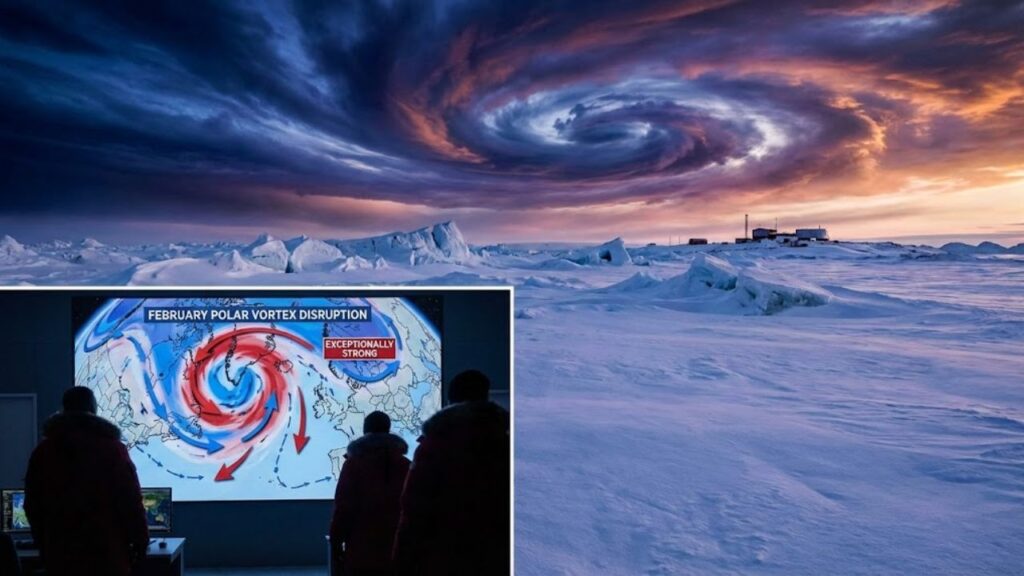
Specialist charts revealed that the polar vortex — the large mass of cold Arctic air — was beginning to falter. For most, weather apps displayed mild forecasts and early signs of spring, while in research centers, experts anxiously refreshed models to monitor the developing situation.
Something rare is about to unfold at the pole.

A February Sky Gone Awry
A typical February in the Northern Hemisphere has a distinct atmosphere. The air feels heavy, the cold is constant, and winter settles in. But this year, the calm feels almost artificial, like a set from a film where the snow was forgotten. Above this stillness, in the stratosphere, winds that usually whip around the North Pole at over 300 km/h are slowing down rapidly.

Satellite images reveal the polar vortex stretching, bending, and contorting in unfamiliar ways. Climate scientists are now fixated on the term “sudden stratospheric warming” (SSW). For the average person, it’s like the atmosphere has been jolted by a powerful shove.
Back in 2018, a similar disruption triggered the “Beast from the East,” which buried parts of Europe in deep snow. In 2021, another event contributed to the devastating Texas freeze, leaving millions without power as Arctic air surged south. These are the types of winters that leave lasting memories and front-page headlines.
Now, early forecasts from institutions like the European Centre for Medium-Range Weather Forecasts and NOAA suggest an event even more significant than usual. One researcher shared that the projected strength of the disturbance sits in the “top tier” of events since the 1970s.
The Mechanics Behind the Polar Vortex Disruption
At its core, the polar vortex is maintained by strong winds moving west to east around the Arctic. When waves of energy from the lower atmosphere rise — influenced by mountain ranges, land-sea contrasts, and persistent weather patterns — they can disrupt the vortex, causing it to weaken. If these waves hit forcefully enough, the winds may slow or even reverse direction.
This process leads to rapid warming in the stratosphere, with temperatures rising by tens of degrees within a matter of days. The cold air, which had been anchored over the Arctic, becomes unstable. It may split or slide away, which increases the chance of extreme temperature swings, late snowstorms, or unexpected “spring-like” conditions far from the pole.
What This Means for Your Weather
So, what does this disruption mean for the weather in the coming weeks? While no model can guarantee exact outcomes, certain patterns tend to follow. After a major polar vortex disturbance, there is an increased likelihood of high-pressure systems over Greenland and Scandinavia, which can push cold air into North America, Europe, and parts of Asia. This process takes time: the stratospheric disturbance happens first, and then the lower atmosphere begins to adjust over the next week or so, triggering changes on the ground.
For regions in the Midwest to Northeast US or across northern and central Europe, late February and early March may feel more like winter’s second act than an early spring. It’s a reminder that winter’s final push can come unexpectedly, even when you’ve already started packing away your heaviest coat.

Farmers in parts of France, Germany, and the US Midwest, who’ve seen early blossoms on fruit trees, might worry about a late frost. Energy traders are already preparing for increased gas and electricity demand should cold temperatures return. These shifts in the weather are the kind of unpredictable swings that come with a broken polar vortex. The ongoing effects of global warming and a strong El Niño may make the contrast between warm and cold spells even more extreme, but they don’t negate the possibility of sharp, brief cold periods.
Preparing for the Unexpected
For most people, the best response to news of a polar vortex disruption isn’t panic but preparation. Check your weather forecasts more often in the coming weeks, especially if your activities depend on the weather. Keep track of not only temperatures but also the expected duration of cold spells.
Consider the possibility of sudden temperature drops. Do you have enough warm layers, and are your vehicle, pipes, and gutters prepared for a freeze-thaw cycle? These might seem like small, mundane tasks, but they can make a difference when winter strikes unexpectedly.
Weather experts are the first to admit the limits of forecasting. A major polar vortex disruption sets the stage for specific weather patterns, but it doesn’t dictate every snowstorm or cold snap. If your area doesn’t experience severe cold, it doesn’t mean the warnings were exaggerated — it simply means the weather behaved differently this time.
Managing Expectations During a Polar Vortex Disruption
It’s easy to fall into a psychological trap when hearing about an “exceptionally strong” polar vortex event. The idea of extreme cold can lead to fear and overreaction. However, some of the most intense SSW events in the past didn’t result in dramatic cold but rather shifted where cold and mild zones were located.
Stay informed without getting overwhelmed by constant updates. The best approach is to remain alert, monitor forecasts, and avoid panic. If the disruption lives up to expectations, it could become a key example in future climate studies.
What This Event Could Mean for Our Changing Climate
There’s something eerie about a major polar vortex disruption occurring in a world that is warming rapidly. The clash between early cherry blossoms in some cities and the potential for Arctic air to spill south is a stark reminder that climate change doesn’t lead to a uniform warming. Instead, it brings sharper contrasts, more extreme weather, and seasons that may no longer follow the traditional script.
Whether this event results in a major freeze or a near miss for your region, it offers an opportunity to reflect on how deeply our lives are connected to the complex systems of the atmosphere. Polar vortex disruptions, once seen as rare events, are now part of the discussion about winter, risk, and resilience in a warming world.
 Why was the Créteil lake still frozen along the shore this afternoon but not in the middle?
| Key point | Detail | Value for the reader |
|---|---|---|
| Exceptionally strong polar vortex disruption | Models show a top-tier sudden stratospheric warming event for February, with unusually intense warming and wind reversal high over the Arctic. | Helps you understand why experts are paying close attention and why this winter may take an unexpected turn. |
| Delayed but significant surface impacts | Main weather effects tend to appear 1–3 weeks after the peak in the stratosphere, reshaping jet streams and storm tracks. | Gives you a realistic timeframe to watch forecasts and prepare for possible late-season cold or stormy spells. |
| Everyday preparation, not panic | Small, practical steps — checking forecasts, reviewing cold-weather gear, protecting vulnerable people and assets — matter more than dramatic reactions. | Turns a complex atmospheric event into concrete actions that can reduce stress and disruption in daily life. |
