The last time I had dinner at my friend Lea’s home, I spent a good five minutes searching for the dining table. There was a sofa, a low modular coffee table on wheels, shelves packed with books, and even a hanging swing chair tucked into a corner. What I couldn’t find was a large wooden table surrounded by matching chairs. Still, within ten minutes, everyone was eating together. Plates rested on poufs, shelves, and a rolling table that unfolded to twice its size. It felt easygoing, slightly chaotic, and surprisingly liberating.
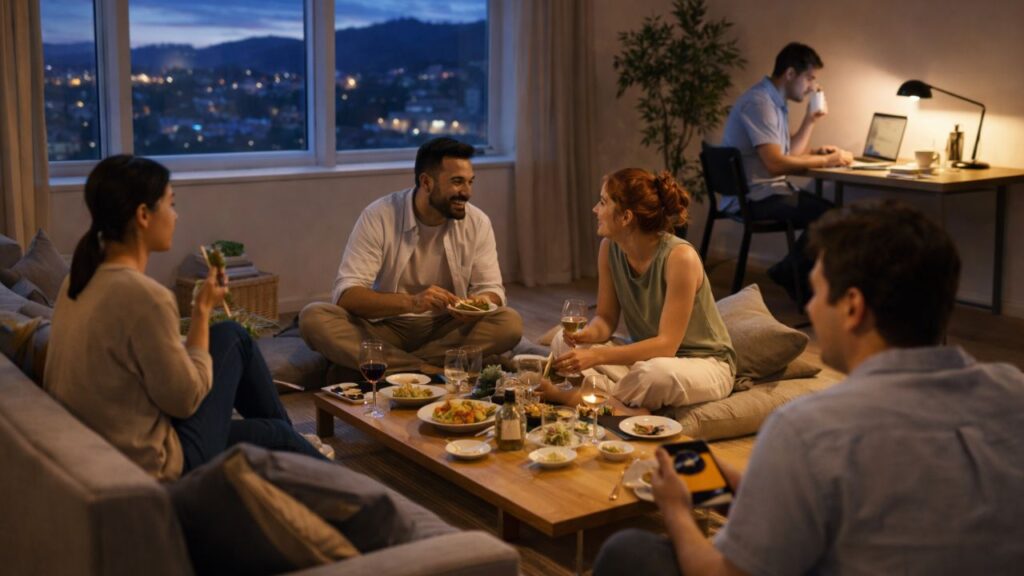
Walking home, one thought kept returning: maybe the traditional dining table is slowly fading away.
Why the traditional dining table is losing its central role
Walk into newly built apartments in cities like Copenhagen, Amsterdam, or Seoul and a pattern quickly appears. The once-dominant “big table moment” is shrinking. Living areas are becoming hybrid spaces, organized around screens, floor seating, and modular elements that shift and adapt. The solid, fixed dining table many of us grew up with—standing like a silent authority in the middle of the room—is being gently pushed aside.

What takes its place isn’t formal or ceremonial. It reflects life in motion.
 Goodbye Hair Dye for Grey Hair: The Conditioner Add-In That Gradually Restores Natural Colour
A Swedish interior designer I met in Malmö offered her own apartment as proof. She lives with her partner and baby in just 42 square meters. Where a dining table would usually stand, she uses a low extendable coffee table that lifts to counter height when guests arrive, along with four stackable stools hidden under the sofa. On weekdays, they eat Japanese-style on floor cushions, bowls in hand. When friends visit, the setup transforms in under three minutes.
No one asks, “Where’s the table?” People simply sit wherever the food appears.
This shift goes far beyond a decorating trend. It’s driven by the overlap of smaller homes, flexible work habits, and a changing social rhythm. Meals happen between video calls, homework shares space with lunch remnants, and evenings are less about formal courses and more about shared snacks near a screen or across a kitchen island. The dining table, once a symbol of routine and obligation, can feel too rigid for this flexible way of living.
The home no longer bends around the table — the furniture adapts to the people.
The modern “table”: islands, consoles, and movable micro-spaces
If this idea appeals to you, the first step isn’t throwing out your table altogether. Many designers are instead breaking the concept of a single, sacred table into several lightweight, movable surfaces. Think of a slim wall-mounted console that folds down for meals. A wheeled kitchen island that rolls into the living room when needed, then slips back into place. Or nesting coffee tables that align into a long buffet when guests arrive.
The goal is to treat your space like a toolbox, not a museum display.

- Say goodbye to the dish rack in the sink: this new space saving trend keeps your kitchen neat, tidy, and clutter free
- Hairdresser reveals hard truth about short hair for women over 50 that many won’t want to hear
- A Nobel Prize–winning physicist says Elon Musk and Bill Gates are right about the future: we’ll have far more free time, but we may no longer have jobs
- A new set of eight spacecraft images reveals the interstellar comet 3I ATLAS with unsettling clarity
- A breakthrough kitchen device is being praised as the invention that could finally replace the microwave
- Keep basil alive indoors using the double pot water mug trick and one daily pinch
- A microfiber cloth soaked in a simple homemade solution can restore old wooden furniture, experts say
- A rare early-season polar vortex shift is forming, with February intensity expected to be extreme
A common mistake is moving straight from a heavy, old-style dining table to having no table at all. At first, it feels freeing. Eating on the couch is relaxed and fun. Then reality sets in: crumbs trapped in cushions, wobbly plates on knees, and sore backs from leaning forward night after night. Many people recognize that moment when a casual streaming dinner turns into a balancing challenge.
The ideal balance sits between bohemian chaos and a stiff, formal dining room. Comfort matters more than pretending every night is a picnic.
A Paris-based architect once summed it up perfectly:
“People think removing the dining table means giving up shared meals. For me, it’s the opposite. I design more places to eat together, just not only one. A bar for quick breakfasts, a low table for tapas nights, a fold-out counter for family celebrations.”
To recreate this flexible approach at home, many urban households are combining:
- A multifunctional wheeled island that works as a desk, buffet, or group table
- Stackable or folding stools that can be stored out of sight
- A simple floor-friendly area with a washable rug and cushions for relaxed meals
Most people don’t eat every meal sitting perfectly upright at a polished table with matching chairs. These movable micro-spaces accept that reality instead of resisting it.
How this shift is reshaping the feeling of home
Once the dominant dining table disappears, the room starts to feel different. The open center can become a yoga space in the morning, a Lego zone in the afternoon, and a standing aperitif area at night. The home’s hierarchy softens. Meals still happen, but without the strict script of everyone sitting in assigned places at a fixed time.
For some families, this change has quietly eased tension around meals. With less formality comes fewer arguments about posture and rules.

- Modular eating areas: Using islands, consoles, and low tables instead of one large table helps adapt to small spaces and shifting routines.
- Flexible social habits: Snacking, tapas-style meals, and floor dining become easier and less stressful when hosting.
- Open central space: A single room can rotate between work, play, and meals without feeling crowded.