
The salon hummed with its usual Tuesday rhythm as coffee cups filled and soft 80s music drifted through the room. In chair three, a woman in her early fifties sat perfectly still, gripping her phone as if it were a lifeline. Her Pinterest feed overflowed with sleek silver pixies and sharp bobs, each one promising a fresher, lighter version of herself. After a quiet breath, she said the line hairdressers hear every day: “I’m over 50. I think it’s time to cut it all off, right?”
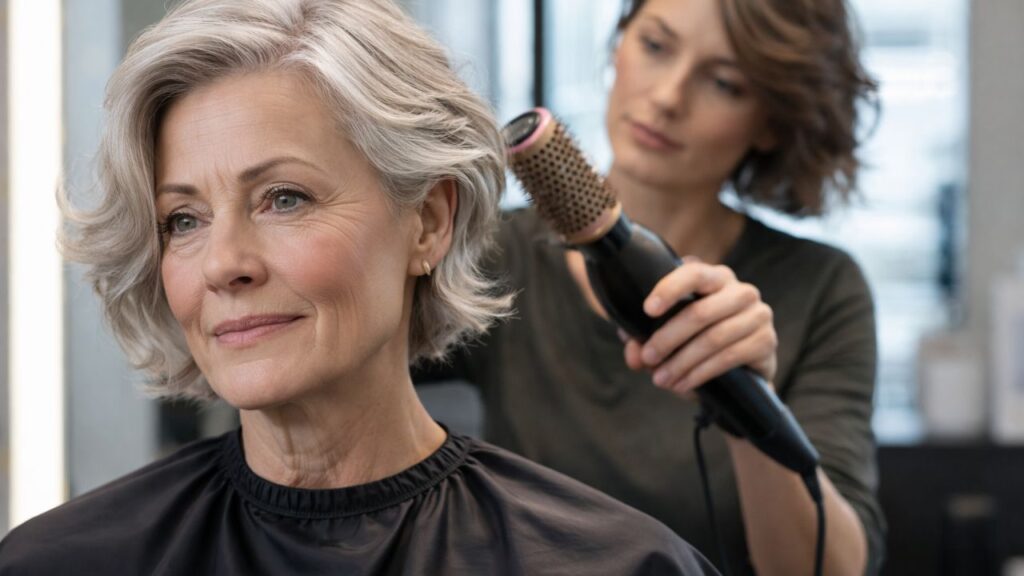
Her stylist paused, set the scissors down, and replied with something she never expected.
“Short Hair Won’t Save You”: What Stylists Really Notice
When a skilled hairdresser looks in the mirror, age is rarely the first thing they see. They notice your face shape, posture, and energy as you settle into the chair. Still, women over 50 repeat the same request again and again: “I suppose I should go short now.” It often sounds less like desire and more like duty.
On the salon floor, the outcomes couldn’t be more different. Some women leave glowing after a big chop. Others walk out with a technically flawless cut and unmistakable regret. On paper, the style works. On them, it doesn’t.

Seasoned stylists quietly talk about “the cut that ages someone ten years in ten minutes.” It’s usually the too-short, too-severe style chosen simply because of a birthday. One London stylist keeps a mental list of clients who arrived saying, “I’ve turned 50, I need short hair,” and left feeling oddly exposed.
Marianne, 56, made that leap after hearing, “Long hair is for young women.” Her fine, thinning hair revealed far more scalp than expected. “I felt older, not younger,” she confessed later, gently asking if there was any way to grow it back faster.
The quiet truth many stylists share once the cape is on is this: short hair is not a magic age eraser. On some faces, ultra-short cuts sharpen every angle and spotlight sagging or fatigue that longer, softer lengths once balanced. A severe crop puts your features into high definition. That can be empowering—or unforgiving.
Short hair doesn’t automatically mean chic after 50. It means everything about your head is fully visible.
The Real Rule: Shape, Texture, and Real Life
Ask top stylists who work with women over 50, and age isn’t their starting point. They focus on bone structure, hair density, and daily habits. A softly layered bob grazing the collarbone can lift a tired jawline better than a rigid crop. A long, sweeping fringe can soften forehead lines or thinning far more gently than blunt micro-bangs.
- Auto technicians explain why keeping the gas tank above half prevents fuel line freezing
- Kate Middleton sparks debate after mirroring Duchess Sophie’s gesture and bending royal protocol
- Scientists pinpoint the age when happiness begins to dip
- Six minutes of darkness approach as the century’s longest eclipse turns day into night
- Nine phrases seniors still use without realizing they offend younger generations
- A man hires a dog sitter and later uncovers unexpected visitors through his home camera
- Greenland declares an emergency after orcas breach dangerously close to melting ice shelves
- Eight phrases deeply selfish people often say without realizing it
Many professionals approach hair like architecture. They study where the face naturally lifts and where it softens, then place volume and length to support that balance. Shorter at the nape for structure, softness near the cheeks, and controlled movement on top to avoid the dreaded helmet effect.
Problems arise when lifestyle is ignored. A textured pixie demands product, trims every four to six weeks, and daily styling. Let’s be honest: few people maintain that routine. That’s why so many “freeing” cuts become flat, shapeless fuzz that clings to the skull and quietly says, “I gave up.”
Stylists often hear women admit they rarely blow-dry anymore, preferring to air-dry on school runs or commutes. For them, a mid-length cut with intelligent layers that falls naturally is far more flattering than a short style that punishes them for skipping a round brush.
The emotional trap is confusing short with easy and long with trying too hard. Hairdressers see both sides. They meet clients who cut off decades of growth only to battle cowlicks and stubborn grey strands every morning. They also see women with chest-length hair, streaked silver and caramel, who look modern because the shape—not the length—is current.
The uncomfortable truth is this: a poorly chosen short cut can age you far more than keeping length and updating the shape. Age shouldn’t decide the scissors. Your real life should.
 Goodbye Hair Dye for Grey Hair: The Conditioner Add-In That Gradually Restores Natural Colour
How to Have the Right Conversation Before the Big Chop
The most powerful moment in the salon isn’t pointing at a photo. It’s saying, “Here’s how I actually live.” Tell your stylist how often you’ll come in for trims, whether you use heat tools, and if glasses are part of your daily routine. Ask directly, “What lengths make sense for my hair and my habits?”
Experienced stylists often suggest a half-step instead of an instant transformation. That might mean moving from long to shoulder length, adding a long fringe, or shortening the back while keeping softness around the face. It gives you that lighter feeling without crossing a line you can’t reverse overnight.
One of the most common regrets women over 50 share is cutting their hair short in a single emotional appointment—after a breakup, a milestone birthday, or a bad mirror day. Stylists recognize the signs: the tight jaw, the brittle laugh, the words, “Do whatever you want.” Big cuts driven by big emotions rarely age well.
A thoughtful stylist slows things down. They might suggest starting with face-framing layers or a fringe. They may gently ask, “Are you ready for your neck and ears to be visible all the time?” Because once they are, every earring, collar, and line beneath the chin becomes part of the look.
“Women still come in at 52 or 58 almost apologizing for wanting long hair,” says Séverine, a Paris-based stylist with two decades of experience. “My job isn’t to cut it because you’re older. It’s to find what will make you feel beautiful when you wake up tomorrow.”
Smart Ways to Avoid Regret
- Ask for honesty, not flattery: Invite your stylist to tell you if a cut will make you look tired or older.
- Test lengths gradually: Move from long to medium, then shorter, learning how exposed and comfortable you feel at each stage.
- Use realistic inspiration: Bring photos of women your age with similar textures, greys, or thinning—not idealized versions.
Choosing for Yourself: Freedom, Risk, and Reality
Online, the message is loud: cut it short, go grey, feel free. In real life, the truth is softer. Some women feel most themselves with a cropped silver pixie that shows every feature. Others feel strongest with long, glossy hair they’ve nurtured for years. Neither choice is wrong. What hurts is feeling pushed into a style you don’t recognize in the mirror.
That moment—stepping out of the salon, catching your reflection, and thinking, “Who is that?”—hits deeper after 50. Faces change quietly over time, and one bold haircut can make that change feel abrupt.
In the best salons, a quiet shift is happening. Stylists are letting go of the old rule that hair must get shorter with every decade. Instead, they suggest something simpler and harder: choose the cut that reflects who you are now, not who you were at 25, and not who society thinks a woman your age should be.
That might mean a shaggy shoulder-length style with grey streaks, a sleek sculpted bob that highlights your jaw, or a boyish crop you can wash and let dry in the sun.
The truth many hairdressers wish women over 50 heard before saying “Cut it all off” is this: short hair is not an aging requirement—it’s a spotlight. It illuminates your face, neck, habits, and style. Sometimes that light feels empowering. Sometimes it reveals more than you’re ready to show.
The real question isn’t, “Am I too old for long hair?” It’s, “What kind of light do I want on me now?”

Key Takeaways
- Age isn’t the main rule: Face shape, hair texture, and lifestyle matter far more than a number.
- Short hair is a spotlight, not a shortcut: Very short cuts expose features and require consistent upkeep.
- Honest communication matters: Sharing real habits leads to a cut you can live with confidently every day.
