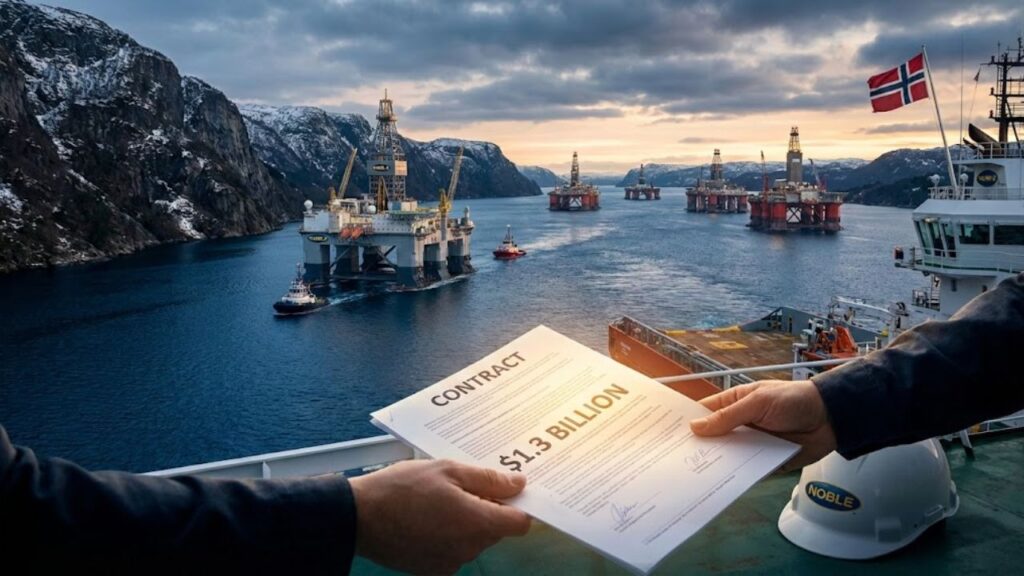
Noble Corporation has secured a fresh wave of work, valued at approximately $1.3 billion. This new set of contracts spans diverse locations, from the icy waters of Norway to deepwater drilling projects off the coasts of West Africa and the Americas. The recent deals significantly reshape Noble’s fleet deployment strategy, with work stretching over the next several years.
Noble’s Strategic Push Into Norway’s Harsh Offshore Frontier
One of the standout moves for Noble is its foray into Norway’s tough offshore environment, particularly within the Norwegian Continental Shelf (NCS). Known for its challenging conditions and stringent regulations, this segment demands specialized technical rigs. Noble has signed a three-year contract with Aker BP for the Noble GreatWhite, a semi-submersible rig designed for harsh environments. This contract, valued at $473 million, marks the GreatWhite’s debut in Norway, with operations set to begin in the second quarter of 2027.
To get the GreatWhite ready for the demanding Norwegian conditions, Noble plans an investment of around $160 million for reactivation, upgrades, inspections, and new equipment. This expenditure is crucial to meet Norway’s rigorous safety and environmental standards, and represents a strategic milestone for Noble in the NCS.
Strategic Expansion and Long-term Goals in Norway
For Noble, this contract is much more than a single project; it’s part of a broader strategy to solidify its position in one of the most stable offshore drilling regions. President and CEO Robert W. Eifler emphasized that the increased backlog demonstrates strong, multi-year demand for deepwater drilling. With 92% of its 24 marketed floaters now contracted, up from 75% previously, Noble’s fleet utilization has significantly improved, supporting stronger cash flow and potentially higher day rates.
New Activity in the Gulf of Guinea and Guyana
Another significant contract for Noble involves the Noble Gerry de Souza drillship, which has secured a two-year contract with Esso Exploration and Production Nigeria, a subsidiary of ExxonMobil. The contract, valued at $292 million, is set to begin in mid-2026. The Gerry de Souza will operate in offshore Nigeria through PIDWAL, Noble’s joint venture with local partner Derotech. The rig will undergo upgrades for managed pressure drilling (MPD), improving safety and wellbore integrity.
This deal underscores the increasing demand for offshore work in the Gulf of Guinea, a region seeing renewed interest in deepwater drilling. The ongoing trend of local content requirements in African markets means that international contractors like Noble must navigate regulatory complexities and work with local partners to ensure compliance.
Firm Contracts in Guyana and the Americas
Noble continues to strengthen its presence in Guyana, one of the world’s leading deepwater hubs. ExxonMobil has extended its contract with Noble for two more rig-years in the country, securing the Noble Sam Croft, Noble Don Taylor, Noble Tom Madden, and Noble Bob Douglas rigs through February 2029. This long-term commitment provides stability in Noble’s high-spec drillship operations, reinforcing Guyana as a core market for the company.
Additionally, Noble has secured several contracts in the Gulf of Mexico, South America, and the Caribbean, demonstrating the wide range of opportunities across the Americas. Key contracts include a workover well for Beacon Offshore Energy in the U.S. Gulf of Mexico, an 11-well program in South America, and a three-well program for BP in Trinidad, with options for further wells.
Strengthening Cash Flow and Fleet Utilization
These new projects, along with the ongoing work in Guyana, will require significant capital expenditure. Noble estimates that contract preparation will involve about $50 million in capital expenditure for 2026, in addition to the $160 million for the Norwegian project. The strategic approach focuses on investing now to reactivate and upgrade rigs, securing multi-year revenue streams with stronger day rates and minimal idle time.
Why Harsh Environment Floaters are Critical
Harsh environment floaters, such as the Noble GreatWhite, are specialized rigs built to endure extreme weather conditions, including freezing temperatures and rough seas. These rigs are equipped with reinforced hulls, heavy mooring systems, and advanced dynamic positioning and safety features. Operating in challenging regions like the Norwegian Continental Shelf requires meeting strict emissions standards, blowout preventer reliability, and coordinated safety efforts with regulators.
These demands raise the cost of entry into this market, but also stabilize demand for contractors who can meet the requirements. As fewer rigs qualify for these harsh environments, contractors like Noble benefit from more stable contracts and slightly stronger pricing, creating a competitive advantage in this niche market.
Understanding Backlog and Its Significance
For offshore drilling companies, a rising backlog indicates contracted work that is yet to be completed. A healthy backlog provides visibility, aiding in staff planning, maintenance, and financial management. For workers, a solid backlog often means longer and more predictable work periods, with regular rotation schedules. For investors, a growing backlog signals steady revenue streams that are less affected by short-term fluctuations in oil prices.
Risks and Opportunities in the Coming Years
Despite the positive outlook, Noble faces several risks. Project start dates in 2026 and 2027 are subject to regulatory approvals and operator decisions, with potential delays or cancellations impacting revenue timing. Additionally, reactivating idle rigs presents technical and operational challenges, with refurbishments often incurring cost overruns and schedule delays.
On the positive side, if day rates continue to rise, Noble’s contracts could become even more profitable, especially if operators opt to extend drilling programs once initial wells are completed. The continued interest in large-scale oil provinces like Norway, Guyana, and Nigeria highlights the ongoing role of deepwater drilling in the energy landscape, despite the broader energy transition debates.