It started with an unassuming evening by the shore in northern Norway. The usual gray waves lapped against the beach as families gathered, watching the serene waters. But as the sun set, something unusual happened. The water began to glow—a dense, swirling emerald hue, unlike the usual soft blue shimmer of plankton. It was as if someone had spilled liquid highlighter into the fjord. Phones came out, and a drone buzzed overhead. Kids ran closer, laughing as they touched the frothy water, while an older fisherman stood still, lips pressed tight, seemingly unsettled by the sight.
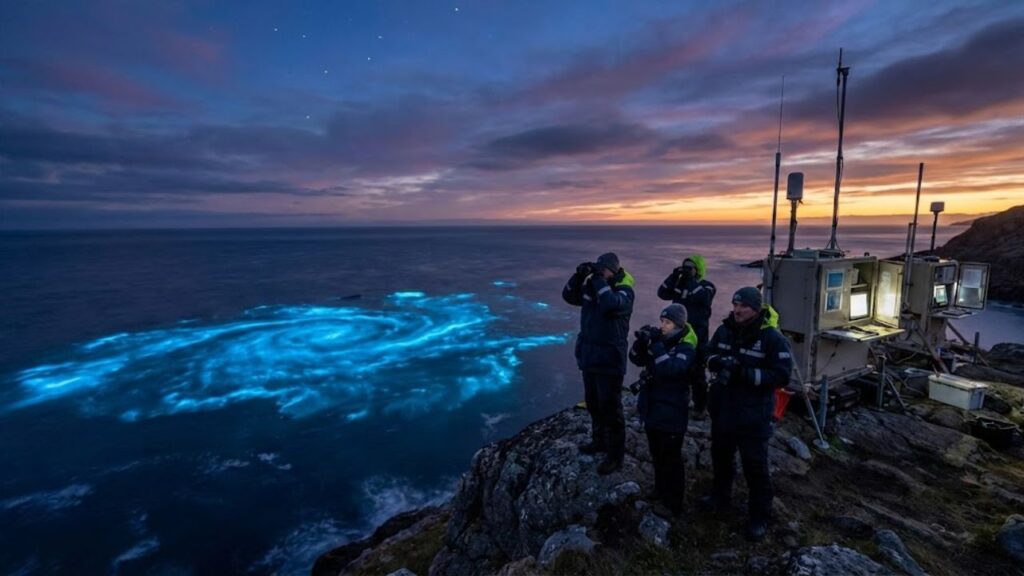
On the hill nearby, a group of scientists observed, not filming for social media, but documenting a significant environmental anomaly. What appeared to be a rare marine “green tide” was happening in waters that were too cold, too dim, and too calm for such an occurrence. This event was more than just a fleeting spectacle; it was a sign of a changing ecosystem.
How Rare Events Signal Deeper Changes
Earth occasionally presents us with oddities that seem like glitches in the natural world—a red waterfall in Antarctica, a sky darkened by swarming butterflies, or a lake turning rusty. But these anomalies often signal larger shifts that most of us may overlook. The green tide off Norway, caused by a sudden rise in sea surface temperature, was one such sign. It wasn’t just a random occurrence; it was part of a larger, ongoing change in the marine environment, a disruption in the balance of nutrients, sunlight, and microscopic life.
Though the green tide may vanish in a week, the conditions behind it—warmer currents and changing wind patterns—point to a deep, slow reset of the marine system. These events act as stress tests, revealing weaknesses in ecosystems that might be too subtle for most to notice. Shellfish populations collapse, seabirds lose their prey, and fishing seasons shift. What seems rare today could become commonplace in the future. Scientists are left asking: What will the world look like when these events stop being rare?
Chasing the Unpredictable: A Scientist’s Race Against Time
When a rare event like this green tide is detected, a flurry of activity ensues behind the scenes. Satellites flag unusual color patterns in the water, and researchers are alerted immediately. Within hours, teams of scientists are dispatched, scrambling to capture data before the moment passes. Boats are prepared, flights are booked, and sensors are dropped into the glowing water. While the rest of the world watches viral videos, the scientists are already gathering crucial information about the phenomenon.
One oceanographer from Tromsø recalls a similar event years ago when warm water entered a fjord earlier than expected, disrupting the local ecosystem. The phenomenon seemed harmless at first, but as more data was collected over the years, it became clear that these unusual pulses of warm water were part of a larger pattern. What seemed like a rare anomaly was a piece of the puzzle that helped scientists understand how quickly Arctic waters were changing.
Understanding the Ripple Effect of Rare Events
These rare anomalies provide a unique opportunity for scientists to measure and analyze the effects on the environment. They collect data on temperature, salinity, oxygen levels, and the types of microscopic life present in the water. Every sample, every measurement helps to piece together a larger story. While most of science is slow, repetitive work, these rare moments force scientists to confront the reality that the world is changing more rapidly than we realize.
What Can You Do When You Witness the Unusual?
If you ever encounter something strange in nature—a river turning an unusual color, birds flying out of season, or a heatwave in an unlikely place—don’t just pass it off. Take notes, photograph it, and share the details with local environmental agencies or citizen science platforms. Your observations could be valuable data points that contribute to larger studies on climate change.
We often hesitate to share our observations, fearing we might be overreacting or bothering experts. But scientists are always in need of data from the real world. Your curiosity could be the missing piece in understanding how our planet is changing.
Shifting Perceptions of “Normal”
As these rare events become more frequent, the line between “freak occurrence” and “new normal” starts to blur. While the green tide off Norway will eventually fade, it serves as a reminder that what we once considered unusual may soon become part of the expected landscape. These shifts are felt most acutely by those on the frontlines—farmers, fishermen, and those who experience firsthand the changing weather patterns and environmental conditions.
The message that the planet is sending with these unusual events isn’t just a scientific curiosity; it’s a reflection of the world we are creating. As we witness these changes, we must ask ourselves: what kind of world do we want to live in, and how much further can we push the boundaries before we admit that something fundamental has shifted?
| Key point | Detail | Value for the reader |
|---|---|---|
| Rare events are signals | Environmental anomalies reveal hidden shifts in climate and ecosystems | Helps you see strange phenomena as early warnings, not just curiosities |
| Science moves fast in these moments | Researchers scramble to capture short-lived data from pop-up “natural labs” | Gives perspective on what happens behind the scenes when you see viral nature clips |
| Your observations matter | Photos, videos, and reports from ordinary people feed real scientific work | Shows how anyone can contribute to understanding and responding to change |