The coffee sits untouched, already cold, as you realize you’ve barely taken a sip. Your phone is face down, but your mind is overwhelmed by everything you think you should be feeling. Am I anxious? Tired? Angry? You scroll past yet another post on “naming your emotions” and “staying self-aware” and, instead of feeling enlightened, you feel… drained. It’s like someone left the light on in your head all night long.
This quiet, invisible fatigue isn’t unique to you.
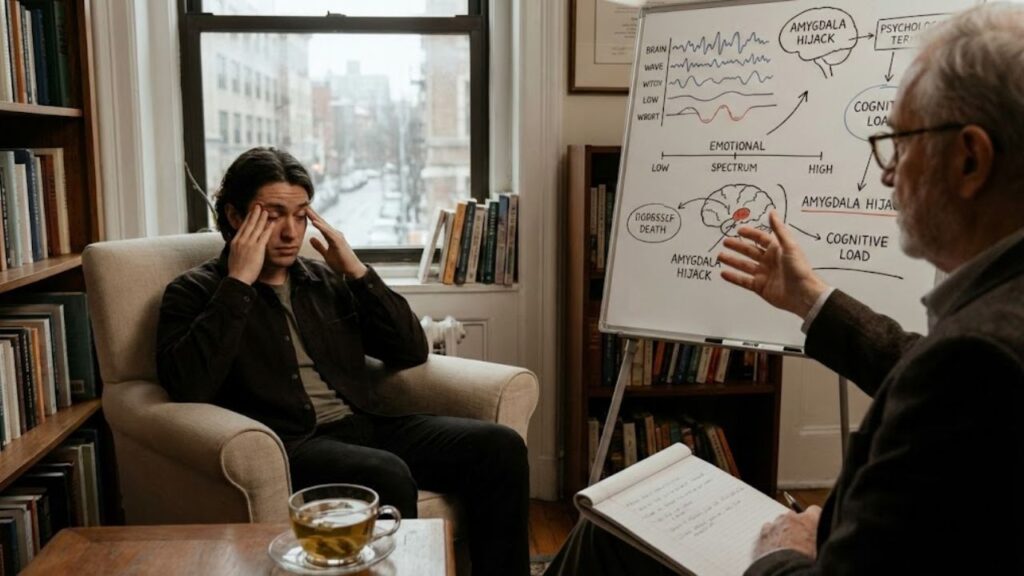
Psychologists are noticing this phenomenon in therapy sessions: people who know all the emotional vocabulary and can label every emotion, but still feel more exhausted than before.
And here’s the strange part: it’s not because you’re doing something wrong.
The Hidden Cost of Emotional Self-Awareness
Emotional awareness seems like an endless positive. You’re supposed to be in tune, mindful, always aware of what’s going on inside you. On paper, it sounds healthy. But in reality, living with your inner emotional radar constantly on can be draining.
Psychologists explain this as a form of mental friction that occurs when we monitor ourselves continuously. It’s like walking with a stone in your shoe: the more attention you give to each step, the more the stone bothers you. Emotional self-monitoring works in a similar way. It amplifies even the smallest signals.
Eventually, even the most mundane emotions begin to feel like problems that need solving.
Case Study: The Hidden Toll of Constant Emotional Tracking
Take Lea, 32, for example. She began therapy after a breakup, where her therapist encouraged her to focus on her emotions rather than numbing them with work or social media. Initially, it worked—she kept a journal, named her feelings, and felt proud of the clarity she gained.
But after six months, she noticed a shift. Instead of feeling relief, her journal entries started to sound like “I feel exhausted by my own awareness.” She began identifying every minor change in her mood: a slight tension became “anxiety,” a fleeting moment of boredom became “sadness.”
What was once a helpful practice turned into emotional surveillance—everything needed a label, a cause, and a deeper meaning. Emotional awareness morphed from a helpful tool into a never-ending task.
The Problem with Over-Monitoring Your Emotions
Psychologists say this happens when emotional awareness evolves into over-monitoring. The brain treats each emotional signal as something to be processed. Feel anger? Analyze it. Feel envy? Explore it. Feel restless? Deconstruct it. Your mind never gets a break.
From a cognitive perspective, this process constantly uses up working memory and attention. You’re juggling self-analysis while trying to live your life. Answer emails—and notice how you feel while doing so. Talk to a friend—and track your micro-reactions to every word they say.
This double workload can often feel heavier than the emotions themselves. Emotional awareness is supposed to give you more freedom, but if it never stops, it adds another layer of pressure.
Finding Balance: How to Be Aware Without Over-Analyzing
Psychologists suggest a simple yet powerful shift: rather than constantly analyzing your emotions, create “check-in windows” throughout your day. Rather than scanning your emotions all day long, build two or three short pauses into your routine—morning, midday, and evening.
During these windows, ask yourself three straightforward questions: What am I feeling? Where do I feel it in my body? What do I need right now, if anything? Then, stop. No deep digging. No turning it into an investigation.
This practice introduces emotional rhythm. There’s a clear beginning and end to your awareness, giving your brain permission to rest. Let’s be real: no one will do this perfectly every day. But even trying most days can lighten the mental load.
Using Broad Categories to Simplify Emotions
Another helpful approach is to use “rough categories” instead of precise labels. Therapists often group emotions into basic families like anger, sadness, fear, happiness, disgust, and surprise. This is usually enough for daily life. You don’t need to pinpoint whether you’re “mildly agitated” or “quietly resentful” every time you feel off.
While it’s tempting to think more precise labels mean more healing, that’s not always true. For some people, hyper-precision leads to rumination, where you spiral into questions like, “Why exactly do I feel this?” or “What does it say about me?”
It’s perfectly fine to say, “I’m in the sad zone today,” and leave it at that. You’re still aware—you just don’t need to turn your feelings into a detailed spreadsheet.
Letting Go of Emotional Perfectionism
One of the most common traps is emotional perfectionism. What starts as a desire to be mature and emotionally intelligent can turn into an internal rule: “I must understand every feeling, or I’m failing at personal growth.” This rule is toxic.
“Emotional awareness was never meant to be a performance,” says clinical psychologist Dr. Elena Ruiz. “The goal isn’t to earn a medal in self-knowledge. The aim is to suffer less, connect more, and respond with kindness to whatever comes up inside you.”
Key Practices for Sustainable Emotional Awareness
- Time-bound awareness: Short daily check-ins are better than all-day emotional scanning.
- Use broad categories: Instead of diving into micro-labels, group emotions into general families.
- Give space for blurry emotions: Not everything needs a clear label—some clarity can come later.
- Let go of the pressure to always understand: “Good” people don’t always understand their emotions.
- Ask yourself: “Is this helping me live, or just helping me analyze?” before diving deeper into feelings.
Accepting Your Emotions as Part of Being Human
Once you view emotional awareness as a tool, not a duty, you’ll feel a sense of relief. You’re allowed to say, “I know I’m upset, and that’s enough for today.” You can go for a walk, chat with a friend, or watch a silly show without turning it into a self-analysis session.
Psychologists remind us that emotional processing happens in waves. Some days, you’re ready to dive deep. Other days, you just need to cope at a survival level. And that’s okay—survival is also progress.
We’ve all experienced those moments when awareness feels like more of a burden than a relief. That’s a signal from your system asking for rest, not more analysis.
Emotional Awareness Summary
| Key Point | Detail | Value for the Reader |
|---|---|---|
| Awareness has limits | Constant self-monitoring overloads attention and energy | Normalizes your fatigue instead of pathologizing it |
| Use rhythms, not 24/7 scanning | Short check-in windows replace constant inner analysis | Provides structure and built-in mental rest |
| Good enough is enough | Broad labels and imperfect understanding still help | Reduces pressure and guilt, supports sustainable growth |