
The early wind along the rim of the Kubuqi Desert carries a sharp mix of dust and pine resin. Beneath a washed-out morning sky, a line of green trucks jolts along a sandy track, each loaded with young saplings wrapped in burlap. Workers climb down stiffly, pulling jackets tight against the cold, and begin unloading trees with a tired, practiced rhythm. One laughs that the desert will be buried in pine needles within a decade. Another studies the empty horizon and stays silent.
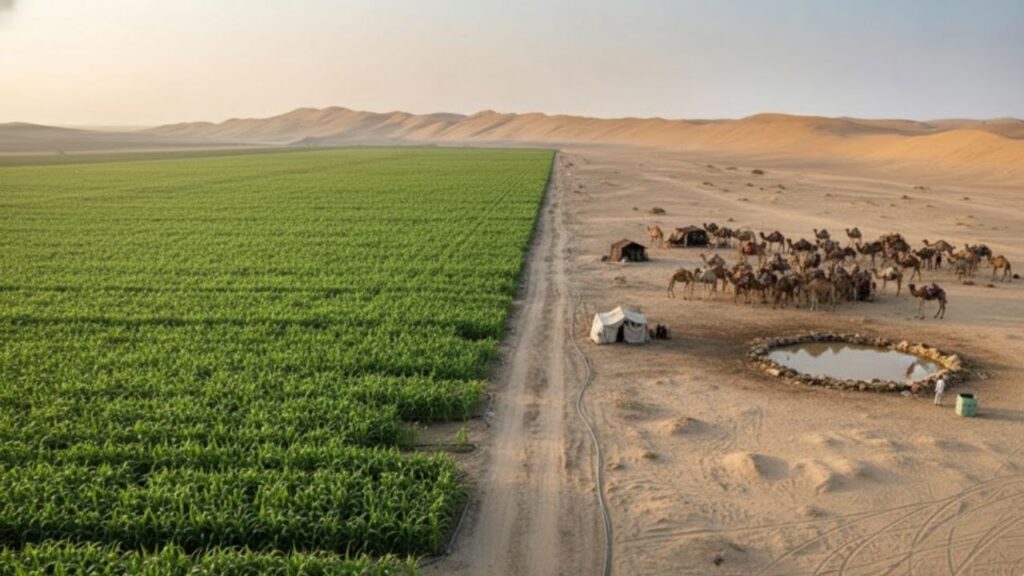
From far away, the scene feels almost heroic. Neat rows of trees pressing into the dunes create an image fit for official documentaries. But standing closer, the land itself tells a quieter, more complicated story.
How China’s Green Barrier Pushed Back the Sand
In villages along the southern edge of the Gobi, older residents gesture toward places where the sand once crept much closer. Their hands sketch a shifting boundary that has gradually moved north over the last twenty years. Satellite records confirm it. In several regions, desertification has slowed, and in certain pockets, the dunes have visibly retreated.

This change traces back to an ambitious idea from the late 1970s: create a vast “green wall” of trees to block advancing sand. After billions of saplings, landscapes once defined by bare horizons now appear markedly different.

From above, the shift is striking. Areas that once showed as drifting sand now register as darker bands of vegetation, especially across Inner Mongolia and Ningxia. In some counties, spring sandstorms arrive less often and with reduced intensity.
Officials highlight the scale with pride: over 78 million hectares restored, enormous public investment, and generations of schoolchildren planting symbolic trees. It is a compelling narrative, perfectly aligned with the world’s appetite for clear, dramatic climate victories.
Scientists on the ground, however, describe a more layered reality. Many new forests rely on a narrow mix of water-demanding species, planted in uniform rows. Groundwater monitors and soil sensors reveal growing strain. Shepherds report wells drying earlier each year, while native grasses and shrubs fade beneath dense canopies.
What looks vibrantly green from space can feel oddly lifeless at ground level.
Planting Trees Where Grass Once Thrived
The strategy behind China’s anti-desert campaign appears simple: add trees to degraded land. In practice, it involves carving pits into sandy soil, often mechanically, and planting fast-growing species such as poplar, pine, and sea buckthorn. In some regions, straw grids are spread across dunes to stabilize shifting sand while roots take hold.
On paper, the plan promises everything at once: sand control, wind reduction, timber growth, and carbon storage. In reality, the desert often resists.
Minqin County in Gansu Province illustrates this tension. Long framed as a frontline against desert expansion, it saw extensive shelterbelts of poplar and willow, irrigation networks across former pasture, and incentives for farmers to maintain young forests. Early gains were visible. Dust storms weakened, and some marginal fields improved.

Over time, water levels fell. The newly planted forests demanded more than the region could supply. Entire stands began dying from the top down, leaving rows of bare trunks that remained classified as forest long after the foliage disappeared.
Ecologists point to a basic truth: many deserts are not empty voids awaiting trees. They are carefully balanced ecosystems dominated by grasses, shrubs, and sparse native trees adapted to scarce water. Dense plantations disrupt that balance, increasing evapotranspiration and draining groundwater faster than rainfall can replace it.
Across the globe, large-scale planting efforts often miss this detail. Counting trees is simpler than understanding landscapes. Not every dry region is meant to become a forest.
The Subtle Costs Beneath the Green Numbers
China’s experience offers a clear lesson: restoration works best when it begins with what the land can sustain, not what appears impressive from satellites. In wind-swept, sandy zones, success often comes from low-growing, resilient vegetation rather than tall forests.
Many specialists now promote vegetation mosaics—careful mixes of native shrubs, grasses, and scattered trees tailored to local rainfall. These systems develop slowly and attract little attention, but they strengthen soil crusts, reduce erosion, and preserve groundwater.
Common missteps repeat themselves: planting too densely, importing species from wetter climates, and irrigating as though water supplies are endless. Pressure to show quick results pushes decision-makers toward visible coverage statistics instead of long-term stability.
As one China-based ecologist observed, grasslands were often labeled forests on maps, while the land’s natural limits were overlooked.
- Monoculture plantations: Large areas planted with a single species appear orderly but remain fragile against pests, disease, and drought.
- Groundwater strain: Water-intensive trees act as constant drains, lowering reserves shared by people, wildlife, and native plants.
- Adaptive restoration: Native shrubs and grasses combined with fewer trees create flexible cover that survives harsh years.
A Living Experiment in the World’s Drylands
Beyond official slogans, communities living alongside these forests draw their own conclusions. Some value the added shade and calmer springs. Others worry as wells empty sooner than they once did or as grazing land disappears.
Researchers increasingly call for a shift in focus: fewer headline numbers, more attention to how trees grow, struggle, and consume water. The contradiction remains clear. China has genuinely slowed desert expansion, while also revealing the risks of reshaping drylands on a massive scale.

| Key point | Detail | Value for the reader |
|---|---|---|
| — | Billion-tree drives can slow sand but also drain scarce groundwater if species and density are poorly chosen. | Helps you read “tree-planting” headlines with a more critical, climate-literate eye. |
| — | Healthy drylands are often grass- and shrub-dominated, not lush forests, and that’s how they stay resilient. | Reframes deserts and semi-deserts as complex ecosystems, not blank spaces to “fix.” |
| — | Future projects in China and elsewhere are shifting toward native, low-water vegetation mosaics instead of monoculture forests. | Offers a glimpse of what smarter, science-led restoration could look like globally. |
