
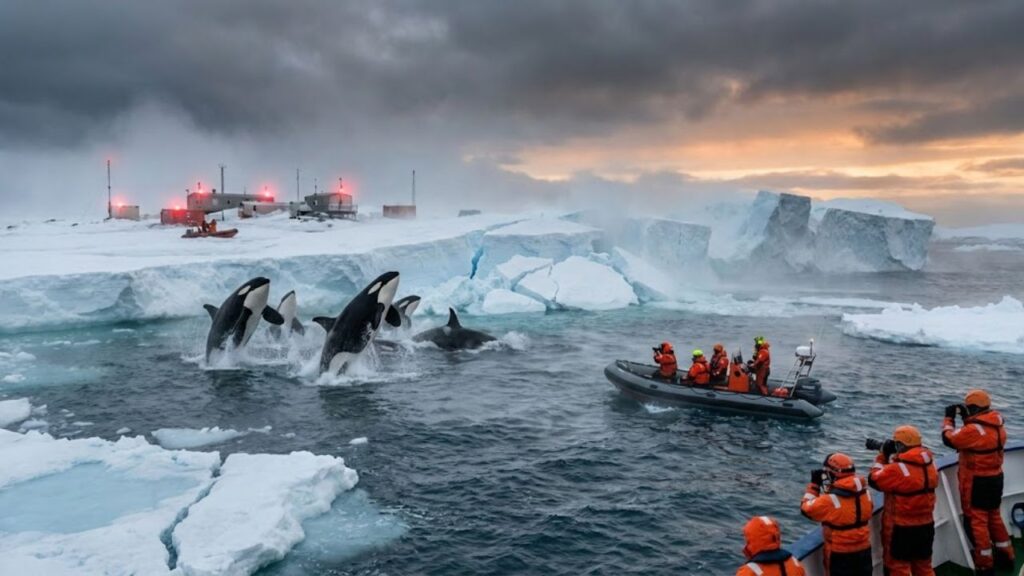
A thin metallic tone rings out, quickly swallowed by the wind scraping across the ice. On the monitoring platform, a few researchers stop their work and fix their gaze on the feed: black-and-white shapes cutting through dark water, an ice wall breaking just meters away. One killer whale breaches the water, its body suspended in the air beside the crumbling barrier. Emergency protocols activate in the background: red banners flash on laptops, radios crackle. At first, no one moves. They just watch as the ice shifts. In the silence, one thought cuts through: something has changed, and it’s not in our favor.
The Moment Ice Stops Feeling Safe
On the edge of a thinning ice shelf, the ocean doesn’t appear majestic. It looks uneasy. That day, researchers off the Antarctic Peninsula described the ice field as “holding its breath,” cracked like glass after a stone has struck. When the killer whales appeared, they weren’t just hunting. They were navigating a narrow path between open water and fragile ice, sending up slush with every breach. The images were stunning. Up close, it was a dangerous gamble.
Emergency protocols are only triggered when absolutely necessary. The team was running a routine behavioral survey when sensors flagged unusual movement. Pressure ridges began shifting, and satellite feeds showed fractures forming rapidly. At the same time, drones captured footage of the whales breaching next to chunks of ice already tumbling. A senior scientist quickly ordered all small craft to retreat, halting close-up operations. No one wanted to be near a collapsing ice edge with six-ton predators pushing waves into it.

What shook experts wasn’t just the orcas’ boldness; it was the timing. Sea ice in the region is retreating earlier and forming later, creating unstable transitional zones—neither solid nor liquid. In these fragile zones, killer whales are testing new hunting routes and behaviors, while the ice is increasingly stressed. Researchers say the breach fits a larger pattern of environmental change: warmer waters eroding ice from below, storms shattering it from above, and top predators arriving earlier. The emergency alert wasn’t about one isolated risk—it was about a system nearing its breaking point.

What Killer Whales are Telling Us About the Changing Environment
When you watch orcas long enough, they start to resemble ocean analysts. They react to tiny changes in real time—water temperature, prey behavior, ice conditions—and then adapt right in front of you. In this case, the whales were using the unstable ice barrier as both cover and tool, driving waves that dislodged seals clinging to the floes. Researchers noted the precision of their movements: swift passes, sudden breaches, last-second maneuvers to avoid the sharpest, weakest ice. It was risky, creative, almost experimental behavior.
One biologist likened it to a city suddenly realizing half its bridges are unsafe. The whales weren’t where they “should” be, at least not according to decades of tracking data. Records from just 20 years ago show sea ice forming months earlier and lasting longer, locking predators out for most of the season. Now, the ice breaks earlier, opening corridors for orcas to reach once-rare feeding grounds. Satellite time-lapse footage over the last decade shows a recurring trend: thinner ice, messy edges, and more frequent collapses. The footage of those breaches is just the most dramatic snapshot of a shift that’s been quietly building in field notebooks and background data.
Scientists speak carefully about these patterns, but the subtext is blunt. The Arctic and Antarctic are warming at roughly twice the global average, reshaping the habitats of marine mammals. This means the old “maps” of safe ice, predictable currents, and steady food sources are disintegrating. For killer whales, adaptation looks agile and impressive. For the ice, it’s accelerated stress. *The breaching next to the crumbling ice didn’t cause the crisis; it revealed it—like a flashbulb exposing what was already breaking in the dark.*
What This Means for Us, Far From the Ice
It’s easy to watch viral clips of orcas near breaking ice and dismiss them as “wild nature moments.” However, the same forces that bring whales closer to dangerous ice edges are also reshaping weather patterns, agriculture, and coastal life thousands of kilometers away. Warmer oceans store more energy, which powers stronger storms, heavier rain, and more extreme shifts between drought and flood. The collapsing ice shelves that prompt researchers to trigger emergency alerts are directly tied to rising sea levels that invade coastal cities like Miami, Kolkata, and Rotterdam. We’re witnessing a connected system, not separate events.
On a smaller scale, it also connects to everyday actions that feel too small to matter. The energy we use, the food we waste, the flights we take without a second thought—they all feed into the atmospheric blanket trapping heat. Most of us react like the whales, adjusting behavior as the environment nudges us, rather than planning ahead. The difference is that orcas aren’t the ones burning fossil fuels—they’re just forced to improvise under the consequences.
Experts who watched the emergency alerts that day emphasize something many headlines overlook: we’re not passive observers. We’re active participants. One researcher put it simply in their field log: “Every degree of warming is a behavioral experiment we’re running on species that never consented.” That may sound harsh, but it’s also uncomfortably accurate.

Turning Emergency Protocols into Everyday Actions
When things go wrong in polar research, there’s no room for debate. Crews fall back on checklists: boats retreat from crumbling ice edges, drones climb higher, and data is archived. The key isn’t panic; it’s preparation—knowing what to do before the ice breaks. Applying that same mindset in daily life means deciding in advance where you’ll reduce your impact, so it doesn’t depend on mood or convenience. One practical method many climate scientists use themselves is to pick three “non-negotiables” and stick to them for a year. Maybe it’s swapping one car trip for public transport, cutting down on meat at lunch, or reducing leisure flights.
On a planet as complex as ours, no one can micromanage every single choice. Instead, focus on the big levers: energy, transport, and food. A family that changes how they heat their home, shares rides, and throws away less food will likely cut more emissions than someone obsessing over the small details. The key is to treat it like system tuning—figuring out where you can make the most significant impact with the least friction. On tough days, any step that feels doable is more valuable than a perfect plan that never leaves the drawing board.
Researchers working in dangerous ice zones will tell you they don’t follow best practices flawlessly either. Equipment fails, plans are disrupted, and humans get tired and cold. That’s where empathy matters, including for ourselves. You’ll forget your reusable bag, take a last-minute flight, or have weeks where nothing “green” happens. The point isn’t perfection—it’s direction. As one oceanographer watching the orca footage put it:
“We don’t need everyone to live like monks. We need millions of people making slightly better choices, most of the time, for many years.”
Taking Small Steps Toward a Bigger Impact
- Choose three habits you can stick to for 12 months, not just three weeks.
- Talk about climate change as real-life stories, not abstract doom.
- Support policies that match the scale of the problem.
- Protect nature near you; proximity breeds care.
- Remember no single action “saves” the planet, but together they help bend the curve.
Living with the Ongoing Sound of the Siren
The siren on the ice-monitoring platform eventually went silent. The whales moved on, the ice edge slumped into the sea slowly, and the researchers returned to their tasks, slightly more alert. There was no explosion, no instant catastrophe—just one more entry in an ever-growing archive of moments when the line between stability and instability blurred. That’s what this era feels like for many people, whether on a polar ship or in a city battling summer heat: not constant disaster, but constant tension.
On a personal level, that tension can be exhausting. We scroll past images of wildfires, flooded subways, stranded whales, and then rush back to emails and grocery lists. The mind can only handle so much urgency before it begins to shut down. On a human level, however, completely turning away doesn’t feel right. *We’ve all had that moment where a climate news story clenched our chest, then we immediately moved on.* That dissonance doesn’t mean we don’t care; it just means we haven’t yet found a way to incorporate the crisis into our lives without drowning in it.
Maybe that’s where the image of the killer whales is unexpectedly helpful. They aren’t frozen in fear. They’re not pretending nothing has changed. They’re navigating an altered world with the tools they have, testing new paths, pulling back when the ice looks too thin. We can do the same: treat climate change not as a distant apocalypse, but as the background condition shaping every decade from now on. Less drama, more steady course correction. Some will take to the streets, others will change jobs, and some will quietly redesign their homes. All of it counts. The siren doesn’t need to stay at full volume to keep us moving.

Key Takeaways
- Killer whales and unstable ice: Orcas’ behavior highlights the rapid changes in sea ice and predator behavior.
- Emergency protocols as a warning: Researchers trigger alerts more often as ice conditions deteriorate faster.
- Everyday “protocols” for us: Focusing on a few realistic, long-term habits for greater impact.
