
A small group of people in their seventies stand loosely arranged, their eyes focused on a strip of tape laid across the floor. One at a time, they lift a knee, shift their weight, stretch an arm sideways, then lower themselves into a chair and rise again without using their hands. There are no machines, no weights, just a sequence of moving, pausing, and regaining balance that feels almost playful.
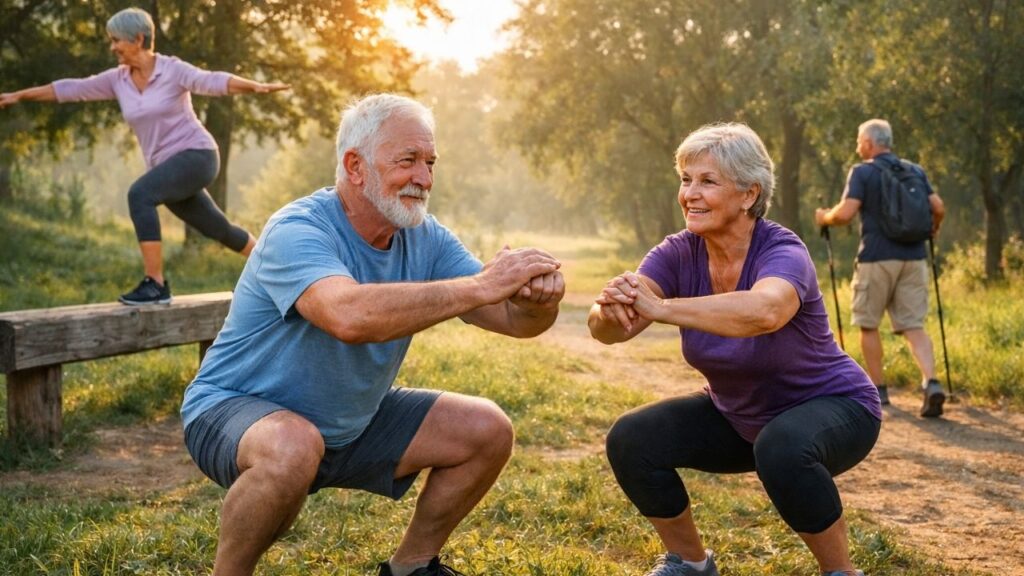
From the outside, it seems simple. Up close, the effort shows. Tight jaws, trembling ankles, hands hovering near chair backs just in case. One woman laughs as she wobbles, then steadies herself and tries again with renewed focus. The gerontologist observing them isn’t tracking steps or calories. He’s watching how quickly their bodies respond to tiny disruptions.
Later, he explains softly, “This is what keeps them independent.” He’s not referring to daily walks.
The Movement Pattern Gerontologists Keep Emphasizing
When people think about living longer, they often picture 10,000 steps a day, gym sessions, or swimming laps. That image of “healthy aging” is familiar. Yet gerontologists working closely with older adults are increasingly focused on something less glamorous: dynamic, multi-directional balance combined with strength. It isn’t one exercise, but a specific way of moving.

It involves shifting weight between legs, reaching in multiple directions, lowering and rising, turning the head while the feet stay planted, and stepping over imagined obstacles with control. The movements are slightly awkward and deeply practical. It’s less about polished form and more about catching yourself before a fall in everyday life.
Clinically, this approach is called “reactive stability training” or “multi-planar functional movement.” The idea is straightforward: instead of training muscles in predictable lines, you teach the body to manage surprises. Real life isn’t repetitive. Floors are slippery, dogs pull leashes, grandchildren dart past. According to gerontologists, people who regularly practise these complex patterns don’t just live longer — they remain functional for longer.
What This Looks Like Outside the Lab
In a Rotterdam clinic, a 79-year-old man named Peter demonstrates how this plays out in real life. He once followed all the rules: daily walks, monitored blood pressure, a steady routine. After tripping on a curb and breaking his wrist, his confidence vanished. Instead of prescribing more cardio, his gerontology team introduced sideways steps over foam blocks, head turns while walking, and one-leg stands while reaching for colored cones.
At first, he disliked it. “I felt ridiculous,” he recalls, comparing it to a kindergarten gym class. Three months later, he could recover his balance with a single quick step if someone bumped into him. His confidence returned before his wrist fully healed. Research from Japan, Finland, and the United States reflects this outcome: older adults who train balance, agility, and lower-body strength in varied directions reduce fall risk by 30–40%.
Behind that statistic lies something crucial. Fewer falls mean fewer fractures, fewer hospital stays, and fewer chains of decline. Preventing one critical fall can extend not just lifespan, but healthspan — the years spent dressing, shopping, traveling, and living independently. Walking and gym workouts help, but they often miss the side-to-side, real-world movements that gerontologists now see as decisive.
Why These Movements Matter So Much
Think of the body as an orchestra. Traditional exercise trains sections separately. Dynamic stability work forces everything to coordinate at once. When you step sideways and twist to reach, your ankles, knees, hips, core, vision, and inner ear must communicate in milliseconds. This neuromuscular control — the speed and accuracy of brain-to-muscle signals — quietly declines with age.
The encouraging part is that this coordination remains trainable even in later life. Gerontologists now argue that maintaining this rapid, whole-body communication is more protective than adding another steady walk. Flat, predictable movement doesn’t challenge reflexes in the same way.
There’s also a cognitive layer. These patterns demand attention, memory, and decision-making. You’re constantly adjusting, reacting, and choosing. Each session becomes a subtle workout for both brain and body. The initial awkwardness is part of the process — that mild discomfort drives the adaptations that help preserve healthspan.
Bringing Healthspan Movement Into Real Life
For everyday life, gerontologists suggest a simple structure: three short sessions per week combining balance, direction changes, and leg strength. Ten to fifteen minutes is enough. No machines are required — a sturdy chair, a wall, and a bit of open floor space will do.
 Goodbye Hair Dye for Grey Hair: The Conditioner Add-In That Gradually Restores Natural Colour
One example is the “clock” drill. Stand near a wall and imagine a clock on the floor. Step lightly to each “hour” and return to center, adding a gentle knee bend. Over time, turn your head or reach an arm toward the direction you step. The movements appear simple, yet they challenge the balance system deeply.
Pair this with sit-to-stand repetitions without hands and brief one-leg stands using fingertip support. Rotate through them as a loose circuit. Consistency matters more than perfection. Even those who claim they dislike exercise often find three short sessions manageable.
Common Pitfalls and Human Realities
In clinics, two mistakes appear repeatedly. First, doing everything on a perfectly stable surface in the same direction. The nervous system disengages. Second, avoiding leg strength due to knee discomfort, then struggling with basic tasks like standing up. Even seated, dynamic patterns can be trained through slow marching, heel-to-toe taps, and gentle torso rotations.
Psychologically, balance training can challenge identity. Admitting that a one-leg stand feels difficult isn’t easy. Progress also isn’t linear. Illness, stress, or caregiving may interrupt routines, yet the nervous system retains what it learns. Many older adults report feeling more present and less anxious in crowds or on public transport after a few months.
Practising for Everyday Life, Not Perfection
As Dr. Laura Jensen, a gerontologist in Copenhagen, explains, “Falls aren’t just accidents of age. They’re often the result of skills we stopped training.” Even at 85, those skills respond to practice. The goal isn’t youth, but rehearsing daily life.
A practical weekly rhythm might include one day focused on standing balance and stepping, one on rising from chairs or low surfaces, and one on playful challenges like line walking or gentle ball-catching. On paper it looks minimal. For the nervous system, it’s rich and demanding. For families, it can determine whether an older relative joins a trip or stays home out of caution.
Simple Ways to Integrate These Movements
- Practise informally while waiting for the kettle or watching the news.
- Attach movements to habits, such as a few sit-to-stands before coffee.
- Use the home as a gym: hallways, counters, and sofa edges.
- Acknowledge fear openly, which often increases commitment.
- Track feelings, not numbers, like turning quickly without grabbing furniture.
Staying Capable, Not Just Alive
Aging science is shifting its message. Exercise was once framed mainly as disease prevention. In geriatric practice, a different concern dominates: maintaining everyday freedom. Reaching shelves, showering alone, catching a train without hesitation.
Those who practise complex, stability-rich movement are often the ones still traveling, cooking, and living independently. Their bodies aren’t flawless, but they know how to adapt, twist, and recover. That adaptability is the true currency of healthspan.
Life rarely moves in straight lines. Side steps, sudden turns, bending for dropped keys — these unnoticed movements determine independence. Training them quietly, at home or in community spaces, can shift the story of aging.
The Core Idea Gerontologists Stand Behind
This approach isn’t about chasing immortality. It’s about preserving choice in the years ahead. Beneath apps, names, and trends, the principle remains simple: teach the body to respond when the world behaves unpredictably.
That’s the movement pattern gerontologists quietly rely on when they speak of extending healthspan. Not the perfectly logged walk or the polished gym routine, but the thinking, slightly chaotic dance of everyday stability. It may never look impressive, yet it could be the reason someone you love stands up, turns easily, and says, “Let’s go, I’m ready.”

Key Takeaways for Readers
- Train reactive balance with weight shifts, direction changes, and recovery steps to prepare for real-life surprises.
- Combine leg strength and balance in short circuits to support stairs, cars, and quick recoveries.
- Use everyday objects like counters, hallways, and cushions to make practice accessible and consistent.
