
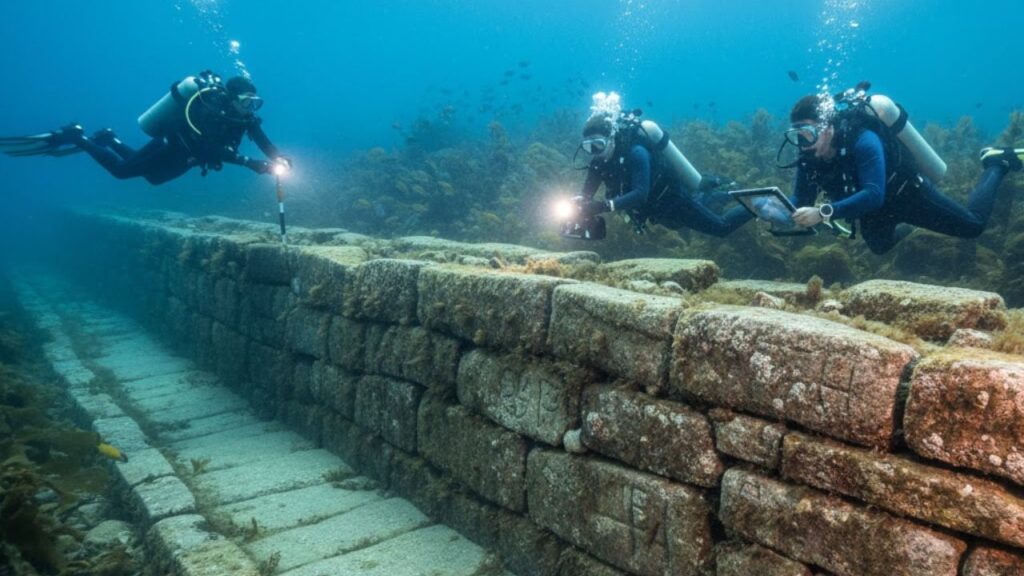
The boat shuts off its engine a short distance from the French shoreline, and the sudden quiet is broken only by waves tapping the hull. The water appears unremarkable, a dull gray surface under a washed-out sky. There is no sign that below lies a structure older than the pyramids, created before villages, cultivated fields, smartphones, or even bronze existed. A diver steadies herself, adjusts her mask, takes two slow breaths, and leans backward into the water. As she sinks through the haze, a shape emerges: a deliberate line of stacked stones, cutting across the seabed like a long scar. This wall was built by human hands, roughly 7,000 years ago.
When an underwater wall reshapes Europe’s early history
Archaeologists never expected to encounter such a construction off the coast of France. While it was known that rising seas after the last Ice Age submerged valleys and river mouths, a continuous stone wall still intact seemed almost unreal. Yet in the Bay of Quiberon in Brittany, the evidence is clear: a stone barrier more than a kilometer long, carefully arranged and now resting beneath shallow water. Sonar and drone images show a straight, narrow line that nature alone could not have produced. Even where stones have collapsed, the underlying plan is unmistakable, revealing precise human intention.
A Mesolithic structure frozen in time
Dating places the wall around 5,000 BCE, during the final phase of the Mesolithic period. At that time, Western Europe was home to hunter-gatherer communities, and the coastline lay far beyond its current limits. What is now seabed was once dry ground marked by marshes, streams, and open plains. The wall likely crossed the routes of migrating animals, particularly wild deer. Rather than serving as a defensive structure, it appears to have been a functional tool, shaped slowly over seasons to guide animal movement and improve hunting success.

Rethinking the abilities of coastal hunter-gatherers
For decades, history drew a sharp line between mobile hunter-gatherers and later farming societies known for permanent buildings and monuments. This submerged wall quietly dismantles that idea. Its construction required planning, coordination, and shared knowledge passed down across generations. Hundreds of stones were placed with purpose, following consistent rules and a collective vision. These communities were not merely reacting to their environment; they were actively shaping it, understanding animal behavior, reading the landscape, and committing to a structure whose benefits unfolded over time.

Building without metal, cities, or written plans
The practical challenge is striking. With no machinery, metal tools, or maps, people relied on observation and memory. They would have tracked seasonal animal paths, noted stable ground, and tested small interventions. Over years, stones were added one by one, sourced from nearby outcrops, adjusted and readjusted as the group learned what worked. The finished wall is not the result of a single moment but a physical record of repeated effort, shared decisions, and accumulated experience.
A global hunting strategy echoed in stone
Archaeologists classify such constructions as game drives, long stone alignments designed to guide animals toward ambush points. Similar systems are known worldwide. In the Middle East, vast stone “desert kites” once funneled gazelles, while in North America, Indigenous communities built low walls to direct bison toward cliffs. Off the French coast, the same principle likely applied. A coordinated group could steer herds toward narrow passages where hunters waited, turning landscape knowledge into reliable food, materials, and social stability.

Engineering knowledge hidden in plain sight
Scientific study reveals that the stones were not placed randomly. Some are carefully wedged and angled to withstand pressure and water movement. The alignment follows natural features of the bedrock, using the terrain itself as support. While not monumental like Stonehenge, the wall reflects a sophisticated understanding of materials and environment. It demonstrates that these people thought beyond daily survival, working at the scale of entire landscapes with clear expectations of long-term results.
Lessons from a wall shaped by change
This submerged structure also speaks to adaptation. Its builders lived through dramatic environmental shifts as rising seas transformed coastlines and reduced hunting grounds. Instead of clinging to old patterns, they adjusted their strategies, investing effort where land and water met. They accepted change and asked what could still be built within it. This quiet adaptability echoes across time, offering a familiar human response to uncertainty and transformation.
A past that feels unexpectedly familiar
The archaeological record paints a realistic picture: trial and error, disagreements over stone placement, failed hunts, and hard winters. These were not idealized figures in untouched wilderness, but communities navigating stress and change. As one marine archaeologist involved in the research explains, these people were already transforming their environment in complex ways, long before farming societies appeared. That shared struggle quietly links their world to ours.
Key findings from the submerged wall
- Age and origin: Built around 5,000 BCE by coastal hunter-gatherer groups at the end of the Mesolithic period.
- Possible function: Likely served as a game drive, guiding animals into controlled hunting zones.
- Why it matters: Challenges the idea of “simple” foragers and pushes large-scale construction further back in time.
- Hidden landscapes: Preserved only because rising seas submerged the area after the Ice Age.
- Ongoing research: Nearby tools, camps, or additional structures may further expand this lost chapter of history.
A question that still lingers after seven millennia
Standing on today’s shoreline, nothing suggests that human ingenuity lies just beyond the waves. Yet beneath the surface, people once lived full lives, building, hunting, arguing, and adapting. The wall turns a simple horizon into a layered story, reminding us that landscapes remember even when submerged. It also hints that much of our own infrastructure may one day appear just as mysterious. What endures is not only stone, but a familiar question that spans time: given the world as it is, what can we build that will last, even briefly?
 Private schools should be banned because they create an unfair advantage for wealthy children
Why this discovery matters today
- Ancient engineering: A 7,000-year-old stone wall reveals unexpected technical skill among hunter-gatherers.
- Shifting coastlines: Its submersion offers a concrete example of how quickly environments can change.
- Modern parallels: Shows how collective, long-term projects help societies adapt to uncertainty.
