
The bottle of vinegar sits on the counter, ready for action when limescale begins to gather around the sink. Next to it, the brown bottle of hydrogen peroxide often stays forgotten in the bathroom cabinet, waiting for the next scraped knee. Recently, someone on social media suggested that mixing the two creates the “ultimate natural disinfectant” that outperforms bleach without the headache. You pause, your hand hovering over the bottles, curious but also cautious about doing something risky in your own kitchen.
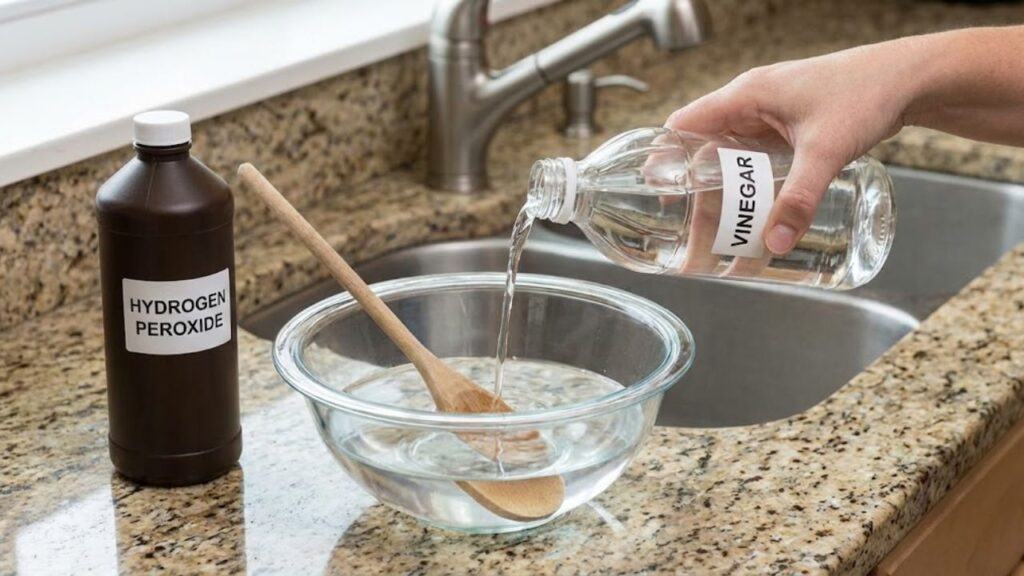
The labels on both bottles scream “caution,” but the comments online call it a “miracle spray.” So, which should you trust?
What Happens When Vinegar and Hydrogen Peroxide Mix?
Let’s break it down. You’re standing in front of a moldy shower or a questionable cutting board, fed up with scrubbing and the harsh chemical odors. That “natural cleaning hack” pops into your mind. Vinegar kills germs, right? Hydrogen peroxide does too. You do the math: if A is good and B is good, combining them must be amazing, right?

The natural conclusion is to grab a spray bottle and mix both liquids together. But here’s where things take a turn.

A few years ago, a woman from Ohio shared her experience online after mixing vinegar and hydrogen peroxide in an old glass bottle to clean her kitchen grout. Initially, she was thrilled — the smell was strong but “clean,” and the tiles looked whiter. But soon, the metal cap began to corrode, and the bottle started to feel unusually pressurized. A chemist friend later explained that she had essentially created a diluted acid that could damage surfaces and irritate lungs.
She wasn’t the only one. Poison control centers receive calls each year about dangerous “home cleaning mixes” gone wrong.
The Chemistry Behind the Reaction
Here’s the science. Vinegar is acetic acid, while drugstore hydrogen peroxide is an oxidizer. When combined in the same container, the two react to form peracetic acid — a much stronger, more aggressive compound than either product on its own. Peracetic acid is used in industrial and medical settings, but only under controlled conditions, with trained professionals, proper ventilation, and safety equipment.
In your kitchen or bathroom, however, without ventilation and using bare hands, this same reaction can lead to irritated eyes, burning throats, damaged metal, and deteriorating rubber seals. So yes, mixing vinegar and hydrogen peroxide “works,” but it’s far from safe and certainly not the homey, harmless solution you might expect from TikTok videos.
The Safe Way to Use Them
There is a safer method that hygiene experts and food safety labs endorse, and it’s surprisingly simple. You can use both vinegar and hydrogen peroxide on the same surface, but never in the same bottle and never simultaneously. Think “duo,” not “cocktail.”
Spray one, let it sit for a bit, wipe or let it dry, then spray the other. No fizzing, no fumes. Just an effective two-step process for eliminating germs.
For instance, when cleaning a wooden cutting board after handling raw chicken, you can first spray plain white vinegar. Let it sit for a few minutes to lower the pH and kill bacteria. After rinsing and drying, follow with 3% hydrogen peroxide, which is commonly used for minor wounds. Leave it on for a couple of minutes, then wipe or rinse it off.
Food safety studies have shown that using vinegar and hydrogen peroxide one after the other significantly reduces microbial contamination more than either product alone. The key? Let the products touch the surface, not each other.
Avoid the Shortcut
The biggest mistake many people make is trying to save time. You’re tired and want a shortcut, so you combine both liquids into one “super cleaner.” While it’s tempting, the one time you do this can create serious issues.

The rule is simple: separate bottles, separate steps. Here’s a handy script from a food safety trainer I interviewed: “Use vinegar. Pause. Wipe. Then peroxide. If it’s fizzing in the bottle, it’s not cleaning your counter; it’s damaging your lungs.”
When to Use Each Product
- Vinegar alone: Use for limescale, soap scum, and deodorizing the fridge.
- Hydrogen peroxide alone: Use for light whitening, disinfecting toothbrush holders, or fresh cutting boards.
- Both in sequence: Use them one after the other (never mixed) for extra disinfection on non-porous kitchen and bathroom surfaces.
Why People Keep Trying the Mix
This debate continues to resurface online, much like an urban legend with improved SEO. The reason? We’re torn between the desire for a perfectly sanitized home and the discomfort of harsh chemical smells and warning labels. Vinegar and hydrogen peroxide feel reassuring — familiar, inexpensive, and “less industrial” than the bright blue gels in childproof bottles.
This emotional comfort creates a blind spot where risky mixtures can sneak in.
Once you realize that peracetic acid is hiding behind this “miracle combo,” something shifts. You start reading labels more carefully. You notice how cleaning brands often warn against mixing their products with anything other than water. You spot tiny pictograms warning about corrosion and respiratory irritation, and suddenly, they’re not just “legal noise” anymore.
The truth is, not every viral DIY cleaning tip is grounded in science. Some are born out of midnight comments, not lab tests.
Cleaning for the Right Reasons
There’s also a deeper reason behind our cleaning routines. When you scrub mold from the bathtub or tackle the sticky ring in the trash can, you’re not just fighting dirt. You’re trying to regain control, to erase that feeling of being overwhelmed as the house slips into disorder.
That’s why a “miracle combo” that promises to “kill everything, naturally” sounds so appealing. It’s not just about germs — it’s about the fantasy of a quick fix for both the mess and the mood. Yet, the homes that feel truly calm are often the ones run with simpler, safer routines. A few trusted products, no experimental mixtures hiding under the sink.
Key Takeaways
The next time you hold those two bottles in your hands, pause for a moment. You’ll remember the difference between *using both* and mixing them. You’ll still want that extra disinfecting boost, but you won’t risk your lungs or your faucets for it.
This is where your habits begin to shift. You’ll label your bottles, store hydrogen peroxide away from light, and stop chasing the strongest smell as proof of cleanliness. Cleaning becomes less of a frantic battle and more of a quiet, safe routine.
It may not look spectacular on Instagram, but it works in real bathrooms at 7 a.m.
One day, you’ll find yourself calmly explaining to a friend why that viral cleaning hack isn’t as smart as it seems. You’ll share the simple two-step method instead. You’ve learned that your home is safer not because of a magic cleaner, but because you finally understood what you’re spraying into the air you breathe.

| Key point | Detail | Value for the reader |
|---|---|---|
| Don’t mix them in one bottle | Vinegar + hydrogen peroxide form peracetic acid, which is corrosive and irritating | Prevents respiratory issues, damaged surfaces, and risky fumes at home |
| Use them in sequence, not together | Spray vinegar, wipe or let dry, then apply hydrogen peroxide separately | Boosts disinfection while staying within safe, home-appropriate use |
| Keep routines simple and clear | Label bottles, ventilate rooms, stick to a few well-known uses | Reduces anxiety around “hidden chemicals” and avoids dangerous DIY mixes |
