
The first orca surfaced so near the ice that a startled glaciologist let his notebook slip from his hands. A black dorsal fin sliced through the dull gray water, circling the sharp white edge of Melville Bay in West Greenland. Radios crackled in several languages, metal thermos cups rattled on a table, and someone murmured that the animals were far too close.
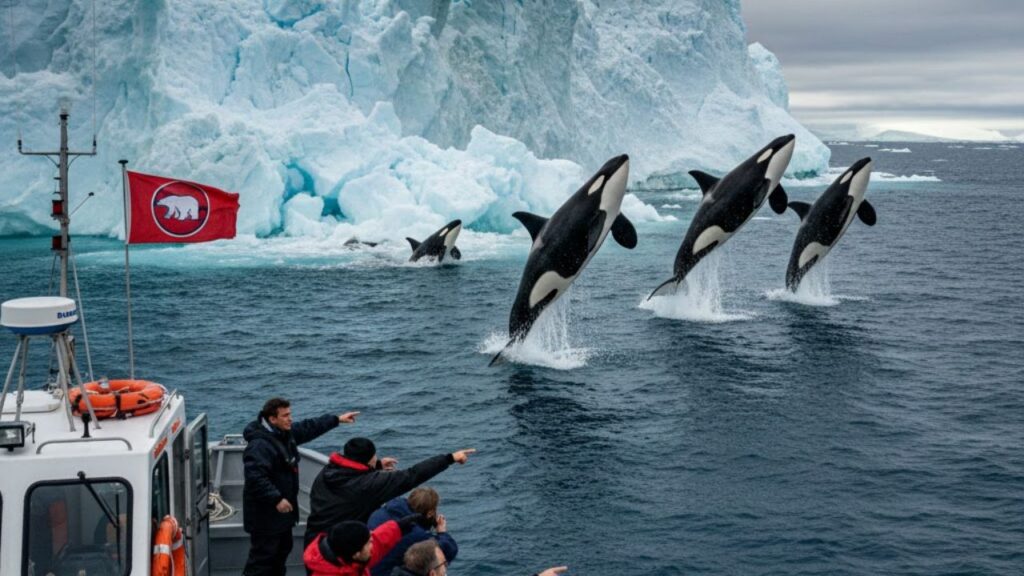
Beyond the research vessel’s window, car-sized slabs of ice rolled and groaned, splitting apart with a deep, hollow echo. More orcas followed, tracing the weakening ice shelf as if guided by an unseen chart.
Then someone on deck finally named the moment.

Emergency.

When Orcas Reach the Ice Shelf Boundary
From above, Greenland’s northwest coast resembles shattered porcelain, white fragments scattered across a steel-colored sea. For most of the year, this region is defined by heavy silence and dense ice. Historically, orcas avoided these waters, blocked by pack ice that could seal shut without warning.
This year, that barrier failed to form.
Researchers flying low over the Uummannaq Fjord began spotting dark shapes gliding through water that satellite charts still marked as ice-covered. Some whales swam within 30 meters of jagged shelves that would have been inaccessible only a decade ago. Images spread rapidly through research networks.
One mid-July Tuesday, Greenland’s climate observatory in Kangerlussuaq issued an urgent alert. A Danish Navy patrol had reported a large pod of orcas moving north, closely following the edges of rapidly thinning ice.
In Qaanaaq, a small community wedged between rock and fjord, residents stepped outside with binoculars. They watched fins slice through waters long known to freeze solid, even in summer. Soon after, scientists from the Greenland Institute of Natural Resources launched a helicopter to confirm what satellites suggested: the orcas were not merely passing through.
They were actively exploring the fragile seams of the ice shelves.
Why Scientists Call This an Emergency
For researchers, this is more than an unusual wildlife encounter. Orcas are apex predators that move where access and prey align. Their presence deep inside former ice strongholds signals that the protective ring of sea ice around Greenland is thinning, breaking earlier, and returning later.
This change does more than shift ecosystems. It exposes the bases of ice shelves to warmer ocean water for longer periods, weakening them from below. Ice that once behaved like a slow, stable fortress is now responding more like soaked cardboard.
In this context, “emergency” doesn’t mean sirens or evacuations. It means the Arctic is crossing critical thresholds faster than climate models anticipated.
Why the Orca Emergency Reaches Beyond Greenland
The immediate response was practical. Research teams were instructed to log every orca sighting, tracking distance from ice edges, group behavior, and the presence of calves. Additional time-lapse cameras were installed near glaciers, not to follow whales, but to detect subtle changes in calving and shelf fractures.
In this way, orcas became living indicators, tracing where the ice barrier had softened. One scientist described it as “using predators as climate sensors.”
For coastal communities, the warning carried deeper meaning. Many Inuit hunters respect orcas but also fear their impact. The whales hunt narwhals and seals, species central to subsistence life. As orcas move north, they don’t just meet glaciers. They intersect with culture.
 Chair workout after 60 reveals elite endurance if you finish strong without breaks or shaking
Elders in Qaanaaq have begun sharing updated safety guidance. Routes once trusted may no longer be safe. Ice remembered from childhood cannot be relied on. Hunters now listen closely to the sounds beneath their boots, adjusting instincts shaped over generations.
The Chain Reaction Beneath the Ice
The logic behind the emergency follows a clear sequence. As sea ice retreats, dark ocean surfaces absorb more sunlight. Warmer water slips beneath floating shelves, thinning them from below. As shelves weaken, massive icebergs break free, altering currents and nutrient flows.
These shifts ripple upward through the food web. Plankton distributions change, fish follow, seals track the fish, and orcas pursue the seals. The sight of top predators carving new routes along melting shelves is a visible sign of changes that began quietly, molecule by molecule, decades ago.
This is why images of orcas skimming Greenland’s ice feel so unsettling. They are striking, but they also act like warning markers in a growing storm.
How Researchers Respond When Ice Loses Its Patterns
When scientists declare an emergency, they shift focus rather than panic. Recent satellite records were combined with traditional sea-ice knowledge from local hunters, forming a new reference map. This blended perspective became the updated baseline.
Ocean sensors soon followed. Small, orange, buoy-like instruments were placed along the whales’ suspected routes, quietly measuring temperature and salinity at depth. Their readings confirm that warmer Atlantic water is intruding under the ice for longer periods each year.
The orcas simply make this hidden process visible.
For those far from the Arctic, it’s easy to treat such updates as distant curiosities. Scientists working in Greenland recognize this fatigue. That’s why they increasingly speak in terms of thresholds rather than abstract targets.
The message is no longer about distant degrees of warming. It’s about watching predators enter places they have never hunted before.
Signals Worth Paying Attention To
- New orca routes reveal thinner, weaker, more fragmented sea ice.
- Greenland’s ice loss contributes to global sea-level rise, reshaping coastal risk worldwide.
- Local choices, from voting to supporting reliable reporting, help keep these signals visible.
A Quiet Emergency Drawing Closer
Some emergencies are loud, marked by alarms and flashing lights. This one is subtle. It sounds like ice cracking at night and whale breath rising into cold air. It looks like a dark fin sliding along a white cliff once thought unreachable.
The events off Greenland this summer may fade from headlines, replaced by the next urgent story. But orcas remember pathways. Once predators learn a route, they rarely abandon it.
What’s unfolding in these remote waters is more than a local encounter between whales and ice. It’s a preview of future coastlines everywhere. Watching orcas trace melting shelves is like seeing tomorrow’s high-tide line sketched quietly, one pass at a time.
The question is not whether we admire orcas. It’s whether we recognize their new paths as messages, not just moments to scroll past.

| Key point | Detail | Value for the reader |
|---|---|---|
| Orcas signal rapid ice change | Unusually close sightings show that once‑solid sea ice no longer blocks predators | Turns abstract warming into a clear, visual sign of climate thresholds being crossed |
| Emergency means “watch differently” | Scientists shifted to intensive monitoring, combining local knowledge and new sensors | Offers a model for how to respond to slow, creeping crises in your own life or city |
| Far‑away shifts have local impacts | Melting shelves contribute to global sea‑level rise and changing weather patterns | Helps connect Greenland’s story to coastal risk, costs, and choices where you live |
