
It often seems to happen at the worst times. You’re driving home from work, the fuel gauge is nearing empty, and the kids are arguing in the backseat. You pull into the nearest station, grab the nozzle, and glance at the price per liter, thinking to yourself, “This is going to hurt.” After filling up, you drive away, unsure of exactly how much you’ve paid or how it compares to last month’s price. It’s just that bitter feeling of overpaying, once again.
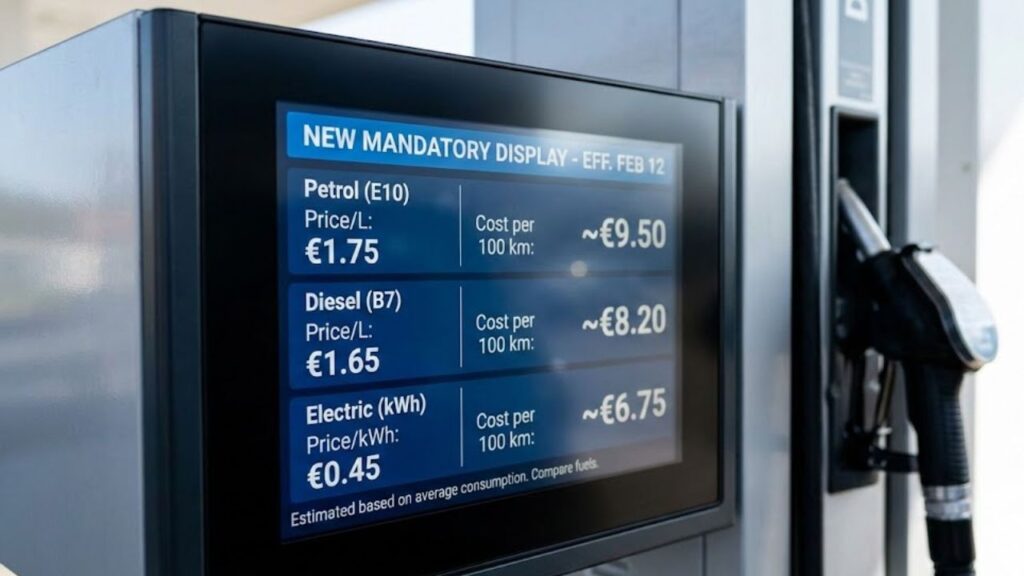
But starting February 12, that moment of confusion at the pump is set to change with a small but powerful addition: a new line on the screen.
A New Fuel Price Display: Everything Changes from February 12
As of February 12, gas stations will be required to display a new piece of information right where it matters most: at the pump. In addition to the price per liter, drivers will also see the average national fuel price, allowing them to immediately compare the price they’re paying with the countrywide benchmark.

Previously, you needed an app, a bit of time, or a quick Google search to determine if you were being overcharged. From now on, that lingering “Am I paying too much?” question will have an answer in real time, right before your eyes.

Imagine the Scene: A Clear Comparison at the Pump
Picture this: you’re driving on a busy highway just before a long weekend, and you stop at a service station to avoid running out of fuel. The price per liter is displayed in bold digital numbers, but this time, just beneath it, a second figure appears: the national average price.
You glance at it and realize you’re paying 18 cents more per liter than the national average. On a full tank, that’s several euros lost in an instant. What once felt like a shrug (“It’s the highway, I’ll deal with it”) now feels like a conscious decision. You’re no longer just accepting the price; you’re comparing it, measuring the gap.
This new rule isn’t just about adding extra digits to the pump display—it’s about shifting power back to you, the consumer. When you can see the reference price, you’re no longer a passive customer; you become a more informed negotiator with yourself: should I fill up now, or wait for a better price at the next station?
For fuel retailers, this transparency is going to be hard to ignore. If the gap between the pump price and the national average is too wide, it’s like a flashing warning sign. And as we know, that kind of transparency tends to push prices downward over time.
How to Make the Most of This New Information
The best response from February 12 is simple: look at both figures—the price per liter and the national average. First, check the price you’re about to pay. Then, take a quick look below at the national average displayed on the pump.

If the difference is only a few cents, you’re likely within a normal range, especially if you’re on the highway or in a more remote area. But if the gap climbs to 10, 15, or 20 cents per liter, you’re in “this station is clearly more expensive” territory. At that point, you can calmly decide: do you fill up fully, just put in a small amount, or drive to the next stop?
Some Additional Tips
- Old-school moisturizer with no luxury branding – dermatologists say it’s the best choice.
- Psychology and strict parents – experts reveal how childhood affects adulthood habits.
- Happy childhood memories – signs you had a joyful upbringing.
- €5,000 a month to live in a remote Scottish island – a job that includes puffins and whales.
- Feeling responsible for peace – psychology explains the origins of this behavior.
- Largest plane in the world – a major alliance could boost its commercial success.
- Parkinson’s disease and oral bacteria – new studies suggest a possible link.
- Cash machine keeps your card – learn the quick trick to retrieve it.
Turning Frustration Into Action with Concrete Numbers
We’ve all had that moment when you leave a station with a vague sense of being overcharged, but no clear numbers to back it up. This new display at the pump turns that feeling into something actionable—concrete numbers that are easier to act on than vague frustration.
Of course, it’s tempting to get obsessed with small savings, like driving 40 extra kilometers just to save 3 euros. Let’s face it, nobody really does this every day. The key is balance: watch the price gap, react when it’s large, and let it go when it’s small. Your mental load doesn’t need another calculator running all day long.
As one consumer expert puts it, “Price transparency is like turning on the light in a room you’ve always walked through in the dark. You still walk through, but now you see where the furniture is.”
How to Use the New Display Effectively
- Look at both numbers: Price per liter vs national average.
- Set a tolerance gap: For example, if the gap is over 10 cents, you may just take the bare minimum.
- Keep track: If a station is consistently above the average, quietly remove it from your regular route.
- Don’t obsess: Use the new info as a guide, not a source of daily stress.
- Combine with apps: The pump provides the big picture, while apps can refine your choices if you’re planning longer trips.
The Bigger Shift: A Small Digital Change with Big Impact
This small change behind the pump display is more than just a new line on a screen. Fuel prices have become a monthly referendum on our purchasing power. Every time you fill up, you’re making a personal calculation: below €1.60 per liter, you breathe a sigh of relief; above €2.00, you start mentally adjusting your budget for the month.
By instantly comparing what you’re paying with what the rest of the country is paying, this reform connects your daily life to a larger picture. You’re no longer just looking at a random price; you’re placing yourself on the national price map. That small context can transform feelings of helplessness into a sense of control.
 Japan unveils a new toilet-paper innovation “and shoppers can’t believe it didn’t exist sooner”
Key Points
- New Display at the Pump: Starting February 12, the national average fuel price will be displayed at stations, providing an instant benchmark.
- Quick Comparison Reflex: Compare the station price with the national average to make smarter fuel decisions.
- Less Vague Frustration: The feeling of being “ripped off” is replaced by concrete numbers, providing greater peace of mind and control over your fuel spending.
