
The estate agent paused mid-sentence, eyes fixed on the centre of the room. Where everyone once admired a chunky stone island, there was now open space. In its place sat a long, slim counter along the window, two stools neatly tucked in, and a freestanding butcher’s block that could roll away in seconds. The kitchen felt larger, calmer, almost studio-like. You could walk straight through without being forced around a heavy slab of quartz.

“We took the island out last year,” the owner said lightly. “Best decision we ever made.”
Why the ‘Must-Have’ Kitchen Island Is Fading Away
This scene is becoming increasingly common in 2025 homes. Designers are quietly stepping back from the old rule of adding an island at all costs. Something more practical and refined is taking its place, reshaping how kitchens look and how they function.

For years, renovations followed a predictable formula: a large rectangle in the middle, pendant lights above, stools lined up, and a sink or hob installed like a centrepiece. It photographed beautifully and signalled open-plan living, even when the room barely had space to breathe.

When Real Life Exposed the Island’s Flaws
As daily life evolved with more home working, more cooking, and more time spent in kitchens, that central block started to feel restrictive. It disrupted movement, narrowed pathways, and turned kitchens into obstacle courses.
Designers began hearing the same concern repeatedly: “We thought we needed an island, but we keep bumping into it.” A couple in London removed theirs and gained nearly a metre of circulation space, allowing multiple people to cook comfortably. In a Toronto townhouse, a family replaced the island with a wall-length counter and a movable cart, instantly freeing space for everyday living.
Several kitchen brands now report that up to 40% of new projects are completed without a central island, particularly in urban homes under 35 m².
The 2026 Shift Toward Lighter, Flexible Kitchens
The reason is straightforward. Islands look impressive in photos, but they demand generous square footage to work well in reality. They lock layouts into place with fixed lighting and plumbing, leaving little room for change.
The trend gaining momentum in 2026 takes the opposite approach: lighter, linear, and adaptable. Instead of one heavy centrepiece, kitchens are embracing elongated perimeter counters, slim peninsulas, and mobile prep stations that move with the user. Freedom of movement is becoming the new definition of luxury.
The Rise of the Linear “Super-Counter”
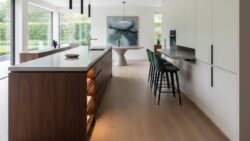
The design replacing the traditional island is known as the linear super-counter. It’s a long run of worktop hugging the wall, stretching across the room, deep enough for cooking, prepping, baking, and even seating.
Paired with a light peninsula or movable prep block, the layout feels like a runway instead of a roadblock. You move seamlessly from sink to hob to oven without navigating corners, and the room feels open rather than divided.
How the Layout Transforms Daily Living
In a compact Barcelona apartment, the owners once squeezed in a small island because it felt expected. Cooking became cramped and awkward. After removing it, they extended the counter beneath the window and added a narrow bar ledge along the side wall. Storage increased, movement improved, and the kitchen finally worked.
 Using the Same Shampoo for Years Can Backfire - Hair Often Needs a Monthly Clarifying Reset
Friends now gather at the side bar while cooking happens along the window. Children use the long surface for homework and crafts. A slim trolley slides out only when extra prep space is needed.
Why Wall-Length Counters Make More Sense
From a design standpoint, walls are often underused. By slightly deepening counters and running them continuously, you gain functional linear workspace without sacrificing flow. The centre of the room stays open for movement, dining, or seating that links the kitchen with the living area.
The result is a cleaner aesthetic with fewer corners, fewer dead zones, and less clutter. With a flexible prep element instead of a permanent island, the room can change character in minutes.
Switching From an Island Without Regret
When planning a renovation, start by mapping how people actually move. Trace paths from the door to the fridge, from the sink to the bin, and from the stove to the table. Wherever those paths collide with an island, consider whether that obstacle is necessary.
Replace it with a full-length wall counter, leaving the centre clear. Divide the run into practical zones: a wet zone near the sink, a hot zone by the hob, a landing zone near the fridge, and a generous prep area.
Designing for Real Life, Not Just Entertaining
Many homeowners later admit they designed for imagined dinner parties rather than everyday routines. Guests leaning on islands often block workflow, leading to constant interruptions. A long wall counter absorbs daily chaos far better than a central monument.
Design consultant Mia Anders explains it simply: people want space to move, spread out, and adapt, not a fixed centrepiece.
- Deepen wall counters to 65–70 cm for serious prep space.
- Add a slim side peninsula or bar ledge that doesn’t block the room.
- Use a movable cart or butcher’s block for flexible prep.
- Limit tall cabinets to one wall to avoid a boxed-in feel.
- Let the dining table handle social gatherings.
Redefining the Heart of the Home
This emerging trend reflects a broader shift in how homes function. Kitchens are becoming multi-purpose studios that adapt throughout the day, from workspace to café to family hub.
The disappearing island marks a collective realisation that magazine features don’t always fit real life. As homeowners reclaim floor space, light, and calm, the focus is shifting toward kitchens that feel effortless to move through.
While islands will always suit large, open homes, many real-world kitchens are embracing the wall-hugging super-counter and its flexible companions. The new question isn’t whether there’s room for an island, but how free you want to feel when you walk into your kitchen.
| Key point | Detail | Value for the reader |
|---|---|---|
| Rethink the layout | Replace a bulky central island with a long, deep wall counter and open circulation | Gain space, light, and easier movement in everyday life |
| Use flexible elements | Combine a super-counter with a slim peninsula and movable prep blocks | Adapt the kitchen quickly for cooking, working, or entertaining |
| Design for real life | Plan around daily routines instead of occasional parties or Instagram photos | A kitchen that actually supports how you live, not just how it looks |
