
From the front, the hair seems acceptable—slightly flat, a little flyaway. But when the stylist lifts the length, light streams through the ends like sunlight through thin fabric. The bottom looks almost transparent. The stylist hesitates, then suggests something deceptively simple: a blunt cut. No feathering. No intricate layering. Just one clean, straight line. Minutes later, the same hair appears noticeably fuller, as if its volume was quietly turned up.
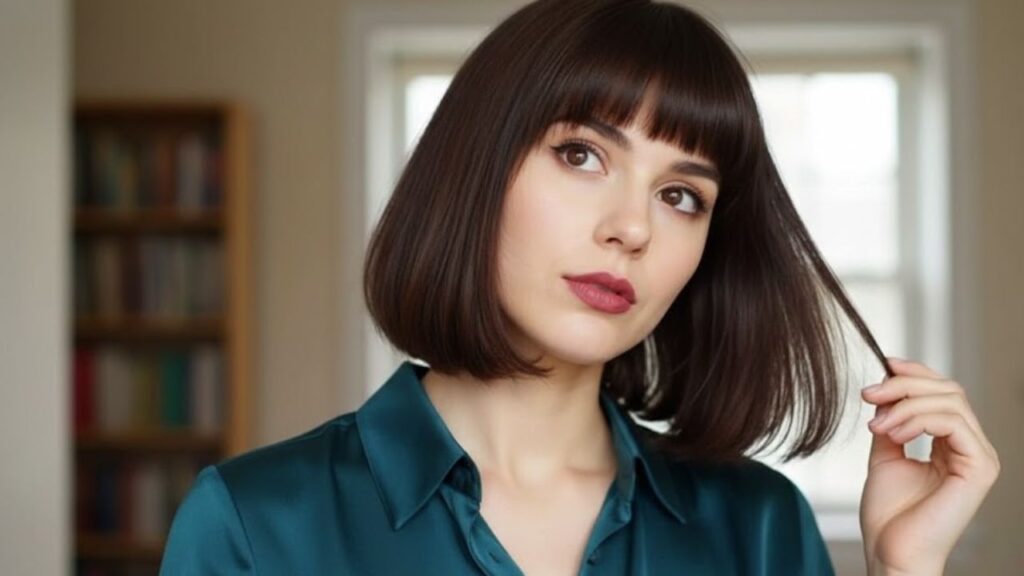
Why Fine Hair Looks Thicker After a Blunt Cut
Scroll through any dramatic haircut transformation and the pattern is easy to spot. Someone arrives with long, wispy ends that drift around the shoulders. They leave with a sharp, solid edge resting near the collarbone—and suddenly the hair looks confident and full.
Nothing about the hair itself has changed. The strands are identical. What’s different is how those strands finish at the bottom. A blunt cut gathers the ends into one dense edge instead of letting them taper away.
 People who push in their chair when leaving the table often share these 10 unique personality traits
That solid edge is what the eye interprets as thickness.
Why Length Often Makes Fine Hair Look Thinner
Many people who grow their hair as long as possible with soft layers notice the same thing: the longer it gets, the thinner it appears. The ends visually fray. The hair bends in multiple directions. In photos, the lower portion seems to fade.
Eventually, after seeing enough sleek bobs and sharp lobs, they opt for a straight cut just above the shoulders. The hair settles with more weight and intention. Friends comment that it looks thicker, as if something dramatic happened.
What changed wasn’t volume—it was distribution.
The Visual Science Behind a Blunt Edge
Think of hair as a bundle of extremely fine threads. With feathered or wispy ends, those threads scatter. Light passes through, softening the outline. The brain reads this as delicate or thin.
With a blunt cut, the threads land almost at the same point. This creates a defined perimeter that blocks light and clearly outlines the shape. The result feels fuller—not because there’s more hair, but because what’s there is concentrated into a visible edge.
How to Ask for a Blunt Cut That Actually Works
The most flattering blunt cuts for fine hair usually fall between the chin and collarbone. This length is long enough to feel polished, yet short enough to avoid thinning and splitting at the ends.
In the chair, be direct. Say something like: “I want a one-length blunt cut that makes my hair look thicker, not wispy.” Use your fingers to show where you want the line to sit. Minimal layering at the bottom is essential. Gentle shaping around the face is fine, but the hem should stay strong.
Think of it as choosing a clean hem over a frayed one.
Why Maintenance Matters More Than Styling
Right after the cut, the hair looks incredible. But weeks later, the familiar stringiness can return. The ends tangle. The sharp line softens. Hair begins to flip unevenly at the shoulders.

Perfect daily styling isn’t realistic. What matters is simple, consistent maintenance. Many stylists recommend trims every 8–10 weeks for blunt cuts—not to change the shape, but to preserve the dense edge. Waiting too long doesn’t save length; it only thins the perimeter.
Fine hair’s biggest enemy is subtle thinning caused by razors or heavy texturizing. What feels light and freeing on thick hair can make fine ends nearly invisible.
What to Clearly Avoid at the Salon
Be clear about what you don’t want. No aggressive thinning at the ends. No heavy internal layers that weaken the outline. Ask your stylist to check how the cut looks when the hair is dry and straight, not just freshly styled.
A clean edge is where visual density lives. Once it’s broken down, products alone can’t recreate fullness.
Choosing the Right Blunt Style for Your Hair Type
- Very fine hair: Choose a bob or lob with almost no layers through the length.
- Fine but wavy hair: Keep the blunt edge, with minimal internal shaping to control bulk.
- Hair thinned by breakage: Cut back to where the ends feel solid, even if it feels short initially.
Living With a Blunt Cut: What Changes and What Doesn’t
A blunt cut won’t change strand thickness or root density. But the daily experience of your hair often improves in subtle ways.
Brushing becomes quicker because the ends don’t tangle as easily. Ponytails look slimmer yet stronger. Blow-drying takes less time, but the result appears intentional. On camera, the outline of the hair holds its shape instead of fading into the background.
Over time, it can also shift how you relate to length. Wispy ends tend to highlight fragility. A solid edge frames the face and gives the eye a clear stopping point.
Many people notice they touch their hair less. With more substance at the bottom, the habit of rolling fragile ends between fingers fades. Styling becomes about small refinements rather than disguising thinness.
A blunt cut doesn’t erase every self-conscious moment, but it changes what you see. Instead of watching the hair disappear as it falls, you see it arrive clearly at a deliberate line.
Hair professionals often talk about shape and movement. What a blunt cut gives fine hair is simpler: presence. The hair feels grounded, healthy, and intentional—soft and flexible, but no longer fading away at the ends.
That’s why many who try a blunt cut for fine hair rarely return to feathery styles. Not because blunt cuts are trendy, but because once hair looks that solid, letting go of wispy length becomes much easier.

Key Takeaways
- Blunt cut vs. wispy ends: A unified edge creates visible density instead of fading strands.
- Ideal length zone: Chin to collarbone offers fullness without sacrificing balance.
- Maintenance habits: Regular trims and avoiding over-thinning preserve thickness.
