
On the control monitors, the ocean floor resembled a trembling lunar plain, washed in greys and deep shadow. Then, at 2,670 meters below the surface, a shape emerged that felt wrong — too angular to be stone, too intentional to be chance. Inside the cramped operations room of a classified military vessel, the mood shifted instantly. Conversation stopped. Bodies leaned forward. What had started as a routine deep-sea mapping mission suddenly felt like crossing into territory that did not belong to them.
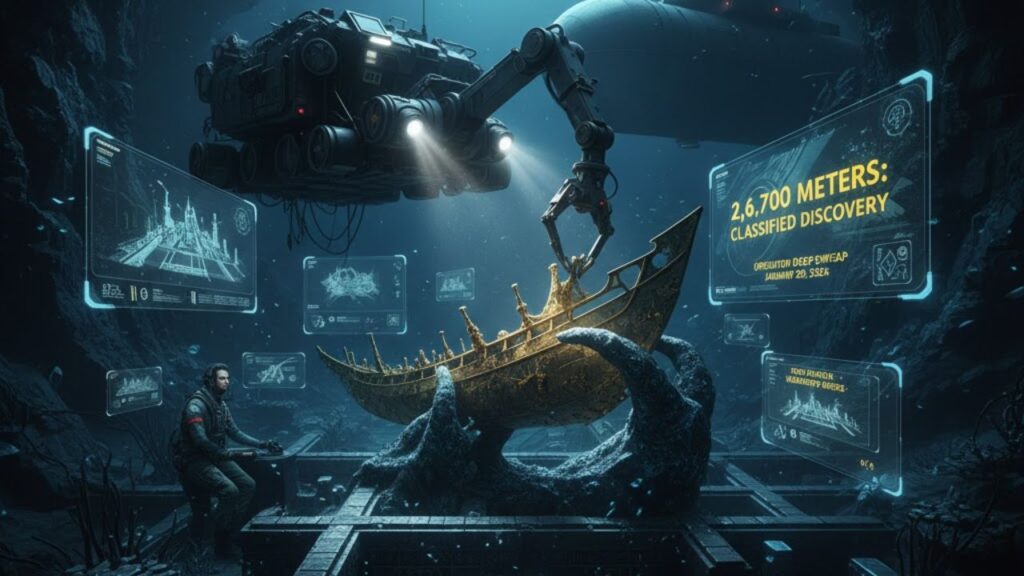
A commander broke the silence, barely audible: “That’s… architecture.” No one laughed. No one disagreed.
The images captured that night would not remain confined to secure military screens. In time, archaeologists, historians, and conspiracy theorists alike would argue over their meaning. Because what appeared on the seabed did not sit comfortably within any accepted historical timeline.

An Unlikely Structure Hidden in Darkness
The discovery began with something mundane: a glitch. During a classified sonar sweep intended for submarine navigation, operators noticed a stubborn geometric pattern nearly three kilometers beneath the waves. Assuming interference or a software fault, they ran the scan again. The shape remained unchanged.

Within hours, a remotely operated vehicle (ROV) descended, its lights slicing through water untouched by sunlight since before civilization. When illumination finally reached the seabed, the control room fell silent. Rising from the sediment was a vast stepped platform, its lines unnervingly straight for something supposedly shaped only by time and chaos.
Cameras revealed more: fluted columns half-buried in silt, blocks arranged in concentric terraces, and what looked disturbingly like a paved causeway stretching into the dark. One operator joked that it resembled a drowned city square, then quickly withdrew the remark. No one needed reminders of the myths this evoked.
As the ROV continued its slow circuit, carved edges and repeating patterns came into view — spirals, interlocking lines, symbols that matched no known modern script. A marine biologist on the secure call noted the sponges and corals fused to the stone, quietly underscoring the point: these were not recent wreckage fragments. They had rested there for an almost unimaginable span of time.
The discovery remained classified at first. Coordinates were locked down, data restricted. Yet shock has a way of spreading even in silence. A small group of archaeologists was brought in under strict nondisclosure agreements, and their reaction was not excitement, but disbelief.
Based on known sea-level histories and tectonic movement, any artificial structure at such depth would need to be either unimaginably ancient or the product of extreme geological upheaval that somehow preserved perfect right angles. Neither explanation aligned easily with established teaching.
When the images eventually leaked months later, the question shifted from “Is this real?” to “What does this do to human history?”
How a Military Mission Drifted Into Prehistory
The operation had nothing to do with archaeology. Its purpose was bluntly practical: securing underwater navigation routes for nuclear submarines and autonomous drones. Large portions of the deep ocean remain poorly mapped, and a single unseen ridge can mean catastrophe.
To address this, a new generation of high-resolution sonar paired with AI-assisted mapping was quietly deployed. The system was designed to identify hazards, not ruins. Yet powerful tools often reveal more than their creators intend. This time, the “hazard” on the map looked unmistakably like an ancient plaza.
The moment everything changed was when the AI flagged the formation as an “anomaly with low probability of natural origin.” The phrase was clinical, but its implication was clear. Somewhere between formal briefings and late-night data reviews, a realization settled in: this was not just an obstacle.

Artifacts soon followed. The ROV retrieved a tablet-like stone fragment veined with mineral deposits and an obsidian-like shard that appeared deliberately shaped. There were no treasures, no statues — only quiet evidence that intelligent hands had once worked there.
The implications spread quickly among those allowed access. If the structure predated known coastal civilizations, it suggested complex building far earlier than assumed. If not, it implied catastrophic events capable of dragging monumental architecture into the abyss while preserving its geometry. Either way, the idea of slow, linear progress from cave to city felt increasingly fragile.
Rethinking How We Search, Date, and Tell the Past
Behind closed doors, the discovery has sparked a quiet shift in archaeological thinking. Military deep-mapping systems, once reserved for defense, are now being cautiously adapted for research. The seabed is no longer treated as empty hostility, but as a buried archive.
The approach is methodical: wide sonar sweeps to identify geometry, targeted ROV dives, then detailed 3D photogrammetry. Only after months of digital reconstruction do small, precise retrievals occur. Random dredging gives way to deliberate, data-driven exploration.
For archaeologists raised on dusty trenches, the adjustment is profound. Screens replace horizons, joysticks replace trowels, and excavation sites become encrypted coordinates. Some fear the discipline’s soul is thinning. Others admit these are the tools they hoped for all along.
The temptation to see lost civilizations in every straight line is real, especially under the emotional weight of such a find. That is why the most cautious voices insist on a single word: patience.
As one marine archaeologist involved noted anonymously, “Technology gives us a searchlight, not judgment. When discoveries feel extraordinary, that’s when restraint matters most.”
Using Technology Without Letting Myth Lead
- Verify before believing: Military-grade sonar can spot geometry, but rigorous testing must come first.
- Anchor findings in data: Sediment dating, marine growth, and tectonic records ground discoveries in measurable reality.
- Expect archaeology to move offshore: Future research will increasingly blend oceanography, AI, and history.
A New Frontier and an Unsettling Question
The story of the 2,670-meter discovery is still unfolding. Locations remain obscured, raw data tightly controlled. Public statements continue to reference “geological formations under review.” Privately, few involved doubt that something intentionally built now rests where natural light has never reached.
What lingers is not only the image of a possible lost complex, but the realization that it may not be unique. The same technologies designed for silent patrols may be uncovering chapters of our past erased by floods, storms, and shifting crust.
Between defense briefings and academic debate hangs a deeper question: how will we respond if human history proves far more fragmented and fragile than our timelines suggest? Will nations compete over submerged heritage, or will this force a shared understanding that deep history belongs, imperfectly, to everyone?
The next sonar anomaly may be nothing more than a ridge. Or it may be another plaza, another staircase, another reminder that humanity has been building, losing, and forgetting far longer than our maps admit.
 Daily training after 50 rebuilds chest muscle better than bench press with safer joint positioning
Key Takeaways From the Discovery
- Military technology reveals the unexpected: Sonar and AI mapping exposed a structure at extreme depth.
- Deep-sea archaeology is emerging fast: ROVs and digital modeling are replacing blind exploration.
- Historical timelines face pressure: Such structures force renewed questions about ancient civilizations and catastrophes.
