
The sea was unnaturally still when the first unmanned vessel slipped past the carrier’s bow. There was no wake of sailors, no figures resting against railings. Just a low, grey hull slicing through the Pacific, precise and emotionless, like code given physical form. On the bridge, officers watched as its signal appeared on their displays: a US Navy warship without a crew, moving in close formation alongside one of the most powerful carrier strike groups in the world.
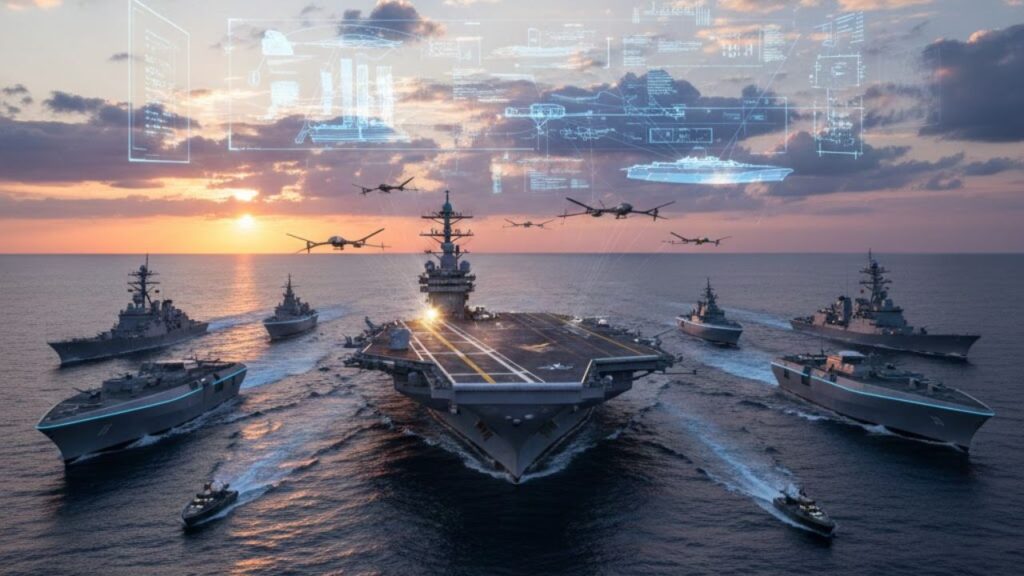
Between the steady hum of radar systems and the distant thunder of jet engines, the realization settled in. Something irreversible had started. A threshold had been crossed, and there was no turning back.
When autonomous ships joined the carrier formation
A carrier strike group is normally a masterpiece of coordination. Every maneuver, launch, and radar sweep is carefully timed and debated. For decades, the lineup barely shifted: a carrier at the center, cruisers and destroyers guarding it, supply ships trailing behind, submarines unseen below.

Now, for the first time, fully autonomous surface vessels have taken their place. These ships can navigate, sense threats, and exchange data without a single sailor at the helm. Officially, the Pentagon calls this an integrated manned–unmanned force. Among sailors, it feels more like crossing a point of no return.

Imagine a streamlined, 200-foot vessel similar to the Navy’s Ghost Fleet Overlord prototypes. No bridge windows. No living quarters. Just sensor masts, antennas, satellite domes, and inside, server racks where bunks would usually be.
During recent drills, these ships didn’t simply trail the group. They pushed forward, scouting ahead, feeding radar data back in real time, and practicing missions that once demanded a fully staffed combat center. In one exercise, an autonomous ship reportedly executed complex navigation patterns for days without human correction. It simply continued, uninterrupted.
Why the Navy is betting on unmanned hulls
The reasoning is stark. If a vessel can enter a high-risk missile zone on its own, there’s no need to risk hundreds of lives. If it carries sensors or weapons, the strike group suddenly gains extended reach and awareness.
US planners are watching the numbers: China’s expanding fleet, growing missile ranges, and the rise of drone swarms. Building more aircraft carriers on traditional timelines isn’t realistic. Autonomy offers a workaround — a way to add digital hulls faster than crews can be trained. This is no longer an experiment; it’s becoming part of standard operations.
How algorithms take the helm
There is no wheel to turn aboard these ships. Control comes from a dense web of radar, cameras, LIDAR, GPS, and infrared sensors. Their data feeds autonomy software trained to follow maritime rules, avoid collisions, and interpret traffic patterns, even in crowded waterways.
As the carrier strike group maneuvers, unmanned vessels slide into position, adjusting in real time for weather changes, fishing fleets, or shifts in formation. Humans remain involved, but at a higher level — supervising routes, approving missions, and stepping in when judgment is required.
A watch officer on a destroyer might glance at a console at 2 a.m., coffee growing cold, and see two autonomous ships operating 30 nautical miles ahead. He isn’t steering them. He’s reviewing system health, fuel status, and sensor output, managing them like remote teams rather than machines.
In one exercise, an unmanned vessel reportedly detected a simulated threat and injected the data directly into the group’s combat system. No radio chatter, no shouted commands — just instant machine-to-machine exchange. In that moment, the ship acted less like equipment and more like a silent partner.
Trust, testing, and uneasy adjustments
This capability is built cautiously. Engineers push these ships through endless edge cases: GPS failures, uncooperative traffic, sensor loss in rough seas. Legal teams wrestle with maritime law, questioning who is truly “in command” when no one stands on the bridge.
The human adjustment is just as real. Crews must learn to work alongside vessels that don’t sleep or complain. New procedures, new instincts, and new ways to override systems when something feels wrong are still taking shape. More than a few sailors admit the sight of empty decks keeping perfect station still feels unsettling.

Between hype and hard reality
Stripped of buzzwords, the approach is practical: start small, fail quietly, and scale what works. Early missions focused on simple transits, then expanded to formation sailing, threat detection, and data sharing under electronic interference.
Each deployment adds another lesson — a weather pattern learned, a vessel type recognized, a better rule for when humans should intervene. The carrier strike group is merely the most visible chapter in a process unfolding for years in test ranges and simulators.
The truth lives between extremes. Autonomous systems break. Updates introduce bugs. Calm-sea performance doesn’t always translate to storms or congested ports. Those closest to the technology describe trust as a sliding dial, not an on-off switch.
As one retired Navy captain put it, the question isn’t philosophical. It’s operational: how much risk belongs on steel, and how much on flesh?
What these ships actually do today
- Forward sensing and surveillance
- Scouting and threat detection
- Data relay and network extension
- Experimental logistics support
Where the real tension sits
The challenge lies in balancing speed and innovation with safety, accountability, and maritime rules written for ships with crews.
Why this matters beyond the military
The technologies being refined at sea — autonomy, resilient communications, human-machine teaming — are already flowing into civilian shipping, ports, and self-driving vehicles.
What the ghost ships say about us
The decision to place autonomous vessels inside a carrier strike group is more than a tactical shift. It reflects how quickly societies are willing to hand critical decisions to algorithms when pressure mounts. Conflict has always accelerated change.
There’s a quiet irony in it. The ocean once tested human judgment against storms and stars. Now, some of that uncertainty is handled by code sealed inside steel hulls, far below the deck.
Strategically, the signal is clear. The US isn’t trying to win by matching ship for ship. It’s redefining what counts as a ship at all. An uncrewed hull becomes combat power. A strike group becomes a distributed network, not a single mass.
The ethical questions follow closely. What happens when these vessels carry weapons instead of sensors? Who answers if an autonomous decision escalates a tense encounter? These issues are no longer theoretical. They sail with the fleet.
Among sailors, reactions vary. Pride, unease, pragmatism. Many see a simple trade: if an unmanned ship can absorb the first strike instead of a crewed destroyer, that’s a trade they’ll accept.
It’s the familiar feeling of a new tool quietly reshaping how people see their own role. That moment is happening now, far beyond the horizon, where a ghost-grey ship holds flawless position beside a carrier — and no one stands watch on its bridge.

| Key point | Detail | Value for the reader |
|---|---|---|
| Technological Rubicon | First-ever deployment of autonomous surface ships inside a US carrier strike group | Understand why this marks a historic shift in naval power and AI use |
| Human–machine teaming | Manned crews oversee, task, and correct unmanned vessels rather than directly piloting them | Grasp how autonomy actually works in practice, beyond the hype |
| Wider implications | Military advances in maritime autonomy feed back into civilian shipping and global norms | See how distant defense experiments may soon shape everyday technologies and regulations |
