
The café was nearly full, yet there was little real conversation. Screens glowed, AirPods were in, and fingers flicked through endless social media feeds. A delivery rider across the table scrolled through job alerts while a student beside him used ChatGPT to draft a marketing project.
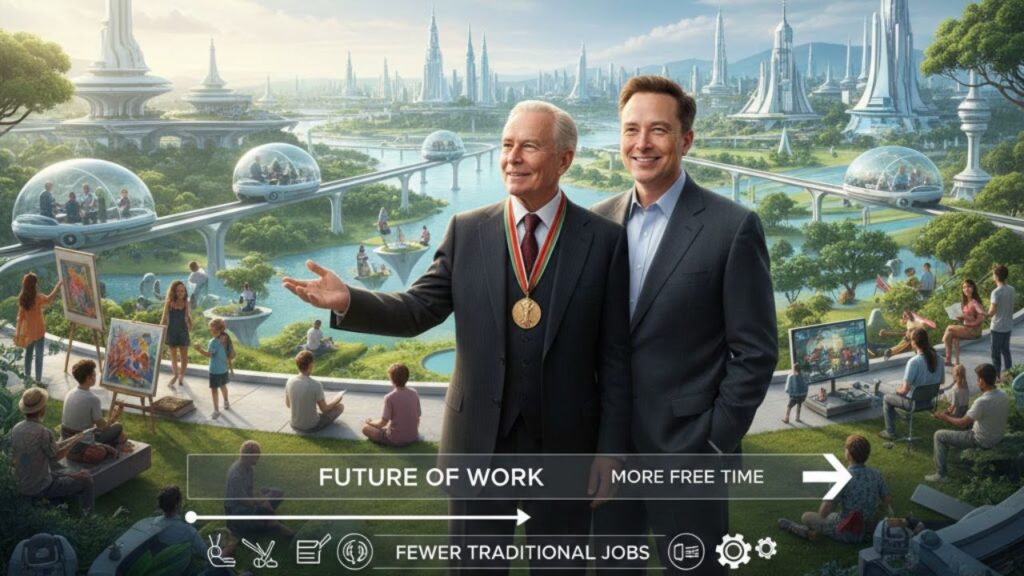
A notification popped up on my phone: a headline about a Nobel Prize-winning physicist agreeing with Elon Musk and Bill Gates. According to him, we are heading into a world with more free time and fewer traditional jobs.
The rider glanced up, watched a robot vacuum sweep across the floor, then returned to his phone. For a moment, the future didn’t feel like something out of a sci-fi film. It felt like just another Tuesday afternoon.

What the Future of Work Looks Like, According to Experts
The physicist in question is Christopher Pissarides, a Nobel laureate who specializes in understanding how jobs evolve and disappear. His message is calm, even optimistic, despite the unsettling implications.

Pissarides believes that AI and automation will eradicate many traditional “9 to 5” jobs. However, he also suggests these advancements could give us something our grandparents never had: time — time for family, personal projects, and leisure without the guilt of “doing nothing.”
His outlook aligns with the views of Elon Musk and Bill Gates. Musk frequently talks about “universal high income,” where robots and AI perform most of the labor, and Gates envisions AI as a “digital personal assistant” that handles tasks like emails and scheduling.
While they may not agree on everything, they all agree on this core idea: fewer traditional jobs, more automation, and more free time for everyone. It’s a future where the classic office job, CV, and retirement party are relics of the past.
The Reality of Living in the Early Stages of This Future
You can already see the beginnings of this shift in everyday life. The Uber driver coding on the side. The teacher running an Etsy shop powered by AI-designed prints.
Pissarides refers to this shift in cold economic terms: “labor market reallocation” and “task automation.” But at its heart, it’s a simple and slightly unsettling idea: Technology doesn’t just take jobs away; it breaks them into smaller tasks. Some of these tasks will be replaced by AI, but others — the human parts — will become more valuable.
Pissarides envisions a world where productivity soars, allowing humans to work fewer hours while still generating wealth. But the catch is clear: who benefits from these gains, and who gets left behind?
What You Can Do Right Now to Prepare for the Changing Workforce
If you strip away the jargon, Pissarides’ advice boils down to this: think of your job as a collection of tasks, not a fixed label. Ask yourself honestly: which parts of my job could be done by a smart intern or basic AI?
Next, flip the question. What parts of your work are deeply human — requiring judgment, creativity, empathy, or intuition? Every time you find yourself solving a tricky problem or making a connection that others don’t see, that’s a signal that this is where your value lies.
 Goodbye air fryer : new kitchen gadget goes beyond frying with 9 different cooking methods
One simple exercise: for a week, jot down your daily tasks in two columns: “replaceable” and “uniquely me.” Don’t overthink it; just circle what feels obvious. This is not only about protecting your job but also about understanding the future version of your role.
Small Adjustments Lead to Big Changes in the Future
Many people hear Musk or Gates and feel instantly behind, as though they should already be AI power users with multiple income streams and a perfectly optimized life. But the reality is much messier. Most workers are juggling rent, kids, parents, and burnout — and they don’t have hours each night to upskill or binge on online courses.
The smarter move is to think in small, manageable steps. Use AI to draft that tricky email. Ask it for suggestions on improving a work process. Start small and let these tiny experiments reshape your work life gradually, without overhauling everything at once.
Preparing for a Future Where Work is Less About a Job and More About Tasks
Pissarides envisions a hopeful scenario: if we manage this transition well, technology could reduce drudgery, leaving us with better-quality work and more free time. The risk, however, lies not in the machines, but in whether our systems and choices can keep up.
He emphasizes that the real challenge isn’t the machines — it’s us. How will governments, companies, and individuals respond to this shift? Musk, Gates, and Pissarides all agree: the future is programmable, and it’s up to us to shape it.
Steps to Take Now to Prepare for the New Work Landscape
- Audit your tasks: Identify which parts of your work are routine and which require human skills.
- Experiment with AI: Use tools like ChatGPT to automate tasks and practice new ways to integrate technology into your workflow.
- Leverage human skills: Focus on skills that AI can’t replicate, such as negotiation, creativity, leadership, and empathy.
- Protect your time: If technology saves you time, don’t fill it up with more work — use it to explore new skills or hobbies.
- Talk about the future of work: Start conversations at work about automation, roles, and new opportunities.
The Paradox of More Free Time and Fewer Jobs
The dream of a future with more free time sounds appealing, but there’s a catch: who pays for it? Pissarides believes the rise of AI and automation could increase productivity and fund shorter workweeks, but the rewards might be concentrated at the top. Musk’s idea of “universal high income” is one potential solution, while Gates advocates for new tax models to accommodate this new reality.
Despite the promise of more leisure, there’s an uncomfortable truth: What happens to identity, meaning, and mental health when your job is no longer your main source of status? We’ve all experienced that moment when someone asks, “What do you do?” and you feel your answer shrinking.
Embracing the Shift Toward a More Flexible, Human-Centered Work Life
As we move closer to this future, the real shift may not just be technological or economic — it’s cultural. The focus will shift from asking, “What’s your job?” to asking, “How do you spend your days?”
This change will influence how we raise children, design cities, and assign value to various roles in society. It’s not just about working less; it’s about deciding what we want to do with the extra time we gain. Pissarides isn’t promising a utopia; he’s warning that without the right policies, the benefits of this shift will remain concentrated at the top, while others may feel left behind.

Key Takeaways for the Future of Work
- AI will reshape jobs: Certain tasks will be automated, but human skills will remain in high demand.
- More free time is possible: AI-driven productivity gains could fund shorter workweeks and safety nets for all.
- Start small with automation: Use AI tools to automate minor tasks and save time for more important pursuits.
