
The first thing that hits you is the silence. It’s just sand, scorching heat, and a sky so flawlessly blue it feels surreal. Then, on the horizon, a towering silver structure pierces the desert, too high to be real, as if a skyscraper from a video game was dropped in the middle of nowhere. As you approach, it feels increasingly absurd. Gigantic construction cranes loom like dinosaurs, air-conditioned tents shelter investors, and a VIP golf cart whizzes by workers covered in dust. On a pristine billboard, a slogan reads: “Reinventing the future of humanity.”
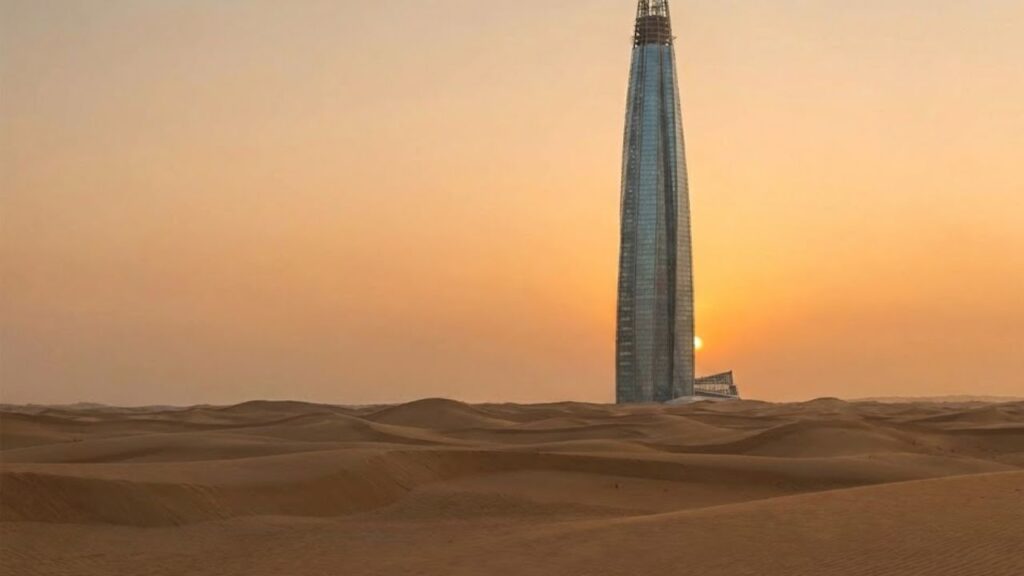
You squint at the mirage of glass and steel and ask yourself one question: Who is this really for?
A Monument to Luxury, Not Necessity
On paper, a one-kilometre tower in the desert seems like a bold achievement. Record-breaking engineering, jaw-dropping design, and a symbol of national pride—a marvel that grabs attention and sparks viral drone footage. Yet, standing in the heat with sand in your shoes, it feels strangely fragile. It’s as though a tremendous amount of money is being spent to ignore the pressing issues happening right around it.

The desert is getting hotter, the water supply is dwindling, and energy consumption is soaring. Yet, the headline here is… a luxury skyscraper.

Look at recent mega-projects in the Gulf or North Africa: massive glass towers boasting “vertical cities,” “floating forests,” and “carbon-neutral living.” On the opening day, there are fireworks, celebrity architects, and maybe an F1 driver cutting the ribbon. A year later? Half-empty office floors, evaporating artificial lakes, and workers commuting from distant dormitories. The Burj Khalifa remains only partially occupied. The Jeddah Tower has turned into a cautionary tale of delays and budget overruns. Meanwhile, the surrounding cities face real challenges: sky-high rents, soul-crushing traffic, and neighborhoods where the only shade comes from a billboard.
This is the quiet tragedy of so-called “iconic” projects. They sell an image of progress, all while sidestepping the actual work of progress. Fixing sewage systems. Cooling schools properly. Building reliable public transport instead of broadening highways that melt under the heat. A one-kilometre tower doesn’t prevent flash floods. It doesn’t cool down workers on scaffolds in August. It doesn’t make food affordable for the staff working in those skyscraper restaurants at night. It simply provides the wealthy with a higher balcony to watch the struggle below.
True Progress in a Burning World
Real progress in a desert begins 30 centimetres above the ground. With shade, wind, and water that doesn’t vanish as soon as it hits the soil. Imagine low-rise, densely-packed neighborhoods designed to capture cool air using narrow streets. Whitewashed walls reflecting the sun. Courtyards filled with trees, not LED screens.
There are engineers and planners quietly crafting this type of city: passive cooling, smart irrigation, solar panels on every rooftop, rather than one grand crown atop a single tower.
When you speak with architects working outside the spotlight of glossy conferences, they share a different vision. Modest housing blocks with every window aligned for cross-ventilation, echoing the design of traditional Arabic and Berber homes. Wind towers, used for centuries, that bring cool breezes into warm rooms. Tram lines, not heliports.
But these ideas rarely make the cover of magazines. A simple, shared, shaded bus stop doesn’t look “sexy” to investors. A cool, comfortable public park doesn’t get a Netflix documentary. So cities continue chasing the same illusion: a taller, shinier object that looks modern from the air, while people on the ground still walk along roads without sidewalks.
There’s a disconnect here. Political leaders and real estate moguls still believe that progress must be visible from space. A skyline is treated like a business card. If your country has the tallest, the longest, the most spectacular, then you’ve “arrived.”
But true progress isn’t a photo. It’s tap water that doesn’t turn brown. It’s a bus that actually arrives. It’s a neighborhood where you can walk at noon without feeling your skin burn. Let’s face it: no one really lives their life in the penthouse; they live it between their door, the street, and the places they can afford. When you plan for the helicopter view rather than the human view, you’re not creating a future, you’re just displaying a trophy.
Rejecting Vanity Projects, One Decision at a Time
The simplest way to challenge this vertical fantasy is not abstract at all. It’s incredibly simple. Next time you read about a “visionary” mega-tower or a “city of the future” in the desert, ask yourself three questions:
- Who will live there?
- Who will work there?
- Who will sweat there?
If the answers are vague, wrapped in buzzwords and renderings that show suspiciously few people, consider that a red flag. Real cities start with residents, not drone shots.
Planners and citizens fall into the same traps repeatedly. We’re seduced by the term “smart” stamped on every new project: smart roads, smart towers, smart cities in the middle of nowhere. The risk is that you end up with very smart technology wrapped around very poor decisions.
We’ve all experienced it—the moment when a new mall or business district opens and feels futuristic for six months, before traffic jams and vacant storefronts begin to appear. The lesson isn’t that progress is bad; it’s that progress without people at the center is simply marketing with concrete, and marketing doesn’t offer shade at a bus stop when the temperature hits 48°C.
Urbanist Carlos Moreno, creator of the “15-minute city” concept, summed it up perfectly: “A city that looks impressive from far away but feels hostile from up close is not a city. It is a product.”
Key Questions to Assess Real Progress
- Does the project improve daily life within a 15-minute walk?
- Is there real investment in water, shade, transit, and housing before glossy icons?
- Are local residents’ voices heard more than real estate press releases?
- Do the renderings feature real, ordinary people, or are they full of pristine images?
- Do small, human-scale improvements take precedence over a single mega-symbol?
The truth is, the knowledge to build better cities is already available to us. We know how to design cooler, more energy-efficient cities. We know how to grow food closer to where people live, recover wastewater, and reintroduce nature into our streets instead of isolating it on golf courses. We even know that smaller, slower, shadier cities tend to be healthier and less stressful. The gap isn’t technological. It’s emotional. Pride prefers a spire to a shaded alley.
So, when we cheer for a one-kilometre tower in the desert, what exactly are we applauding? Engineering brilliance? Certainly. Human stubbornness? Absolutely. But perhaps most of all, we’re cheering our own denial—the idea that if we build high enough, we can escape the consequences of how we’ve built so far.
That fantasy won’t hold. Sand and heat don’t care about records. What they respond to is respect: respect for the climate, for limitations, and for the people whose lives are played out at street level, not cloud level. The day we get excited about a cool, walkable neighborhood rather than a shiny needle in the sky will be the day progress returns to common sense.
 Why A Shrinking Human Population Won’t Automatically Save Wildlife: Lessons From Rural Japan
Summary
- Human-scale first: Focus on shade, water, transit, and housing before chasing icons.
- Question the story: Ask who will live, work, and sweat in new developments.
- Prefer many small wins: Multiple modest, local improvements trump one giant tower.
