
Not loud, not dramatic. Just a low mechanical murmur above a quiet courtyard, where laundry dries and kids’ bikes lean against stairwells. One neighbor calls it “the sound of progress,” while the woman downstairs calls it “the sound of my nerves snapping.” On the fourth-floor balcony, two small white wind turbines spin in the afternoon breeze, their owner proudly filming them for Instagram. Below, a man is on the phone with the town hall, describing “illegal industrial equipment.” Within weeks, the town orders the turbines to be dismantled. The story spreads faster than the wind that made the rotors turn. Eco-innovation or selfish overreach?
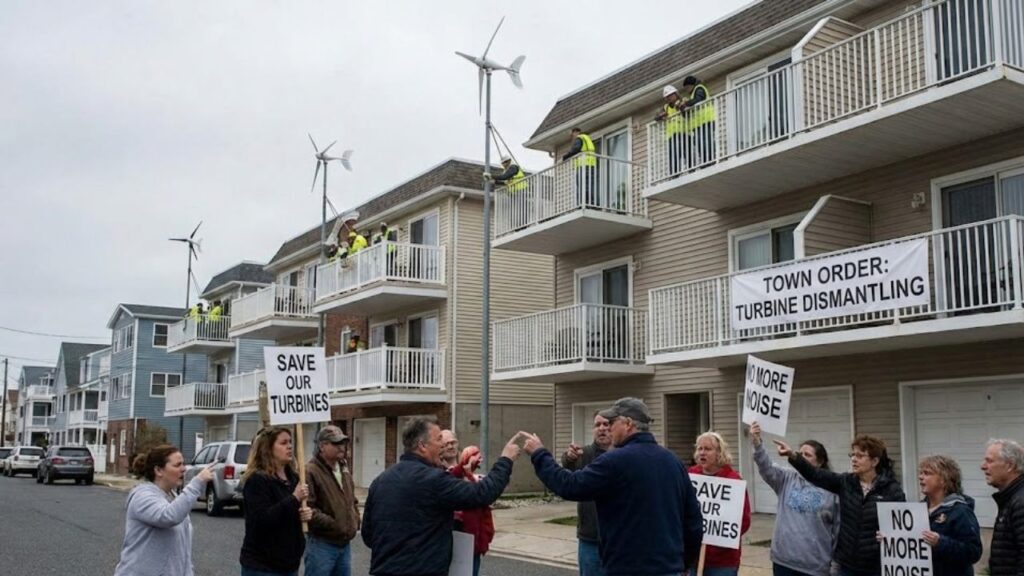
On a grey Tuesday morning in a mid-sized European town, a municipal inspector stands on the sidewalk, squinting up at a beige apartment block. From the street, the turbines don’t look dangerous at all. They appear almost toy-like, turning slowly above potted geraniums and a folding chair.
The owner, a thirty-something engineer with wire-rimmed glasses, leans over the railing, explaining enthusiastically how much carbon he’s saving. The inspector listens, takes a few photos, and hands him a notice with a polite but firm tone: the installation violates building rules and must go. The engineer folds the paper, lips tight. Somewhere between the ideal of green energy and the reality of shared walls, something isn’t lining up. The wind is free, but the balcony is not.

When Green Dreams Clash with Shared Spaces
Balcony wind turbines feel like a symbol of our time. Tiny personal power stations grafted onto the most private slice of city life: the balcony. You stand two meters from your sliding door, in slippers, and half believe you’re contributing to the grid like a mini offshore farm. It’s seductive, almost romantic.

Then you shift perspective. From the neighbor’s sofa, the view is different. Instead of open sky, there’s a set of rotating blades crossing their window frame, small but inescapable. At night, a faint shadow pulses. On still days, there’s a squeak. The neighbor who used to hear birds now tracks a constant, irregular swish. Eco-innovation looks inspiring on YouTube. In the stairwell, it can feel like intrusion.
In one recent case in Germany, a resident proudly installed compact vertical-axis turbines on his balcony, promoted them on social media, and claimed they could power his laptop and some lights. The neighbors didn’t see a clever DIY project. They saw an unapproved, noisy structure bolted into the building façade.
Complaints piled up: noise, risk in storms, even fears about flying debris. The homeowners’ association got involved, then the town’s building department. An inspection showed the mounting system hadn’t been certified for high winds. The town ordered the turbines removed. For the owner, it felt like a personal attack on his environmental commitment. For the neighbors, it felt like the building’s sanity being restored. Two parallel truths, locked in the same staircase.
The Legal and Technical Mess of Balcony Wind Turbines
From a legal and technical perspective, balcony wind turbines sit in a messy zone. Most urban building codes were written for satellite dishes, awnings, and flower boxes, not spinning generators catching turbulent city winds. Many municipalities now treat micro-turbines like small industrial equipment, especially if they’re fixed to the façade or rise above the official building outline.
There’s also the physics problem no one likes to talk about. Urban wind is chaotic. Between buildings, you get gusts, eddies, low average speeds. That means many balcony turbines produce far less power than the marketing promises — sometimes barely enough to offset a single always-on gadget. So neighbors give up peace and a bit of sky, while the actual energy gain is marginal. It’s not just a fight about noise or aesthetics. It’s a question of whether the sacrifice is worth the watts.
How to Install a Micro-Turbine Without Becoming the Villain
If you’re tempted by the idea of a wind turbine on your balcony, the first real step isn’t buying hardware. It’s talking to people. Start with the building rules and the town planning office, not the checkout page. A quick email to the housing association or landlord, asking what’s allowed on façades, can save months of conflict.

Then, think of your neighbors as stakeholders, not obstacles. Knock on their doors with a simple sketch of what you’re planning, where it will sit, and how big it is. Ask them, genuinely, what would annoy them most: noise, shadows, view. Listening at this stage is far cheaper than a forced dismantling. A smaller, slower, well-placed turbine placed a bit lower or set back from the railing might keep the peace and still scratch your eco-itch.
Most people who jump into balcony wind are not villains. They’re just excited. They’ve watched confident YouTube tutorials, read about climate anxiety, and want to act. The trap is going straight from inspiration to installation, skipping the “shared space” reality check. That’s where conflicts flare.
Common mistakes repeat themselves: choosing a model with glossy marketing but no serious safety documentation, ignoring structural loads on an old balcony, installing without any acoustic testing, or assuming “small” means automatically legal. Towns increasingly treat visible turbines like any other alteration to the building envelope. Permits, engineering checks, and neighbors’ rights to light and quiet all come into play. The boring bureaucracy exists because people live stacked on top of each other.
There’s a human layer underneath the regulations. The neighbor complaining might be caring for a newborn, working night shifts, or already stressed by city noise. When they say, “That thing drives me crazy,” they’re not necessarily anti-planet. They’re pro-sleep. An empathic approach means asking yourself: would I accept this outside my own bedroom window if someone else installed it?
The Bigger Picture: What This Conflict Reveals About Us
There’s something almost symbolic about a town ordering balcony turbines to be taken down. On paper, it reads like bureaucracy versus creativity. On the street, it feels more like a negotiation about what kind of future we’re ready to live with, literally outside our windows.
One resident’s idea of progress is another’s sense of invasion. Some will see the dismantling order as a step backward for climate action, proof that rules are stuck in the past. Others will read it as a quiet defense of shared space, a reminder that not all green tech automatically deserves a free pass in close quarters.
In the middle, a strange question lingers: If every balcony became a tiny power plant, what would our cities look and sound like? Forests of spinning blades? A soft, constant hum layered over traffic? Or would the reality be disappointingly simple — lots of expensive toys, little energy gain, and tired neighbors? Sometimes the most climate-friendly move isn’t the gadget we can brag about, but the boring insulation, the shared solar on the roof, the collective investments that don’t show on Instagram stories.
Maybe that’s why this kind of local conflict strikes a nerve. It forces us to admit that personal virtue projects, even green ones, can be just as self-centered as leaving lights on all night. The question is not just “Does this help the planet?” but also “What does this do to the people living five meters away?” On a quiet evening, with the turbines gone and the balcony bare again, that’s the thought that stays.

Key Takeaways
- Balcony wind meets strict rules: Towns often treat micro-turbines like façade alterations needing permits. Helps you avoid legal trouble and forced dismantling.
- Neighbors feel the impact first: Noise, shadows, and visual clutter matter more than brochure promises. Shows why early dialogue beats later conflict.
- Real gains are often modest: Urban wind is weak and chaotic, cutting expected energy output. Lets you judge if micro-wind is worth the tension at home.
