
The change in light arrived before anyone could explain it. A cool, metallic shade washed over the car park, birds fell silent, and nearby conversations softened into uneasy murmurs. People drifted out of cafés clutching coffee cups and phones, gazing upward with that mix of unease and curiosity we feel when something feels wrong yet irresistible. Shadows snapped into sharp focus, as if the world had suddenly switched to ultra-high definition. A dog whimpered at the end of its lead. Someone audibly gasped.
That brief moment was caused by an ordinary eclipse, lasting barely a couple of minutes.
Now imagine that darkness stretching on for a full six minutes.

The eclipse of the century: when day surrenders to night
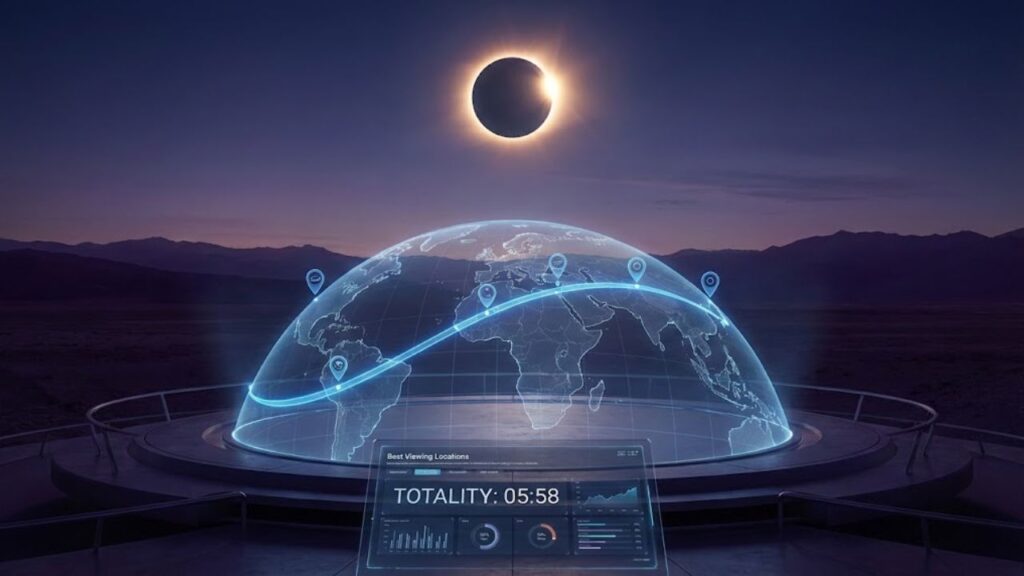
Astronomers are already whispering about what many are calling the eclipse of the century. This rare total solar eclipse will deliver an unusually long period of totality, close to six minutes, making it the most dramatic solar blackout of the 21st century. Most eclipses today offer only two or three fleeting minutes of darkness by comparison.

The date drawing quiet excitement is 25 June 2132. Current calculations from NASA and international experts suggest it will produce the longest totality of this century. It will feel like a stretched lunchtime twilight, long enough for the body to truly settle into the dark and briefly forget that it is still daytime.
To grasp how extraordinary six minutes is, think back to 8 April 2024, when North America shut down for a total eclipse that peaked at about four minutes and twenty-eight seconds. Roads clogged, schools closed, and people slept in cars just to catch those moments. Yet almost everyone agreed on one thing: it ended too soon.
Why six minutes changes everything
Accounts from longer eclipses feel almost surreal. In 2009, a total eclipse lasting six minutes and thirty-nine seconds swept across the Pacific, plunging cruise ships into midday night. Passengers spoke of temperatures dropping, quiet tears, and uncontrollable laughter as the mind struggled to process the scene. Six minutes is enough time for emotions to rise, break, and reform.
The fascination with 2132 comes down to celestial geometry. The Moon must sit at just the right distance, align almost perfectly with the Sun, and cast its shadow across observers positioned near the very center of that path. The Earth’s curve and rotation then subtly stretch the time spent inside that shadow.
This century itself is a fortunate one. The Moon is still close enough to regularly fully cover the Sun. Far in the future, only annular eclipses will remain, where a bright ring of sunlight survives. For now, we are living in a rare sweet spot, and 2132 stands at its peak.
Where the Moon’s shadow is expected to fall
For eclipse chasers, planning can begin decades or even centuries ahead. Early mapping for 25 June 2132 suggests the shadow will cross parts of North Africa and the Middle East before sliding over the Indian Ocean. The path of deepest totality usually forms a narrow ribbon, often less than 200 kilometres wide.
The most sought-after locations are those where this centerline passes over land with a history of clear skies. Preliminary projections highlight coastal stretches along the Red Sea and certain desert plateaus as promising zones. Some areas could come remarkably close to the full six-minute mark, while nearby regions still enjoy four to five minutes of sudden night.
Weather, however, remains the eternal gamble. Many still recall the 1999 European eclipse, where thick cloud robbed observers of the Sun’s corona. That experience taught veterans to trust climate data over scenic beauty. Dry regions and stable skies matter more than postcards.

Why climate matters as much as the map
Looking ahead to 2132, climate models already favor arid landscapes along the projected path. Rocky highlands above dusty basins or coastal zones where sea breezes clear haze may offer better odds. Temporary camps, mobile observatories, and even cruise ships positioned under the shadow have become part of the modern eclipse scene. Six perfect minutes of darkness are worth the effort.
Ultimately, eclipses are predictable, people are not. Some will cross continents for the experience, while others will step outside during lunch and peer up through a makeshift viewer. Both moments are valid, but only one happens inside the path of totality.
Seeing six minutes of darkness safely and fully
For anyone who chooses to chase this eclipse, preparation begins with presence, not equipment. Seasoned observers recommend mentally rehearsing the moment: deciding when to watch the sky, when to scan the horizon, and when to simply stand still.
Two essentials matter long before totality: certified eclipse glasses and accurate local timing. Space agencies release second-by-second schedules years ahead. Having that information close at hand helps calm the excitement and keeps attention on the sky as the light fades.
A common mistake is letting technology steal the moment. People fumble with tripods, scroll screens, and miss the transformation unfolding above them. A total eclipse is not routine. It deserves your full awareness.
A simple rhythm to follow
Before totality, use your eclipse glasses, take photos, and notice the strange crescent shadows under trees. In the final seconds, put devices aside. During totality, bare eyes are safe, and that is when the true spectacle appears: the Sun’s white corona, sudden stars, and a horizon glowing like a full circle sunset. When the diamond ring returns, glasses go back on.
Veteran chaser Lina Morales recalls leaving her camera behind during her second long eclipse. Those six minutes, she says, reshaped her sense of time, like standing inside a held breath.
Planning before, during, and within totality
- Before the trip: Study the path of totality, weather history, and local access. Stay close to the centerline whenever possible.
- On eclipse day: Arrive early with extra glasses, water, and a printed timing guide. Use only equipment you have already practiced with.
- During totality: Spend time with the corona, the horizon, and the surrounding sounds. Let the six minutes unfold slowly.
A shadow that belongs to no one
There is something grounding about an event calculated to the second yet experienced as pure wonder. The 2132 eclipse will outlive nearly everyone reading this, and that perspective feels oddly comforting. The maps and numbers are simply invitations to imagine someone else standing where you might have stood.
The sky does not care who is watching. The shadow will sweep across deserts, coastlines, cities, and quiet rooftops. For exactly six minutes somewhere on Earth, daylight will vanish. And someone, perhaps generations from now, will look up and whisper the same word people always do beneath a total eclipse.
Again.

Key details to remember
- Longest totality: Around six minutes on 25 June 2132, making it the longest of the century.
- Best viewing regions: Projected paths across North Africa and the Middle East, favoring dry, clear-sky climates.
- Best experience: Certified eye protection, careful timing, minimal technology, and full presence during totality.
