While filming a National Geographic series alongside Will Smith, researchers working with the production made an unexpected discovery. The team encountered a massive anaconda that not only stunned the crew but also transformed scientific understanding of these snakes and the environmental pressures they face in the Amazon.
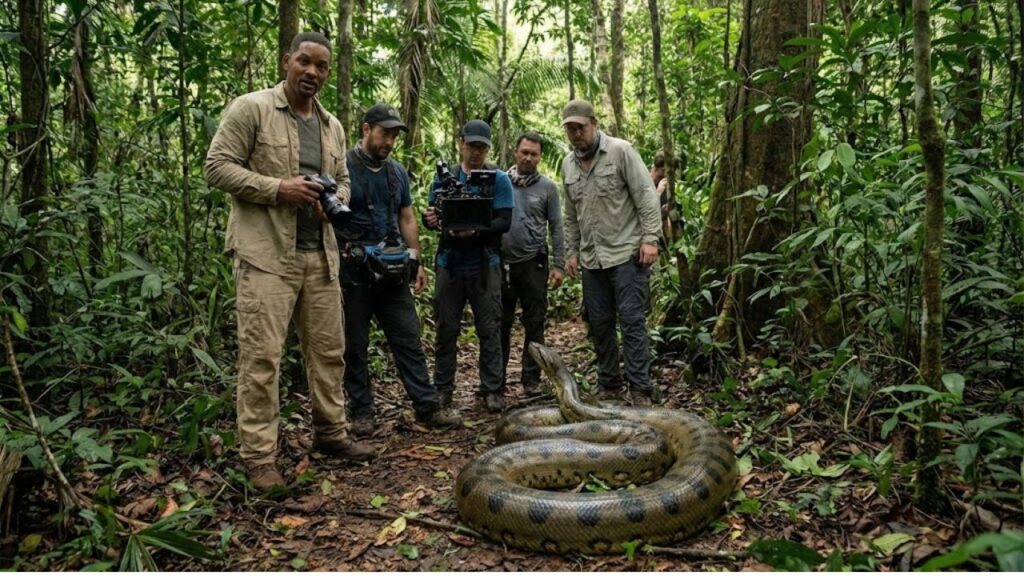
A towering snake meets a global film icon
The moment occurred during production of “Pole to Pole with Will Smith”. The crew was accompanying Professor Bryan Fry, a venom and reptile expert from the University of Queensland, who was studying the long-term impact of oil extraction across Amazonian ecosystems.
Guided by local Waorani experts, the group navigated narrow creeks and flooded forests. Conditions were extreme, with chest-deep water, dense mud, and almost no visibility. Suddenly, a huge snake form appeared beneath the cloudy surface, emerging directly in front of the divers.

The anaconda was estimated to be around 7.5 metres long, an extraordinary size even by Amazon standards.

Green anacondas are already among the heaviest snakes on the planet. A specimen of this length represents a top-tier predator in peak condition, capable of overpowering caimans, capybaras, and large wading birds.
Will Smith, present to host the series rather than handle wildlife, watched as scientists carefully worked around the snake. What began as a dramatic on-camera moment soon became the foundation for research with far-reaching implications.
How male and female anacondas differ dramatically
Fry’s team was collecting data on anacondas, including body measurements, blood samples, and skin tissue for genetic testing. The aim was to connect snake health with pollution levels in rivers influenced by nearby oil operations.
One major discovery involved stark size differences between the sexes. While popular imagery often focuses on massive females, the findings revealed a more nuanced reality.
Females typically grow to about five metres, but in some regions, males can become longer and bulkier, influencing their hunting strategies and dietary choices.
These physical contrasts lead to clear behavioural differences:
- Large males often prey on wading birds and aquatic animals that accumulate pollutants from water and sediment.
- Females more frequently hunt grazing mammals such as capybaras that feed along riverbanks.
- Larger snakes require more energy, pushing them toward prey higher up the food chain.
As apex predators, anacondas become natural indicators of environmental pollution. Toxins present in water, fish, birds, and mammals gradually build up inside their bodies.
Pollution etched into anaconda biology
The research team used these powerful reptiles as bioindicators, analysing tissue samples for heavy metals like lead and cadmium, substances commonly linked to oil extraction, spills, and industrial runoff.
Results revealed that male anacondas carried up to 1,000% higher concentrations of lead and cadmium than females living in the same environments.
This disparity is largely dietary. Wading birds absorb metals through contaminated fish, invertebrates, and sediment. When snakes consume these birds, the toxins become further concentrated.
Elevated heavy metal exposure is associated with:
- Reduced male fertility and abnormal sperm development
- Liver and kidney damage
- Hormonal disruption affecting growth and reproduction
Fry has warned that hydrocarbon pollution appears to impair male fertility in Amazonian anacondas, posing serious risks to populations already threatened by habitat loss.
Two anacondas that appear identical but are not
Beyond pollution studies, genetic testing delivered another major revelation. Samples from different river systems showed that what was long considered a single green anaconda species is actually made up of at least two distinct species.

Anacondas from Ecuador and Brazil were found to be genetically separate, despite looking and behaving similarly.
Ecuadorian snakes were generally larger, with the biggest females measuring about a metre longer than their Brazilian counterparts. The enormous snake filmed during the Will Smith project fits this Ecuadorian pattern.
The Brazilian species occupies a narrower range. Combined pressures from oil extraction, deforestation, and shrinking wetlands make its future more uncertain.
Why species separation changes conservation priorities
Recognising two separate species dramatically alters their conservation outlook. What was once considered a widespread animal now becomes:
- An Ecuadorian species with a broader but stressed habitat
- A Brazilian species with a smaller range and higher exposure to oil activity
Conservation funding, legal protections, and habitat planning often rely on species-level classification. A newly recognised species with limited distribution can quickly become a high-priority conservation case, especially when pollution threatens its ability to reproduce.
Anacondas as guardians of Amazon ecosystem health
Anacondas sit at the very top of the food web. This position gives them power, but also makes them vulnerable. They depend on healthy wetlands, abundant prey, and clean water. When oil pipelines leak or drilling contaminates rivers, the effects ripple upward.
The Waorani communities assisting Fry’s team witness these changes firsthand. Polluted waterways mean fewer fish, unhealthy livestock, and disrupted hunting grounds. The condition of the snakes, including the filmed giant, reflects the health of the entire ecosystem.
The 7.5-metre anaconda is more than a striking television moment. It stands as living proof of how deeply industrial activity can penetrate untouched rainforest.
If pollution continues unchecked, such giants may become increasingly rare, not through hunting, but because the ecological foundation supporting them begins to collapse.
Understanding heavy metals and bioaccumulation
Two scientific concepts underpin this research: heavy metals and bioaccumulation. Heavy metals, including lead and cadmium, are toxic even at low levels. In oil-producing regions, they can seep into soil and waterways, attaching to sediment and microscopic life.
Bioaccumulation explains how toxins build up over time. Small organisms absorb trace amounts. Larger animals eat many of them, concentrating metals in their tissues. Apex predators like anacondas ultimately carry the highest toxin loads.
Similar processes affect human communities that depend on contaminated rivers for food. Symptoms often develop slowly, making long-term scientific studies essential to identifying the cause.
What this discovery means for future Amazon research
Documentary expeditions often focus on capturing dramatic footage before moving on. This project demonstrated a different approach. By integrating scientists into a celebrity-led production, the team returned with data that reshapes both science and conservation policy.
Future missions could combine film budgets with long-term environmental monitoring, including regular sampling of water, fish, and apex predators. Local communities could also be trained to carry out basic checks between visits.
For anyone exploring Amazonian rivers, the lesson is clear. The most iconic animals — massive snakes, caimans, and herons — are the final recipients of everything happening upstream. Their health, numbers, and behaviour offer early warnings about the pressure facing the rainforest, long before those impacts make global headlines.