Across North America and Europe, local councils and homeowners are exploring safer ways to manage icy pavements without harming soil, pets’ paws, or vehicles. A new wave of de-icers and practical low-tech methods is transforming how we handle ice around homes and streets.
Why Traditional Rock Salt Is Losing Favor
Classic road salt, mostly sodium chloride, is inexpensive and effective but brings numerous downsides. It contaminates groundwater, dries out plants, corrodes metal and concrete, and irritates skin and paws. In cities, these effects accumulate quickly. A typical urban winter can see tens of thousands of tonnes of salt spread, much of it ending up in rivers and garden soil.
As a result, councils and residents are seeking alternatives that maintain safety while reducing environmental impact. The aim isn’t to eliminate de-icing, but to use smarter products in smaller quantities, paired with improved timing and simple traction aids.

Two Main Approaches: Melt or Grip
Winter safety strategies generally fall into two categories. The first focuses on melting ice or preventing it from bonding to surfaces. The second enhances traction, helping shoes, pram wheels, and bike tyres maintain grip even when ice remains.

Think of it as a dual toolkit: a melting agent for stubborn ice, and a grippy material for extreme cold or sensitive areas. Additionally, a proactive tactic is to prevent ice from sticking at all. Pre-treating surfaces with a liquid solution before snowfall can make shovelling easier and reduce the overall amount of de-icer required.
Softer De-Icers: Calcium Chloride, Magnesium Chloride, and CMA
Several salt-based alternatives work at lower temperatures and are gentler than traditional rock salt when applied properly.
Calcium Chloride for Extreme Cold
Calcium chloride (CaCl₂) is widely used for rapid ice removal. It draws moisture from the air and releases heat as it dissolves, allowing it to break through ice quickly. Typically sold as pellets or flakes, it works effectively down to about -32°C (-25°F), making it ideal for steps, shaded areas, and steep paths. Used sparingly, it reduces overall de-icer usage, but overuse can still harm soil and plants.
Magnesium Chloride for Pets and Plants
Magnesium chloride (MgCl₂) is favored near gardens or pet paths. It works down to roughly -23°C (-10°F) and leaves less gritty residue than sodium chloride. Veterinary groups highlight it as less irritating for paws, though ingestion of large quantities can still be harmful. Many pet-friendly products combine magnesium chloride with traction material for added safety.
CMA: The Anti-Stick Specialist
Calcium magnesium acetate (CMA) differs from chlorides. Instead of aggressively melting thick ice, it prevents snow and thin ice from bonding tightly to surfaces. It is often applied as a preventive spray on high-risk areas like hospital entrances or transit stations and is generally less damaging to soil.

| Product | Main Role | Typical Use |
|---|---|---|
| Calcium chloride | Fast melting in deep cold | Steps, steep drives, shaded paths |
| Magnesium chloride | Gentler melting | Areas with pets or plants nearby |
| CMA | Prevention and anti-adhesion | Before snow on pavements and car parks |
Beet Brine and Homemade Solutions
Beet brine, a byproduct of sugar beet processing, is increasingly used in North America. Mixed with a small amount of salt, it helps salt adhere to roads and slows refreezing, cutting overall usage. At home, beet brine is best applied sparingly on existing tarmac or concrete as a preventive measure, not on fresh concrete or delicate plants.
Homemade mixes, like lukewarm water with a splash of dish soap and rubbing alcohol, can help reduce ice adhesion on small surfaces. These should only be used on thin ice layers and followed by clearing slush to prevent refreezing.
Traction Without Melting: Sand, Ash, and Grit
When temperatures drop or moisture should be avoided, traction materials are effective.
Sand and Wood Ash
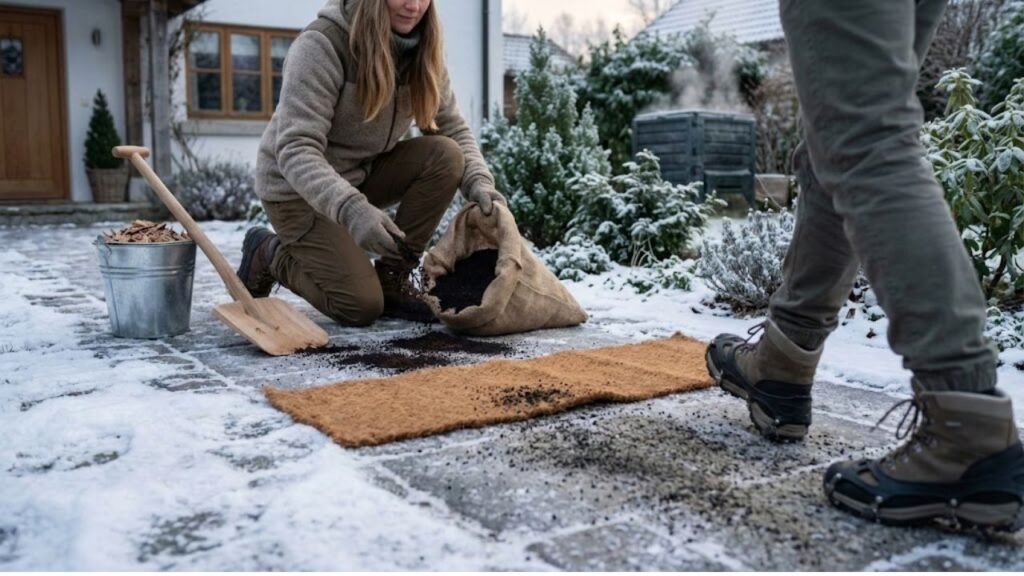
Sand offers instant grip and slightly warms icy surfaces in sunlight. Wood ash provides a similar effect at minimal cost, with the added benefit of minor de-icing through residual heat and minerals. Both need to be cleared after thawing to prevent clogging drains or making a mess.
Wood Chips and Crushed Stone
Fine wood chips and crushed stone remain stable through freeze-thaw cycles, suitable for slopes or gravel drives. “Chicken grit” or traction grit – sharp, angular granite pieces – provides strong grip without dissolving into soil. Only a thin layer is needed, and much can be reused after melting.
High-Tech Solutions: Heated Mats and Driveways
For steep paths or mobility challenges, technology can minimize chemical use. Electric heated mats can clear shallow snow and frost quickly and are rolled away in spring. Fully heated driveways and walkways, with pipes or electric cables beneath the surface, warm the area from below. While energy-intensive, these systems are useful for exposed hills or busy shared access points.