
The plastic freezer door looked ordinary enough. A plain white flap, frosted at the edges, humming softly in a marine biology laboratory in Bangor, Wales. But when a technician opened it in 2006, the contents were anything but routine. Inside was the frozen body of an animal born long before Shakespeare, before the printing press reshaped Europe, before much of the modern world existed. What lay there was a clam, roughly the size of a human hand, carefully tagged and catalogued—and unknowingly killed.
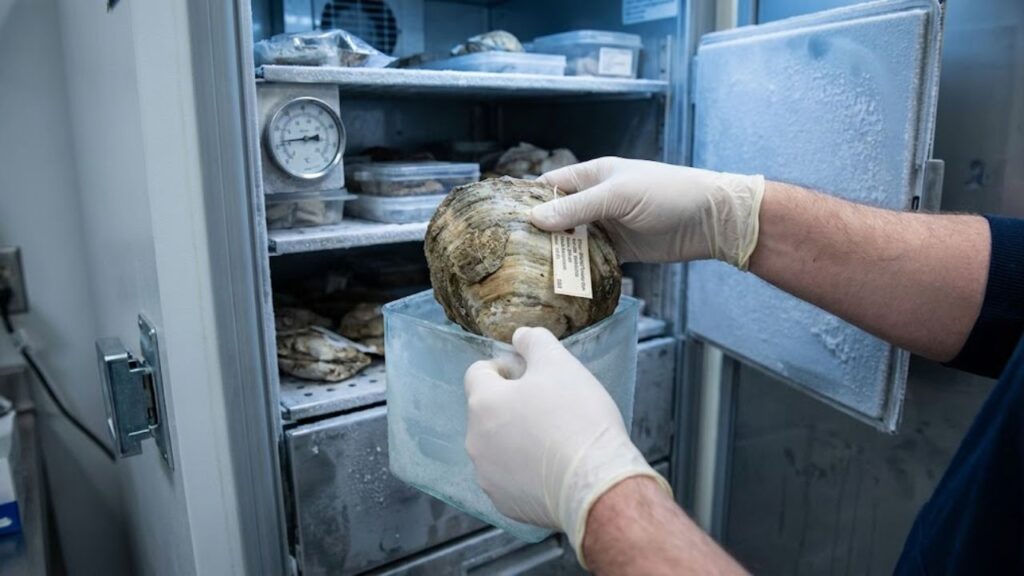
A clam that survived centuries, only to end in a freezer
The animal recovered from the seabed in 2006 seemed unremarkable at first glance. It was a quahog clam, collected from the cold waters off Iceland during a standard research cruise. One shell among many, it was placed into a tray, sealed in a bag, and stored in a freezer as part of a broader effort to study historical climate conditions.
No one paused to wonder what they were holding. No one suspected they had just ended a life that began in 1499. At that moment, it was simply another sample, another data point in a long scientific process.

When age rings revealed an unexpected history
The realization came later, when scientists counted the clam’s growth rings, similar to the rings found in trees. The numbers were startling. Further testing confirmed the finding: this clam, later nicknamed Ming, was around 507 years old. It had lived through the rise and fall of empires, centuries of storms, predators, and increasing human pollution.

After surviving half a millennium on the ocean floor, it did not survive a laboratory freezer. The equipment designed to preserve samples for science became the reason its long life ended.
The uneasy balance between discovery and loss
The story spread quickly, in part because it was unsettling. A living being that had endured for five centuries died without anyone realizing its significance at the time. Yet its shell has since been used to reconstruct 500 years of North Atlantic climate history, drawing on chemical records stored in its growth lines.
This is the tension science often faces. Research that causes harm can also generate knowledge that protects ecosystems and lives in the future. The deeper question is not only whether boundaries were crossed, but what responsibility exists toward a life ended unknowingly.
How laboratories weigh curiosity against harm
In marine biology labs, this conflict is part of daily routine. Before specimens are collected, researchers complete ethics reviews, environmental impact assessments, and detailed protocols. Forms are signed that effectively authorize the taking of life for the sake of knowledge.
In practice, these decisions are rarely comfortable. Documents are reviewed quickly, justifications are made, and expeditions move forward. Once the ship leaves the harbor and the nets are deployed, the system runs on habit and efficiency.
Why Ming’s case stands out
Ming’s death was not an isolated event, only a visible one. Other long-lived animals have met similar ends. An eel known as Topsy was discovered to be over 80 years old only after dissection. Greenland sharks, some estimated to be nearly 400 years old, are sometimes killed accidentally during tagging attempts.
In each case, the response is familiar. A brief pause, a moment of silence, followed by the phrase many researchers admit to using: “At least we’ll learn something.”

Systems, not villains, behind the outcome
On paper, ethics committees and principles such as Replace, Reduce, Refine guide scientific work. In reality, decisions are shaped by lab culture, leadership, time pressure, and the demand to publish results. Ming’s death was not the result of recklessness but of routine.
A sample was collected, processed, and frozen. Only years later, when its age was revealed, did the moral weight of that routine become clear.
Lessons from a clam that never saw daylight
A simple shift could have changed the outcome or at least softened the impact. Treating every unknown specimen as potentially irreplaceable until proven otherwise would slow the process just enough to allow attention. On research vessels, this means creating space for someone to say, “This one is different.”
On land, it means recording more than numbers. Notes such as unusual size, distinct pattern, or possible extreme age can preserve context before a specimen disappears into storage.
Small practices that reshape ethical fieldwork
- Detailed labeling with location, depth, and physical observations.
- Scheduled observation time alongside collection goals.
- Non-lethal sampling when alternatives are available.
- Teaching students to pause and observe before processing specimens.
- Open discussion about the emotional weight of killing for research.
These steps do not undo what happened to Ming, but they can influence how future discoveries unfold.
Wonder, timing, and the real ethical divide
Ming’s story occupies an uncomfortable middle ground. The clam was not targeted or mistreated, and the research it contributed to may help protect marine life from warming oceans. Yet the anonymous, automatic nature of its death contrasts sharply with the awe felt once its age became known.
The ethical divide lies between how scientists acted in the moment and how they felt afterward. Perhaps the failure was not excessive curiosity, but insufficient wonder early enough to change the outcome.
What this story asks of readers
This is not a call to abandon science. It is a reminder that curiosity works best when paired with attention. The freezer, the lab, and the procedures were not inherently wrong. What was missing was the habit of seeing life as more than data before a record made it remarkable.
When a 507-year-old clam dies unnoticed and that realization stings, it signals something important. Not to stop learning, but to push toward a form of science—and curiosity—that notices life before numbers make it famous.

Key takeaways
- Ming’s age exceeded 500 years, discovered only after its death.
- Its shell now supports climate research spanning five centuries.
- Minor changes in research habits can reduce unnecessary loss of life.
