
On a calm Tuesday afternoon, in a modest suburban kitchen, a woman named Carla is carrying out her own small revolution. On the counter sit a chipped glass bowl, a bottle of 3% hydrogen peroxide from the local drugstore, and an aging box of baking soda that has clearly been around for years. There are no flashy spray bottles or complicated routines. Just a cloudy paste, stirred carefully, driven by the focus of someone tired of buying the latest “miracle cleaner” pushed by viral ads. It feels simple, intentional, and quietly defiant.
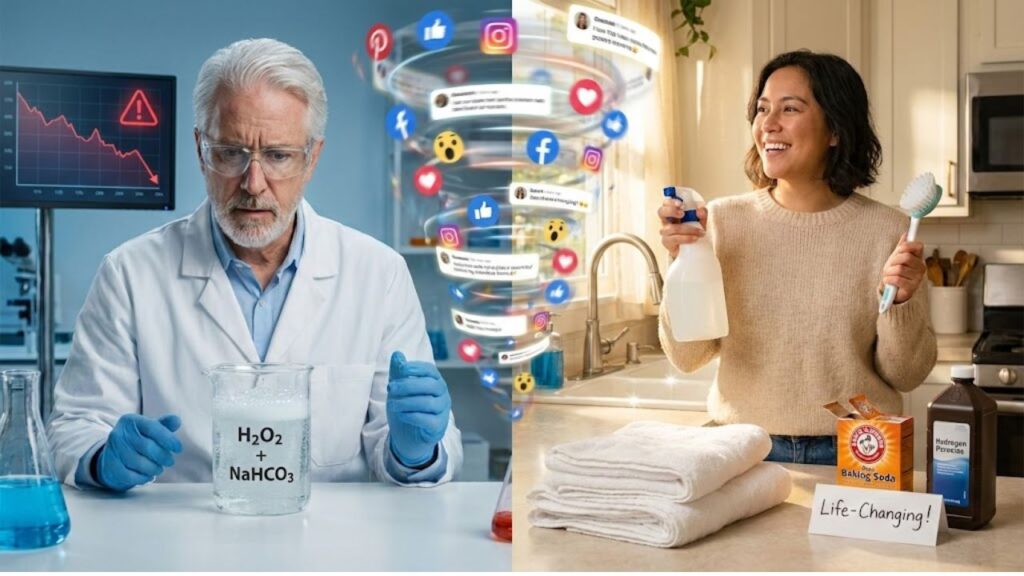
She spreads the mixture onto a stained baking tray, glances at her phone, and scrolls through glowing comments: “Game changer.” “I use this on everything.” “They don’t want you to know this.” Beyond that kitchen, however, professionals are starting to feel uneasy.
From forgotten cupboard staples to viral fix-alls
For decades, hydrogen peroxide and baking soda lived quietly in medicine cabinets and pantry corners. Now, they dominate social feeds, praised as all-purpose solutions for whiter teeth, cleaner grout, DIY hair lightening, mold removal, and even underarm “detox.” Their appeal is easy to understand. They’re cheap, familiar, and free of intimidating labels. The fizz feels honest, almost nostalgic, like rediscovering a household secret everyone somehow forgot.
 At odds with the family, one heir refuses to see the notary: can the estate still be settled?
Online testimonials stack up fast. A student shows sneakers restored to near-new brightness. A parent lifts a pan once deemed hopeless. A smiling influencer flashes visibly lighter teeth, claiming she ditched expensive kits for this $2 pairing. Beneath it all, a recurring question appears: “Why didn’t anyone tell us sooner?” For many, it feels like cracking a code and escaping unnecessary spending.
 Wrapping A “Jacket” Around Your Hot Water Tank Could Save £50–£60 On Your Energy Bill This Winter
Why professionals are sounding the alarm
While social media celebrates the simplicity, scientists and dermatologists see a more complicated picture. Hydrogen peroxide is a strong oxidizing agent. Baking soda is a coarse alkaline abrasive. Together, they can remove stains and reduce bacteria, but they can also irritate skin, weaken enamel, damage hair structure, and inflame airways, especially when used often or incorrectly.
Experts stress that the danger isn’t the ingredients themselves. It’s how easily a cleaning trick turns into a daily personal-care habit. Short videos rarely show what happens weeks or months later. The chemistry works immediately, but the consequences tend to arrive quietly.
Where it helps, where it harms, and where it crosses the line
Used carefully, the peroxide and baking soda combination can be genuinely useful around the house. A small amount of baking soda mixed with a splash of 3% hydrogen peroxide creates a paste that tackles stained mugs, grimy grout, and baked-on residue. On hard, non-porous surfaces, the mild abrasion and oxidation can be effective. Some professional cleaners rely on similar methods for stubborn messes.
Problems arise when the mixture moves from tiles and pans to teeth, gums, skin, and scalp. Dentists frequently warn about DIY whitening routines. One described a patient who followed a week-long peroxide-and-baking-soda regimen. Her teeth looked brighter, but she developed sensitivity and inflamed gums. The enamel damage was permanent. As the dentist explained, enamel does not regenerate, and repeated abrasion quietly removes that protection.

Dermatologists report similar issues with homemade hair-bleaching and skin-brightening masks. Peroxide can lighten pigment but also weakens hair fibers and dries the scalp. Baking soda disrupts the skin’s natural pH, stripping its protective barrier. The short-term results often give way to breakage, irritation, and lingering sensitivity.
Using the mixture wisely, without long-term damage
For those still interested, moderation is essential. Think of the mixture as a spot solution, not a lifestyle change. For household cleaning, many experts suggest a ratio of roughly one part 3% hydrogen peroxide to two parts baking soda, just enough to form a paste. Apply it to targeted areas like grout, oven racks, or sink stains. Let it sit briefly, scrub gently, and rinse thoroughly. Proper ventilation is important, especially in small spaces.
When it comes to personal care, caution becomes even more critical. Dentists may allow occasional baking soda use for surface stains, but routine peroxide exposure raises concerns. Dermatologists typically recommend proven, gentle products rather than alkaline powders and oxidizers. Anyone experimenting should patch-test first, limit contact time, and stop immediately if burning or redness occurs.
- Reserve it mainly for household cleaning, not daily body use.
- Only use 3% hydrogen peroxide; stronger concentrations are unsafe without training.
- Limit frequency; occasional use is very different from daily application.
- Listen to warning signs like stinging, tightness, or sensitivity.
- Consult a professional before adopting long-term routines.
What this viral duo reveals about modern habits
The popularity of this pairing reflects more than chemistry. It highlights a growing frustration with expensive products, confusing claims, and constant marketing. Two basic ingredients feel like reclaiming control. The fizzing reaction offers a sense of victory, a belief that the system has been outsmarted.
Experts aren’t declaring the duo forbidden. They’re emphasizing that context and restraint matter. Used appropriately, hydrogen peroxide and baking soda can be safe, affordable, and effective. Pushed too far, they can quietly cause damage that takes far longer to fix than it did to create. In the end, the real lesson may be less about cleaning hacks and more about balancing trust, thrift, and respect for the body’s limits.

| Key point | Detail | Value for the reader |
|---|---|---|
| Best uses for the duo | Targeted cleaning on hard, non-porous surfaces (grout, pans, sinks) with a mild paste of 3% peroxide and baking soda | Readers know where the mix really shines without unnecessary risk |
| Where risks increase | Repeated use on teeth, skin, and hair can damage enamel, barrier function, and hair structure over time | Helps people avoid turning a quick hack into a harmful routine |
| How to stay safe | Use low concentrations, short contact times, patch tests, and professional guidance for any long-term or body-related use | Offers a practical framework to keep experiments from spiraling out of control |
