Aviation leaders increasingly treat additive manufacturing as a core industrial strategy, not a novelty. The focus has shifted from experimentation to measurable gains in weight reduction, emissions cuts, and supply reliability. The real discussion today is not whether 3D printing belongs in aerospace, but how extensively it can reshape aircraft design and production.
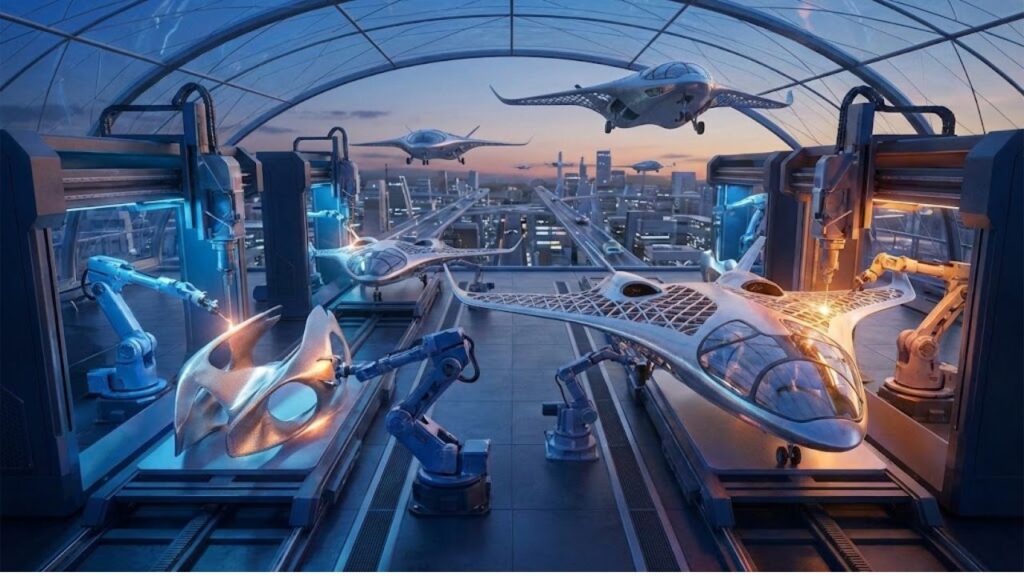
Additive manufacturing gains altitude in aerospace
Additive manufacturing, commonly called 3D printing, produces components by building material layer by layer rather than cutting away from a solid block. Material is deposited only where required, eliminating the waste associated with milling large titanium billets down to much smaller final parts.
This approach rewrites traditional design constraints. Engineers can now create complex internal channels, lattice frameworks, and organic geometries that were once impractical or impossible with conventional machining. In aviation, where every gram must earn its place, this design freedom delivers clear advantages.

Lightweight, on-demand components directly address two long-standing aviation challenges: fuel consumption and supply chain vulnerability.

Aerospace manufacturers rely on high-performance printable materials, including titanium for strength and corrosion resistance, aluminium for mass reduction, cobalt-chrome for heat and wear tolerance, and advanced composites for targeted stress areas. These materials allow printed components to withstand the intense mechanical and thermal demands found in engines, landing gear, and structural assemblies.
The additive campus model reshapes production
Safran’s Additive Manufacturing Campus in Bordeaux illustrates how the technology is being industrialised. Opened in 2022, the site brings together design engineering, materials research, production, and quality assurance within a single integrated environment. Its purpose is to move additive manufacturing from isolated trials to certified, large-scale output.
One notable example involves a titanium landing-gear component. Under traditional manufacturing, the part began as an eight-kilogram metal block. After redesign for additive production, the same function is achieved with just five kilograms. Safety margins remain unchanged, but the aircraft carries three kilograms less weight on every flight.
While a few kilograms may seem insignificant in isolation, the cumulative effect across hundreds of parts and thousands of flights leads to substantial fuel savings and lower carbon emissions.
The campus also reflects a strategic response to recent global disruptions. Localised printing reduces reliance on distant subcontractors, limits exposure to shipping delays, and cuts lead times previously tied to specialised tooling and transport.
Why aircraft manufacturers invest in additive manufacturing
For aerospace companies, additive manufacturing now functions as both an innovation platform and a risk-management tool. Its advantages span multiple stages of aircraft development and operation.
- Material efficiency improves by using only the metal required for the finished part
- Development timelines shorten as prototypes are produced in days rather than weeks
- Design flexibility increases without the need to discard costly moulds or fixtures
- Production can be relocated closer to final assembly locations
- Long-term maintenance is supported by printing spares for aging aircraft fleets
Lighter aircraft support lower emissions
The aviation industry faces growing pressure to reduce greenhouse gas output. While alternative fuels and electric propulsion attract attention, basic physics still applies: a lighter aircraft burns less fuel. Additive manufacturing contributes quietly but effectively to this goal.
By replacing solid sections with internal lattice designs, printed brackets and supports retain stiffness while using less material. Complex systems such as fuel lines or hydraulic manifolds can be consolidated into a single printed component, reducing joints, fasteners, and potential leak points.
Safran integrates these incremental gains into a broader decarbonisation strategy. Over an aircraft’s lifetime, every kilogram saved can prevent tens of thousands of litres of fuel from being burned, reinforcing improvements achieved through engine efficiency and aerodynamic refinements.
Although not a standalone solution, additive manufacturing amplifies the impact of other efficiency measures. It also reduces material waste. Traditional machining can discard up to 90 percent of high-value metal as scrap, whereas additive methods typically require only minimal excess material, much of which can be recycled.

From early prototypes to flight-critical components
Initial excitement around 3D printing centred on plastic prototypes and consumer products. Aerospace applications operate at a far higher standard. Components must endure pressure cycles, temperature extremes, fatigue loads, and rigorous certification processes.
Facilities like the Bordeaux campus combine digital design with extensive testing to meet these demands. A typical approval pathway includes:
- Concept design tailored for additive production
- Simulation of deformation, vibration, and long-term stress
- Initial builds to verify accuracy and surface quality
- Mechanical and thermal testing, including destructive analysis when required
- Regulatory certification before flight approval
- Serial production with locked quality controls
This deliberate progression explains why adoption feels steady rather than rapid. Every printed component must prove its reliability before being cleared for service.
Supply chains evolve through digital manufacturing
Recent disruptions exposed weaknesses in long, specialised aerospace supply chains. Additive manufacturing offers a practical alternative by replacing physical stockpiles with digital inventories.
Instead of storing thousands of spare parts, manufacturers can secure design files and print components near maintenance locations using certified machines and approved powders. This approach shortens aircraft downtime and reduces warehousing requirements.
Over time, some of the most valuable aerospace assets may exist not in storage facilities, but as encrypted design data held on secure servers.
The shift carries geopolitical implications as well. Regions that host advanced additive facilities gain leverage by offering rapid delivery, local employment, and tighter control over critical components.
Challenges, constraints, and future direction
Additive manufacturing is not without limitations. Printed metal parts still require extensive post-processing, including heat treatment, machining, and inspection. Equipment costs remain high, powder handling demands care, and quality assurance standards are strict.
Workforce adaptation is another hurdle. Machinists must learn additive techniques, designers must rethink long-established constraints, and regulators must address defects unique to layered materials, such as porosity or bonding inconsistencies.
These demands are also creating new roles, including additive process engineers, powder specialists, and data experts who link machine output with digital models of each component.
Essential concepts shaping additive aviation
Several terms now define the intersection of aerospace and additive manufacturing:
- Topology optimisation: software-driven shaping that places material only where loads require it
- Powder bed fusion: a laser or electron beam process widely used for aerospace-grade metal parts
- Support structures: temporary printed elements removed after production
- Digital thread: a continuous data record tracking a part from design through service life
Looking ahead, manufacturers envision scenarios where certified facilities print critical components on demand, even in remote locations. Instead of extended groundings, aircraft could return to service within days. That operational resilience captures the promise aerospace firms see in additive manufacturing.