As European governments struggle to meet climate goals and debate nuclear energy and carbon pricing, another major player has moved far faster. This country now dominates global renewable energy expansion and continues to widen its lead year after year. Through sustained investment and rapid deployment, it has reshaped the balance of clean power worldwide.
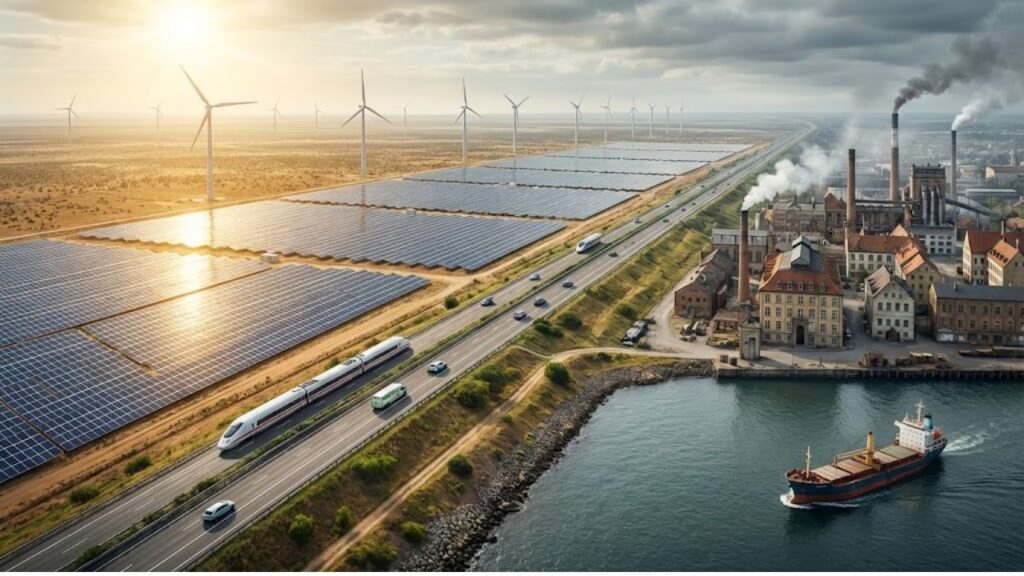
China quietly emerges as the global renewable leader
When asked which country produces the most renewable electricity, many people point to Norway, Iceland, or Sweden. These nations benefit from abundant hydropower, low populations, and long-standing clean-energy systems. Yet the actual leader is far less expected: China.
China now generates more renewable electricity than the entire European Union. This includes wind, solar, hydropower, and a fast-growing share of modern bioenergy. In both wind and solar, the country installs more new capacity each year than any other economy, placing it firmly at the center of the global clean-energy transition.

Years of planning drive an unmatched expansion
China has become the world’s largest renewable-power producer, adding roughly two-thirds of new global wind capacity in recent years. This shift was not sudden. It followed two decades of heavy investment, long-term industrial planning, and strong state-backed financing.

Chinese manufacturers and developers scaled production at unprecedented speed. The outcome has been lower global prices for solar panels and wind turbines, while the performance gap with Europe has steadily widened. What began as domestic policy has reshaped international energy markets.
Wind and solar show where China pulls ahead
Onshore wind turbines now stretch across the northern plains of Inner Mongolia and Xinjiang. Offshore wind farms rise rapidly off the coasts of Jiangsu and Guangdong. In both cases, construction advances at a pace European developers struggle to match.
Wind power highlights the contrast. In France, wind provides about 10% of total electricity. In China, wind already accounts for a higher share in several provinces, with national capacity continuing to grow at speed.
Solar expansion accelerates nationwide
Solar development follows a similar pattern. Rooftop panels cover factories, warehouses, and newly built housing. Vast utility-scale solar parks fill deserts in Gansu and Qinghai, feeding power into ultra-high-voltage transmission lines that carry electricity to coastal megacities.
Each year, China adds more solar capacity than the next several countries combined. This scale has pushed global panel prices sharply downward, reinforcing China’s dominance across the renewable supply chain.
Industrial control lowers costs and speeds deployment
These renewable projects rely on a supply chain that China largely controls, from polysilicon and wafers to finished modules and inverters. This industrial strength allows new installations to move faster and cost less than in many Western markets.
The result is not only rapid domestic growth but also growing influence over global clean-energy manufacturing.
Europe and the United States remain major players
The United States and the European Union still rank second and third globally in renewable electricity production. Both host advanced technologies and ambitious climate policies. However, their growth curves are flatter than China’s.
While investment continues, momentum has slowed, especially as costs rise and projects face increasing delays.
Why Europe is losing ground
Europe began early, driven by strong feed-in tariffs in Germany and Spain and generous offshore wind support in the North Sea. Over time, progress has slowed due to multiple structural challenges.

- Lengthy permitting processes delay projects for years.
- Grid connections struggle to keep pace with variable renewable output.
- Higher financing costs increase overall project expenses.
- Local opposition limits onshore wind and new transmission lines.
In the United States, low-cost gas and shifting federal politics complicate long-term planning. Some states push ahead, while others remain tied to coal and gas, creating uneven national progress.
The numbers behind the global green shift
Global energy agencies highlight a clear trend: almost all new electricity capacity added worldwide in recent years comes from renewables, with China responsible for a large share.
- China: Solar, wind, and hydro with rapid annual expansion.
- United States: Wind and solar with steady but uneven growth.
- European Union: Wind, solar, and hydro with continued but softer momentum.
These outcomes reflect national choices. China treats renewables as both a climate solution and a strategic industry, supported by state-owned banks and clear long-term planning.
Why China is betting heavily on clean power
Several factors drive China’s renewable push. Severe air pollution in major cities sparked public anger a decade ago, making smog reduction a political priority. At the same time, the country seeks to reduce dependence on imported coal, oil, and gas.
Renewables address both concerns. They cut local pollution and reduce exposure to volatile global fuel markets. They also position China to dominate emerging industries such as batteries, electric vehicles, and grid equipment.
Environmental trade-offs and global impact
The rapid pace of construction comes with costs. Large hydro projects flood valleys and displace communities. Solar farms alter fragile desert ecosystems. Despite these trade-offs, the scale of deployment has shifted the global emissions trajectory faster than many expected a decade ago.
What this means for Europe’s energy future
Europe now faces a clear choice: accept a weaker position in clean technology or adjust policies to compete more effectively. This does not require copying China’s state-led model but does demand simpler permitting and clearer investment signals.
Faster approvals for onshore wind, coordinated offshore grid planning, and joint procurement of critical materials could alter Europe’s path. Stronger industrial support may also help European manufacturers compete with lower-cost imports.
Key concepts shaping the energy debate
Two technical terms appear repeatedly: capacity and intermittency. Installed capacity measures maximum possible output, while intermittency describes variable generation when wind and sunlight fluctuate.
To manage this variability, grids rely on storage, flexible power plants, and long-distance transmission. China emphasizes ultra-high-voltage lines, Europe prioritizes cross-border trade and storage, and the United States balances regional approaches.
What could happen next
If China maintains its current pace, power-sector emissions could peak well before 2030, easing global warming projections even as coal remains part of the mix. At the same time, China may tighten control over clean-tech supply chains.
For Europe and the United States, this could mean rising trade tensions alongside continued cooperation on climate goals. For households and businesses, it signals more rooftop solar, greater price fluctuations, and new opportunities to earn by adjusting electricity use through smart technologies.