Far away from skyscrapers and air-conditioned shopping centres, engineers are constructing one of the most ambitious energy projects ever attempted. Deep in the desert, a massive solar complex is taking shape with a bold goal: to deliver round-the-clock clean electricity with the same reliability traditionally associated with fossil-fuel power stations. Designed to operate day and night, the project aims to prove that solar energy can serve as a stable backbone of a national power grid, not just a daytime supplement.
A desert project setting a global benchmark
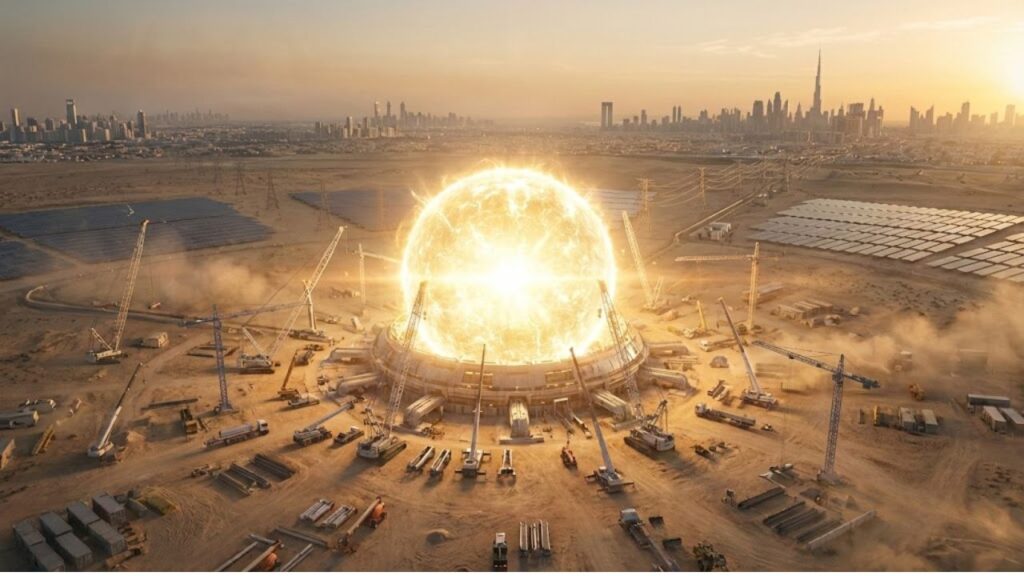
At the centre of this effort is Khazna Solar PV, a vast renewable energy facility under construction in the United Arab Emirates. Spanning roughly 90 square kilometres in the Abu Dhabi desert, the site rivals the footprint of a major city. Once completed, it is expected to become the largest solar power plant in the world, pushing the boundaries of what utility-scale solar can achieve.
The project is being developed by Masdar, alongside Engie and the Emirates Water and Electricity Company (EWEC). Their shared objective is to demonstrate that solar power, when combined with advanced storage, can function like a fully dispatchable power station rather than an intermittent energy source.

Khazna is engineered to supply 1.5 gigawatts of low-carbon electricity continuously, operating 24 hours a day, seven days a week. Achieving this level of constant output using solar energy alone would be unprecedented. With commissioning planned for 2027, the project supports the UAE’s efforts to reduce its reliance on gas-fired power plants.

Millions of panels creating a man-made sun
To reach its ambitious targets, Khazna Solar PV will deploy around three million photovoltaic panels across the desert landscape. Each panel converts sunlight into electricity, and together they form an immense reflective field that functions like an artificial sun spread across the sand.
What sets this facility apart from conventional solar farms is its ability to keep producing power after sunset. Instead of output dropping to zero at night, Khazna will depend on large-scale electricity storage systems to maintain supply during darkness and cloudy conditions. By combining solar generation with advanced batteries and intelligent grid controls, the plant is designed to deliver steady, uninterrupted electricity.
The goal is straightforward: provide non-stop solar power at a scale capable of supplying entire cities. Once operational, the plant is expected to meet the electricity needs of around 160,000 households across the Emirates. Environmentally, this translates into avoiding more than 2.4 million tonnes of carbon dioxide emissions each year, comparable to removing roughly 470,000 petrol or diesel vehicles from the roads.
Why continuous solar generation is a breakthrough
Traditional solar facilities perform best under clear skies and strong sunlight. However, when evening arrives or clouds gather, output falls sharply, forcing grid operators to rely on gas, coal, or nuclear plants to maintain supply.
Khazna follows a different approach. By integrating massive solar capacity with energy storage and smart management systems, the plant behaves more like a conventional power station that can be planned and relied upon. This reliability makes renewable energy easier to integrate into the grid and reassures both industries and households that moving away from fossil fuels does not mean unstable power or blackouts.
Advanced technology beneath the desert surface
The concept of an “artificial sun” goes beyond sheer size. The Khazna site will incorporate a range of cutting-edge technologies designed to maximise output and maintain efficiency in harsh desert conditions.
- Solar tracking systems that rotate panels to follow the sun throughout the day.
- High-performance inverters that convert direct current into grid-ready alternating current while stabilising voltage and frequency.
- Digital monitoring platforms capable of tracking performance at the individual panel level.
- Predictive maintenance tools that use data analysis to identify potential faults before failures occur.
Solar tracking plays a key role in boosting generation. Fixed panels only operate at peak efficiency for a short period around midday. By contrast, automated trackers allow modules to tilt and pivot from morning to evening, capturing more sunlight and reducing pressure on batteries after sunset.
Managing heat, dust, and sand
Constructing a massive power plant in the desert presents unique challenges. Sandstorms, airborne dust, and extreme heat can significantly reduce performance if left unaddressed.
To counter these risks, engineers are expected to use several strategies:
- Robotic cleaning systems that remove dust while minimising water use.
- Anti-soiling coatings on panel surfaces to limit dirt accumulation.
- Cooling solutions for inverters and batteries to ensure reliable operation in temperatures exceeding 45°C.
In arid regions, water conservation is critical. Many large solar installations are shifting towards dry or near-dry cleaning methods, using mechanical brushes and small amounts of recycled water to keep panels clear without competing with urban or agricultural needs.
 The pressure is mounting on Nasa: the space station is nearing its end and no successor is secured
Understanding what 1.5 gigawatts represents
Power figures can feel abstract, so putting them into context helps. Khazna’s planned 1.5 GW of firm capacity is equivalent to multiple traditional energy sources.
- Large gas-fired power plants: roughly two to three facilities.
- Modern nuclear reactors: approximately one large reactor.
- Onshore wind turbines: several hundred units.
For the UAE, which has long depended on natural gas to power cooling systems and heavy industry, a solar project of this scale can meaningfully shift the electricity mix toward renewable energy. It also frees up gas for export or for uses that are harder to electrify.
Desert solar in the global energy transition
The Middle East is not alone in viewing sun-rich deserts as engines of clean energy. Similar large-scale solar and storage projects are emerging in North Africa, Australia, China, and the American Southwest.
The reasoning is clear: deserts offer abundant sunlight, relatively low land costs, and fewer conflicts with farming or housing. However, challenges remain, including long-distance grid connections, environmental impacts on sensitive ecosystems, and questions about who ultimately benefits from the electricity produced.
Supporters see Khazna not only as a domestic energy asset but also as a global showcase. As countries pursue aggressive climate targets, scalable models for 24/7 solar power could become a valuable export.
Challenges and open questions
Like all mega-projects, Khazna carries risks. Large-scale battery systems raise concerns around raw material sourcing, recycling, and long-term safety. Extreme weather events, from intense sandstorms to record heatwaves, will test both hardware and software resilience.
Financial considerations also play a role. Solar-plus-storage facilities require significant upfront investment, with returns spread over many years. Success depends on regulatory stability, long-term power purchase agreements, and confidence that future electricity demand will support the scale of development.
The outcome of Khazna will likely influence global investor confidence in round-the-clock solar power.
Core ideas behind an “artificial sun”
Several key concepts underpin projects like Khazna:
- Photovoltaic panels: semiconductor devices that convert sunlight directly into electricity.
- Grid-scale energy storage: large battery systems that store excess power and release it when needed.
- Capacity versus energy: capacity measures maximum power output at a moment, while energy reflects total electricity produced over time.
When planners state that Khazna can deliver 1.5 GW continuously, they are referring to the combined effect of solar generation and storage that keeps usable capacity near that level day and night.
In practical terms, this mirrors a city’s daily rhythm: cooling systems peaking at midday, offices operating through the afternoon, and households drawing power in the evening. While conventional solar supports only part of this cycle, an artificial sun extends clean energy across most of the day, reducing reliance on fossil-fuel power plants.