Behind closed doors, senators, lobbyists, and leaders in the space industry are increasingly uneasy about a looming problem: a future where US astronauts may have no permanent home in orbit. The International Space Station is approaching retirement, while its replacements remain unfinished concepts. Caught in between is NASA, facing pressure to prevent a break in continuous human presence above Earth.
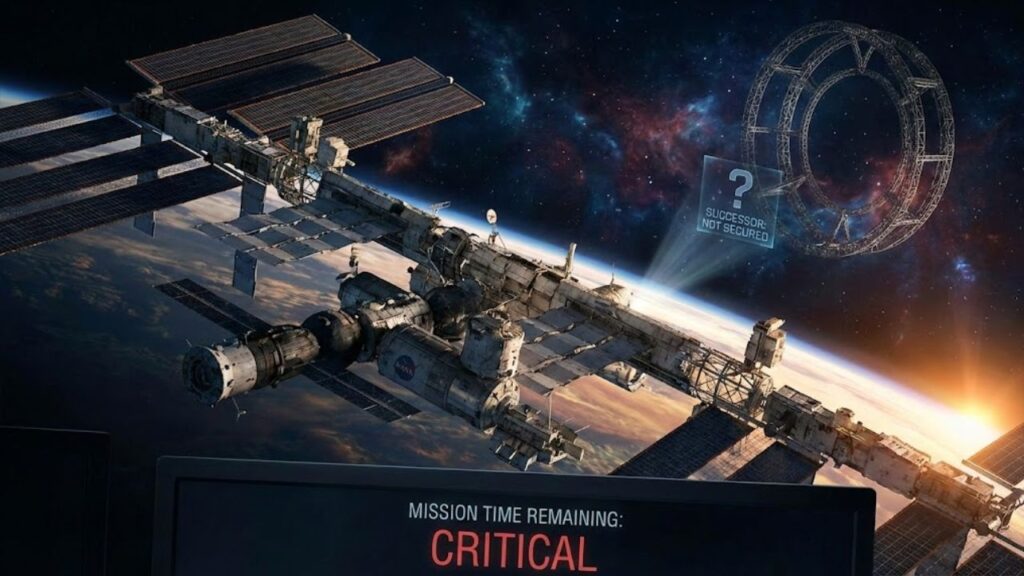
The International Space Station Nears Its Final Chapter
The International Space Station (ISS) was never designed to last indefinitely. It is an aging, complex structure that requires constant care just to remain operational. Partner agencies have agreed to keep it active until 2030, after which it will be deliberately guided into Earth’s atmosphere, where most of it will burn up over the ocean.
This plan is already in motion. Aging hardware, rising maintenance costs, and accumulating minor faults mean the ISS demands continuous attention. From replacing power systems to sealing air leaks and monitoring micrometeoroid damage, the station requires ongoing intervention simply to stay safe.

When the ISS is finally deorbited, Earth will lose the only orbital laboratory that has hosted continuous human habitation since 2000. The controlled descent is intended to prevent debris from falling over populated areas, but once the station is gone, the United States will lose its sole permanent foothold in low-Earth orbit.

Lawmakers Push to Avoid a Human Spaceflight Gap
The prospect of an empty orbit has unsettled lawmakers. In the US Senate, aides working for Texas Republican Ted Cruz, who plays a key role in overseeing space policy, have begun delivering unusually direct warnings to NASA.
Senior staff have stressed that the agency must ensure no interruption in human presence in orbit. Their message is clear: when the ISS is retired, American astronauts should already be living and working aboard a new platform, not waiting on Earth.
For Texas, the concern extends beyond symbolism. Houston’s Johnson Space Center anchors the nation’s human spaceflight operations. Any pause in missions could translate into fewer contracts, reduced employment, and diminished influence over future crewed programmes.
Lawmakers are determined to avoid a repeat of the post-shuttle era. After the space shuttle retired in 2011, NASA relied for nearly a decade on Russia’s Soyuz spacecraft to reach orbit, a dependence many in Washington now view as a costly mistake.
NASA’s Strategy for Commercial Space Stations
NASA’s primary solution is a programme known as Commercial LEO Destinations (CLD). Instead of constructing another government-owned station, the agency plans to rely on privately built and operated outposts in low-Earth orbit.
Three major contenders currently dominate the field:
- Orbital Reef, led by Blue Origin and Sierra Space
- Starlab, developed by Voyager Space in partnership with Airbus
- Axiom Space, which is already constructing commercial modules designed to initially attach to the ISS
Under this approach, NASA would shift from owner to customer, purchasing crew time, research access, and cargo services while directing public funding toward deep-space goals such as the Moon and Mars.
The challenge lies in timing. With the ISS expected to retire around 2030, commercial stations must be operational, certified, and safe before then to prevent a gap.
Can Commercial Space Move Fast Enough?
Transforming ambitious designs into working orbital habitats is a slow and demanding process. It requires the development of life-support systems, power infrastructure, docking mechanisms, radiation shielding, and extensive safety testing.
Current timelines leave little room for delay. Technical setbacks, funding shortfalls, or launch failures could easily push operational readiness beyond 2030. The industry also depends heavily on a limited number of launch providers, with SpaceX playing a central role in both crew and cargo transport.
Beyond NASA contracts, companies must also establish sustainable business models. While tourism, manufacturing, and media projects are often mentioned, none of these markets yet exists at meaningful scale.

Growing Competition in Low-Earth Orbit
While the United States weighs its options, other nations are moving ahead. China already operates the modular Tiangong space station and has opened it to international partners. Russia has signalled interest in a future national station, though its timelines remain uncertain.
If the ISS is deorbited without a US-backed replacement ready, the symbolic impact would be significant. China could become the only nation with a permanent human presence in orbit, gaining scientific and diplomatic influence.
The concern in Washington extends beyond research. Norms governing debris management, satellite servicing, on-orbit construction, and even military behaviour are shaped by those with continuous operational experience in space.
Pressure Mounts for Faster Decisions
Lawmakers are urging NASA to accelerate the commercial station effort with clearer milestones, firmer deadlines, and potentially stronger funding commitments.
This creates a delicate balance. Moving too slowly increases the risk of an orbital gap, while moving too quickly could commit billions to systems that are not yet fully proven.
Inside NASA, managers must weigh these pressures while also funding Artemis lunar missions, Mars planning, Earth observation satellites, and numerous other projects competing for limited resources.
Why Continuous Presence in Orbit Matters
Permanent habitation in orbit supports critical research into bone density loss, fluid shifts in the human body, advanced materials, and protein crystal growth for drug development. Many experiments depend on long-term, repeated exposure to microgravity.
A multi-year break between the ISS and its successors could disrupt research continuity and weaken training pipelines for astronauts and flight controllers.
Key Terms Shaping the Debate
- Low-Earth orbit (LEO): The region roughly 200–2,000 kilometres above Earth, offering frequent access and lower launch costs.
- Deorbit: A controlled manoeuvre that lowers a spacecraft’s altitude until it burns up in the atmosphere, usually over the ocean.
- Commercial station: An orbital habitat owned and operated by private companies, with governments acting as paying customers.
These ideas signal a broader shift from a single government-run laboratory to multiple commercial platforms, potentially reshaping who can access space and for what purposes.
Possible Futures After the ISS
Several outcomes remain possible. In the most favourable scenario, at least one commercial station becomes operational before 2030, allowing astronauts to transition directly from the ISS using existing vehicles such as Crew Dragon and potentially Starliner.
A middle-ground outcome could involve partial stations hosting short missions rather than permanent crews, maintaining human presence but limiting long-duration research.
The most concerning scenario involves a full gap: the ISS is deorbited, commercial stations are delayed, and Tiangong becomes the only crewed outpost in orbit. In that case, NASA could again face reliance on foreign platforms or shift its focus entirely to lunar missions.
The choices made in the coming years will determine whether the United States moves seamlessly from one station to the next or faces another prolonged absence from routine life in low-Earth orbit.