On a grey morning along the Norwegian coast in the late 1960s, local fishermen noticed something deeply unsettling. The sea beneath their boats seemed to pulse and tremble, despite the absence of storms or nearby vessels. It felt as though an enormous force had surged past beneath the waves. What they could not see was a Soviet submarine racing underwater at a speed no one believed possible at the time.
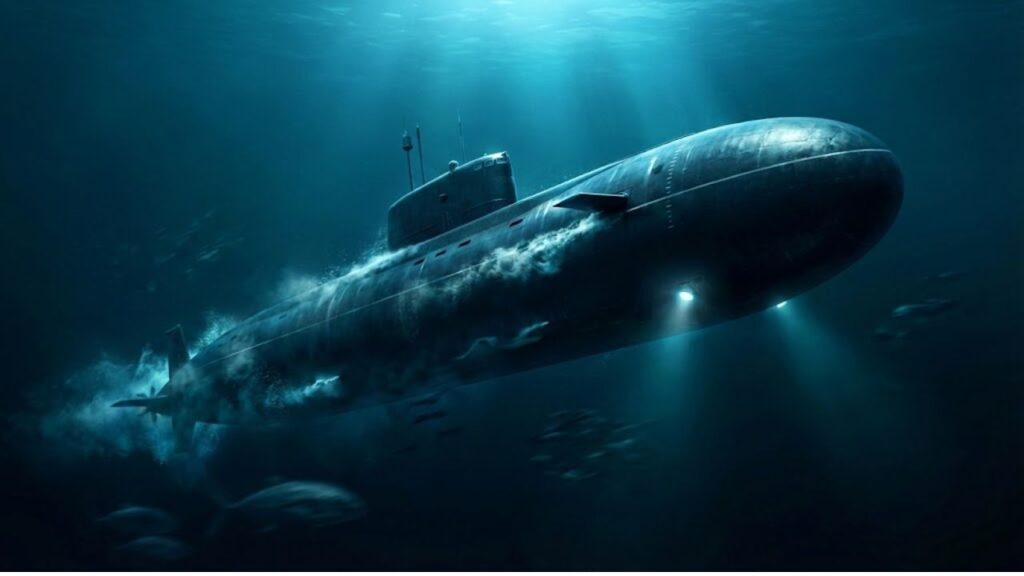
Years later, that strange encounter still sounds like the kind of story shared quietly in seaside bars. Yet this tale was real, and it had a name: K-222, often remembered as the golden bullet of the Cold War.
When a submarine shattered underwater speed limits
The K-222 never looked mythical when it first left the shipyard. Its long, streamlined body and aggressive lines reflected a new kind of ambition at the height of Cold War tension. Officially classified as a nuclear attack submarine, it was, in reality, something far more radical. Soviet engineers had created a vessel designed less like a traditional warship and more like a high-performance machine built for speed.

On December 30, 1970, the K-222 achieved a verified top speed of around 44.7 knots, exceeding 80 kilometers per hour underwater. For a massive steel structure stretching over 100 meters and weighing thousands of tons, this was unprecedented. While Western sonar teams were accustomed to tracking loud Soviet submarines, this one appeared as a rapid, unfamiliar echo that defied existing expectations.

Former NATO sailors later spoke of rumors about a Soviet submarine that could outrun danger like a torpedo. Many initially dismissed these claims. The K-222’s trials proved those doubts wrong and forced military planners to confront an uncomfortable new reality.
A titanium experiment built to outrun everything
The submarine’s record-breaking performance was the result of Project 661, a highly classified Soviet initiative focused on pure speed. Its most striking feature was a titanium hull, chosen for its strength and ability to withstand intense pressure at high velocities. This material allowed the K-222 to dive deep while enduring forces that would have damaged conventional steel designs.
Power came from twin nuclear reactors that drove enormous turbines, prioritizing acceleration over silence. The underlying strategy was straightforward: if pursued by enemy forces, the submarine would simply escape by speed alone. It was a technical answer to a strategic fear—being hunted with no route of retreat.
The cost of speed and the limits it revealed
Achieving such performance required extreme compromises. Designers ignored concerns about cost, comfort, and noise, focusing entirely on pushing boundaries. The result was a vessel that strained its own structure at full power. Crew members later described intense vibrations, rattling panels, and sound levels so high that normal conversation became impossible.

From a combat perspective, this created a serious drawback. High speed generated noise that made the submarine easier to detect. The very trait that defined the K-222 also reduced its stealth. Combined with its enormous expense—so high it earned the nickname “Golden Fish”—the project proved impossible to scale. Only one submarine was ever built.
Ultimately, the K-222 became a technological demonstration rather than a practical blueprint. It proved that extreme underwater speed was achievable, but also showed why later designs favored balance, quiet operation, and endurance over raw velocity.
What the K-222 reveals about power and priorities
The story of the K-222 highlights how obsessively pursuing a single goal reshapes every design decision. Speed was not just a feature; it was the central principle guiding materials, propulsion, and hull form. While this approach delivered an unmatched record, it also narrowed the submarine’s real-world usefulness.
As naval thinking evolved, many fleets chose submarines that could remain hidden rather than flee quickly. The K-222 could escape faster than anything else, but it struggled to operate discreetly. That trade-off limited its operational value despite its engineering brilliance.
- Record speed: Approximately 44.7 knots, over 80 km/h underwater
- Exotic construction: Titanium hull that pushed manufacturing limits
- Experimental role: A single prototype rather than a mass-produced vessel
- High cost: Earned the nickname “Golden Fish” due to its expense
- Strategic lesson: Extreme speed impressed, but stealth proved more valuable
A legacy that still lingers beneath the surface
The K-222 was withdrawn from service in the 1980s and eventually dismantled without ceremony. Despite its quiet end, its legacy remains vivid. Whenever new submarines are discussed, questions about speed inevitably arise, and the K-222’s record still stands as an uneasy benchmark.
Beyond naval engineering, its story reflects a broader human tendency to chase extremes. The K-222 serves as a reminder that while raw performance can be intoxicating, it rarely tells the whole story. In pushing technology to its limits, something else is often sacrificed—and understanding that balance may be the submarine’s most enduring lesson.