
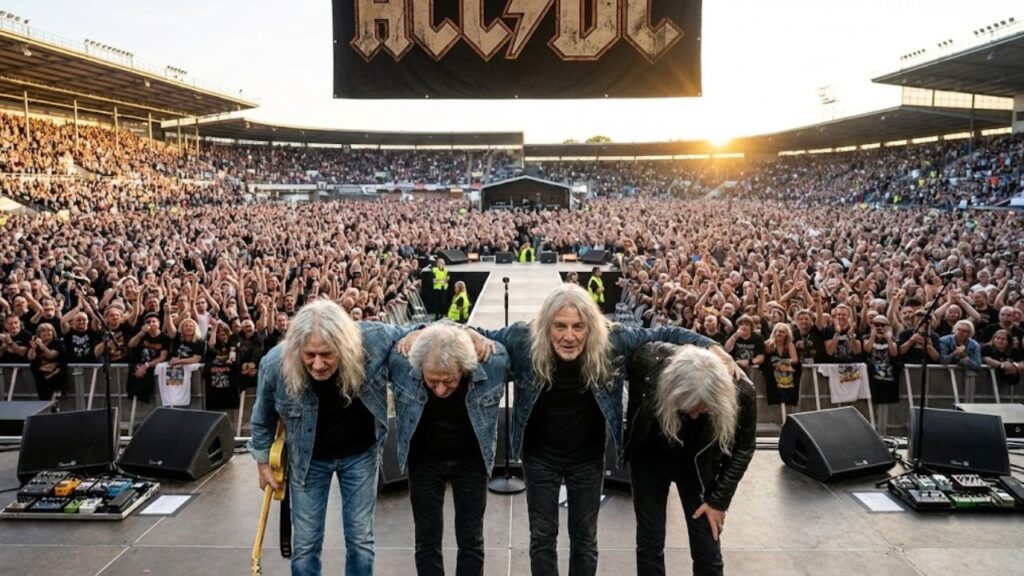
That weightless pause before the final encore—20,000 people sharing the same breath, phones lifted, adults slipping briefly back into their teenage years. On stage, four familiar silhouettes, aged the way old photographs do: gradually, then suddenly. The drummer loosens his shoulders. The singer leans toward the microphone. Somewhere behind me, someone murmurs, “This is it.”
Then a single, unmistakable guitar riff cuts through the darkness. Everyone recognizes it. Everyone.
The night a 50-year journey ended on one final chord
On Saturday night, inside a stadium filled from the highest seats to the front rail, the legendary rock band behind what many call “the hit everyone knows” stepped off the stage for the last time. There were no ironic farewells and no teasing promises of a reunion tour. Just a final bow, a lingering wave, and the quiet realization that a soundtrack spanning generations had come to a stop.

You could feel the atmosphere shift when the singer said softly, “After 50 years, this is our goodbye.” The crowd didn’t erupt. They simply listened.

Before the lights went down
Hours earlier, it was clear this wasn’t a typical tour date. Fathers in faded shirts from the 1980s walked beside daughters wearing freshly bought merchandise. Friends had flown in from different countries just to hear that chorus one last time.
At the merchandise stand, the most popular item wasn’t a flashy hoodie. It was a plain black T-shirt—the band’s logo on the front, and “1974–2024” on the back. A beginning and an end. Nothing more needed saying.
More than a career, a lifetime
Fifty years stretches far beyond a typical career. It holds decades of cramped van rides, worn-down backstage rooms, broken strings, relationships formed and lost, chart-topping highs and long anonymous stretches. Bands don’t last that long by chance. They survive by outlasting trends, resisting algorithms, and continuing to play even when attention drifts elsewhere.
On paper, the numbers are staggering: over 2,000 shows, countless platinum records, and one global hit that still streams millions of times each month—even among listeners who couldn’t name the band. That’s the strange power of a song that slips free of its creators and becomes something shared.
When even legends choose to stop
Eventually, every enduring group faces a difficult question: do you stop before the music loses its meaning?
The anatomy of “the hit everyone knows”
Ask ten people what that song means to them, and you’ll hear ten different memories: a first kiss, a painful breakup, late-night drives with the windows down and nowhere to be. That’s what a true classic does—it embeds itself in ordinary moments and quietly elevates them.
The band has often shared how the song came together in a cramped hotel room, written quickly, almost as a joke, when they were young and tired. It nearly didn’t make the album. Then radio picked it up—then every radio picked it up. Soon it echoed through supermarkets, school dances, weddings, and karaoke bars where strangers sang it like a confession.
Early footage shows the song played to polite applause. A decade later, crowds were so loud that security staff covered their ears as the first line began. That’s when it stopped being just a song and became a shared reflex.
Fans often claim they prefer obscure tracks, rolling their eyes when the opening riff starts—yet their foot still taps. The band itself wrestled with the song for years, sometimes hiding it mid-set or considering dropping it altogether. Each time, the message from audiences was the same: grow, experiment—but don’t take away the one thing we sing together.
On this final night, they embraced it fully, letting the intro linger, allowing the crowd to roar, and giving everyone permission to lean into nostalgia without embarrassment.

Deciding to leave while the crowd still sings
There’s no guidebook for retiring while arenas still sell out. The decision began quietly: physical aches, missed family moments, grandchildren appearing on video calls from far away while another night passed in a hotel room.
One member described waking up in a new city and needing a moment to remember which country he was in. At 25, that felt exhilarating. At 70, it felt disorienting. The choice wasn’t about demand—it was about time, and who had claim over what remained of it.
Fans sometimes feel abandoned when a band steps away at its peak. There’s a sense of ownership, and a deeper fear that a piece of youth disappears with them. But staying forever can hollow the music out. The band chose to stop before the songs dulled, turning the final tour into a measured thank-you rather than an obligation.
In one rare interview, the singer explained their thinking plainly: they wanted to leave as a band people argued over, loved to, and lived alongside—not one people pitied. There was, he said, dignity in knowing when to exit.
What they wanted the farewell to be
- Full-length shows in every city, not shortened legacy sets
- No compromised performances; songs that couldn’t be played properly were removed
- Balanced setlists mixing deep cuts with the biggest hit
- Enough rest days to perform as musicians, not exhausted travelers
- A final, unchanging closer: the hit everyone knew, lights up, no effects—just band and crowd
When a farewell reflects back on us
As the last chorus echoed through the stadium, phones slowly lowered. A couple in their forties turned toward each other and sang the final lines face to face. Nearby, a teenager leaned into their father, quietly wiping away tears.
Moments like these are no longer about the band alone. They’re about remembering who we were when we first heard that song, and noticing who still stands beside us as it plays one last time.
Outside, as the lights came up and crews began dismantling decades of routine, no one rushed away. People lingered, softly humming the riff in the parking lot. Someone muttered, “Guess that’s that.”
Yet there was also relief. The band had drawn a clear line—no endless farewells, no gradual fading. Just a clean ending that preserved the music’s edge.
The band doesn’t truly vanish after tonight. The song will keep resurfacing in playlists, supermarket aisles, late-night car rides. New listeners will discover it without knowing they arrived late. Longtime fans will pass it on, watching reactions out of the corner of their eye.
That may be the real legacy—not numbers or sold-out shows, but how a piece of music settles into everyday life and refuses to leave.
The stage is empty now. The trucks are packed. Somewhere, four older musicians are waking up without a soundcheck ahead of them. And somewhere else, someone has just pressed play on that song for the very first time.

- End of an era: After 50 years, the band retires with one final tour and last performance
- The power of one song: A single track became a shared cultural memory across generations
- Knowing when to stop: Choosing to leave while still at the top preserved both dignity and meaning
