That small rectangular device was not a concept model locked behind glass. It was a fully functional computer, capable of running advanced language models directly from a pocket, without depending on any remote data centre.
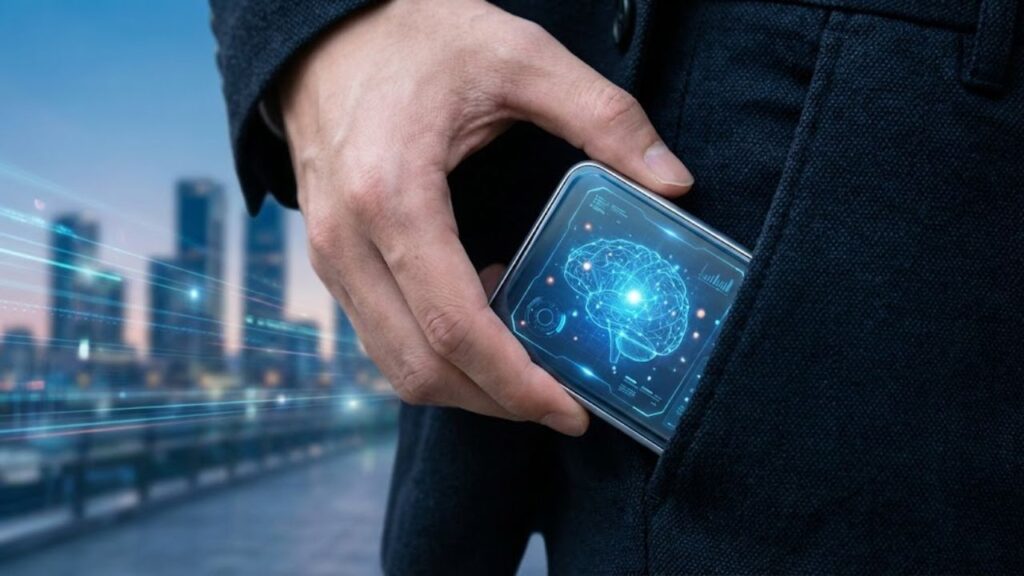
The world’s smallest fully functional AI mini-PC
US start-up Tiiny AI says its latest device, the Tiiny AI Pocket Lab, is the smallest complete AI mini-PC able to run complex language models locally. This is not just a promotional claim. Guinness World Records has officially certified the Pocket Lab as the world’s smallest mini-PC capable of running advanced language models without cloud support.
The device measures just 14.2 × 8 × 2.5 cm and weighs about 300 grams. In everyday use, it easily fits into a jacket pocket or small bag and rests comfortably in one hand. Its appearance is closer to an oversized smartphone or a thick power bank than a traditional computer.

The Tiiny AI Pocket Lab can run language models exceeding 120 billion parameters entirely offline, all from a device small enough to carry anywhere.

Unlike many AI products that function as thin clients connected to remote servers, the Pocket Lab performs on-device inference. According to the company, compatible models can reach decoding speeds above 20 tokens per second, enabling smooth conversations or coding assistance without the lag typically seen on weaker hardware.
Compact design with high-end internal hardware
To achieve this level of performance, Tiiny AI has packed components usually reserved for much larger systems into an extremely small chassis. At its core is a 12-core ARM processor combined with a dedicated neural processing unit (NPU) rated between 160 and 190 TOPS (trillions of operations per second).
The most striking specification is memory. The Pocket Lab includes 80 GB of LPDDR5X RAM, an unusually large amount for a device of this size. This memory capacity allows the system to host very large models entirely in RAM, avoiding disk swapping or reliance on cloud infrastructure.
With 80 GB of high-speed memory, the Pocket Lab handles workloads that previously required a desktop-class GPU or a remote server.
Supported language models and updates
The device supports a growing range of open-source language models, including:
- Llama
- Qwen
- DeepSeek
- Mistral
- Phi
- GPT-OSS variants
Model installation is handled through a one-click interface. The system also receives over-the-air (OTA) updates that deliver new models, security patches, and performance improvements without manual intervention.
Software optimisations that maximise performance
Hardware alone does not explain the Pocket Lab’s capabilities. Tiiny AI has developed its own software technologies to extract more performance from the system. Two internal tools, TurboSparse and PowerInfer, play a central role.
TurboSparse targets sparse activity within neural networks. In large models, many neurons do not need to activate for every generated token. By identifying and skipping unnecessary activations, TurboSparse reduces wasted computation, lowers heat output, and improves overall speed.
PowerInfer focuses on workload distribution between the CPU and the NPU. Instead of routing all tasks through a single processor, it dynamically assigns work based on each component’s strengths. This balanced scheduling is essential when running data-centre-scale models on a pocket-sized device.
Why a pocket-sized AI computer matters
At first glance, the Tiiny AI Pocket Lab may appear to be a niche product for enthusiasts. However, its combination of power, portability, and offline operation enables use cases that cloud-dependent systems struggle to support.
- Travel and field work: Operates without internet access in remote or disrupted environments.
- Data privacy: Prompts and documents remain on the device instead of being transmitted to external servers.
- Creative work on the move: Writers, designers, and developers carry an AI assistant wherever they go.
- Cost control: Local inference removes ongoing cloud subscription costs.
For professionals moving between offices, homes, and client locations, the Pocket Lab can function as a personal AI workstation. It connects to a monitor and keyboard or runs headless, accessed wirelessly from a laptop or tablet. When work ends, the entire setup travels with the user.
Designed for users without technical expertise
Tiiny AI is not positioning the Pocket Lab solely for machine-learning specialists. The interface is designed to be approachable, even for users without technical backgrounds. Model selection, chat tools, and configuration are managed through visual menus rather than command-line workflows.

This approach addresses a common barrier to AI adoption. Many users are comfortable interacting with AI through web interfaces but struggle with model installation, hardware configuration, or performance tuning. The Pocket Lab aims to simplify that experience.
The goal is to treat AI inference as an appliance: plug in the device, choose a model, and start working.
Portability strengthens this concept. Users can carry the same AI environment between locations without syncing conversations across services or managing multiple accounts.
Offline AI and user control over data
Running language models locally changes the balance of control between users and AI providers. Cloud-based tools often log prompts, responses, and usage patterns. While this can improve systems, it also raises concerns about sensitive information being stored or reused.
An offline AI device reduces that exposure by keeping data entirely on the hardware. Confidential documents, medical notes, business concepts, or proprietary code can be processed locally, even with networking disabled. For journalists, lawyers, and researchers, this level of control can be a decisive advantage.
However, increased control also brings responsibility. Without enterprise-grade monitoring, users must manage security themselves. If the device is lost or improperly protected, stored information could be exposed. Encryption, strong authentication, and physical security become essential considerations.
Applications from education to software development
Beyond individual users, small organisations may find value in pocket-sized AI systems. Schools and universities could deploy devices that remain on local networks, ensuring student data stays on site. Educators could generate lesson materials or translations while demonstrating AI concepts without sending student work to external servers.
For developers, the Pocket Lab can serve as a dedicated inference engine. A laptop handles coding and version control, while the pocket PC manages text generation, code completion, or test data creation. This mirrors remote GPU workflows, except the hardware sits nearby.
Journalists and field researchers working in areas with unreliable connectivity could use the device to transcribe interviews, summarise notes, or translate content without depending on mobile networks.
Understanding key terms and practical limitations
Two technical terms frequently appear in Tiiny AI’s claims: parameters and TOPS. Parameters are the learned values inside a trained model. Larger parameter counts generally allow more nuanced outputs but require greater memory and compute resources. Supporting 120-billion-parameter models signals capacity for large, capable systems.
TOPS, or trillions of operations per second, measures raw AI processing capability. While higher numbers indicate greater potential performance, real-world results still depend on memory speed and software optimisation. Ratings of 160–190 TOPS place the Pocket Lab among high-performance edge devices.
There are also trade-offs. Running large models locally can generate significant heat and power draw during sustained use, which may limit battery operation and favour plugged-in scenarios. Additionally, local models may lag behind fast-evolving cloud systems unless updates remain frequent.
Despite these constraints, the arrival of a Guinness-certified pocket AI computer signals a broader shift. Instead of AI as a remote service rented by the prompt, devices like the Tiiny AI Pocket Lab present AI as personal hardware—something users can carry, control, update, and turn off at will.