Fresh infrared observations from the James Webb Space Telescope have pierced the obscuring dust surrounding a nearby galaxy, revealing how a supermassive black hole at its core truly behaves. These findings overturn long-held assumptions, showing that the black hole is not primarily ejecting material outward, but is instead being steadily nourished by dense, surrounding dust. The results offer the clearest picture yet of the energetic processes shaping this active galactic centre.
A restless neighbouring galaxy just 13 million light-years away
The research focuses on the Circinus galaxy, also known as the Compass galaxy, located only 13 million light-years from Earth. In astronomical terms, this places it within our broader cosmic neighbourhood, close enough to be faintly visible through a good amateur telescope under dark skies.
Despite its proximity, Circinus has long challenged astronomers. Its position near the plane of the Milky Way means thick clouds of interstellar dust and crowded star fields obscure views from ground-based telescopes. Even large observatories have struggled to clearly resolve activity in its dense, chaotic core.

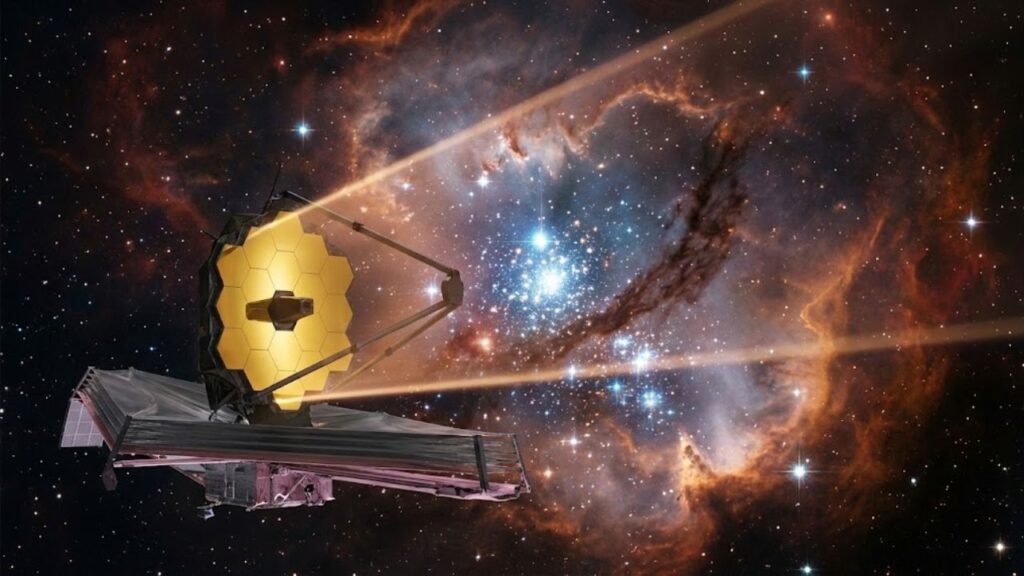
Orbiting about 1.5 million kilometres from Earth, well beyond atmospheric interference, the James Webb Space Telescope provides a dramatically clearer perspective. Using advanced infrared instruments, Webb has delivered the most detailed view yet of Circinus’s centre, where intense activity is driven by a supermassive black hole.

Webb’s data reveal that the black hole is not simply blasting matter into space. Instead, it is being continuously supplied by a compact, dusty structure tightly wrapped around it.
Published in Nature Communications, these findings reshape scientific understanding of why this nearby active galaxy emits such strong infrared radiation.
Solving the infrared mystery around the black hole
Before Webb’s observations, the Hubble Space Telescope had already detected an intense infrared source near Circinus’s central black hole. Based on prevailing models, many astronomers believed this glow came from powerful outflows, where matter heated by the black hole was being hurled outward at extreme speeds.
The new Webb data tell a different story. By resolving much finer detail within the galaxy’s core, scientists have been able to accurately trace the origin of the infrared light.
Approximately 87% of the infrared emission once attributed to violent outflows actually comes from a thick, hot cloud of dust encircling the black hole and feeding it.
This dust-and-gas structure, known as a torus, forms a ring-like region around the black hole. From afar, it resembles a cosmic doughnut, cooler on the outside and intensely hot along the inner edge where material spirals inward.
As the black hole draws in this material, it forms an accretion disc, a flattened, rapidly rotating structure similar to water swirling down a drain. Friction and gravity heat the gas and dust to extreme temperatures, causing the region to shine brightly, especially at infrared wavelengths.
From Earth, this intense glow blends with the light of millions of surrounding stars, turning Circinus’s core into a bright, tangled blur. Earlier telescopes could not clearly separate emissions from dust, outflowing gas, and star-forming regions. Webb’s observations finally begin to disentangle these components.
Pushing Webb’s instruments to their limits
Webb’s advantage lies not only in its large mirror and sharp vision, but also in its sophisticated handling of light. For this study, astronomers used NIRISS, a near-infrared instrument capable of operating as an interferometer.
In simple terms, this technique combines light in a way that suppresses overwhelming glare, allowing fine structures to emerge. Using NIRISS in interferometric mode, Webb effectively reduced the blinding brightness of the galactic centre and detected features just a few light-years across in another galaxy.
This marks the first time such an interferometric method with JWST has been applied to a target beyond the Milky Way. The approach filtered out light from bright stars and minimised distortions caused by dust, producing a much cleaner view of regions closest to the black hole.

After processing the data, astronomers determined how the infrared emission from Circinus’s core is divided:
- About 87% originates from the dense, dusty torus feeding the black hole
- Around 1% comes from material genuinely being expelled by the black hole
- Roughly 12% arises from more distant regions previously unresolved
The small outflow component aligns with earlier Hubble observations, but the revised breakdown shows it plays only a minor role. The core is primarily a feeding region, not a blast zone.
What this reveals about active galaxies
Circinus belongs to a group known as active galactic nuclei (AGN), where central black holes consume matter and flood their surroundings with radiation. Understanding how dust, gas, and radiation interact in these systems is essential for explaining how galaxies evolve over billions of years.
Webb’s findings strongly support long-standing models in which a dusty torus both feeds the black hole and obscures it from certain viewing angles. When observed edge-on, the torus blocks direct light from the accretion disc, leaving mainly reprocessed infrared emission. When viewed more face-on, the central engine appears brighter and less hidden.
Circinus now serves as a clear example where the theorised dusty torus can be directly resolved and measured with precision.
By accurately determining how energy is distributed across different regions, astronomers can better calibrate models for more distant AGNs that cannot be imaged in such detail. Circinus effectively becomes a nearby laboratory for studying how black holes grow and influence their host galaxies.
Key concepts behind the observations
- Light-year: The distance light travels in one year, roughly 9.46 trillion kilometres
- Supermassive black hole: A black hole millions or billions of times more massive than the Sun, typically found at a galaxy’s centre
- Infrared radiation: Light with wavelengths longer than visible red light, ideal for penetrating dust
- Accretion disc: A rotating disc of gas and dust spiralling into a massive object, heating up as it falls inward
- Torus: A ring-shaped cloud of dust and gas surrounding a black hole and its accretion disc
Implications for future black hole research
Scientists view the Circinus results as a powerful proof of concept. If Webb’s interferometric techniques can dissect the core of this nearby active galaxy, they can likely be applied to many others across the local universe.
Future studies may focus on galaxies resembling the Milky Way at earlier stages, or on AGNs that appear unusually faint or bright for their black hole mass. Repeating this detailed separation of infrared light will help determine whether Circinus is typical or exceptional.
The findings also offer a caution. When astronomers estimate black hole growth using unresolved infrared signals, they often assume most of the light comes directly from the accretion disc or its outflows. Circinus demonstrates that a substantial portion can instead be reprocessed by dust in the torus and surrounding regions.
A practical way to visualise Webb’s view
One way to picture this system is to imagine a city hidden by thick smog. In visible light, only a hazy glow is visible. Switch to infrared, and individual heat sources begin to stand out. Add interferometry, and the image sharpens further, revealing distinct structures.
In Circinus, the “smog” is interstellar dust, while the “city centre” is the torus and accretion disc around the black hole. Webb’s instruments allow astronomers to separate these regions, measuring where energy is concentrated and how activity is distributed.
For amateur astronomers in the southern hemisphere, Circinus can still be spotted near the Milky Way’s band. While the black hole itself remains invisible, observing the galaxy’s faint glow offers a direct connection to the object now being studied in extraordinary detail.
As the James Webb Space Telescope continues its mission, similar deep investigations of dusty galactic centres are expected to build a clearer picture of how often black holes quietly feed, how often they erupt, and how these cycles shape the evolution of galaxies like our own.