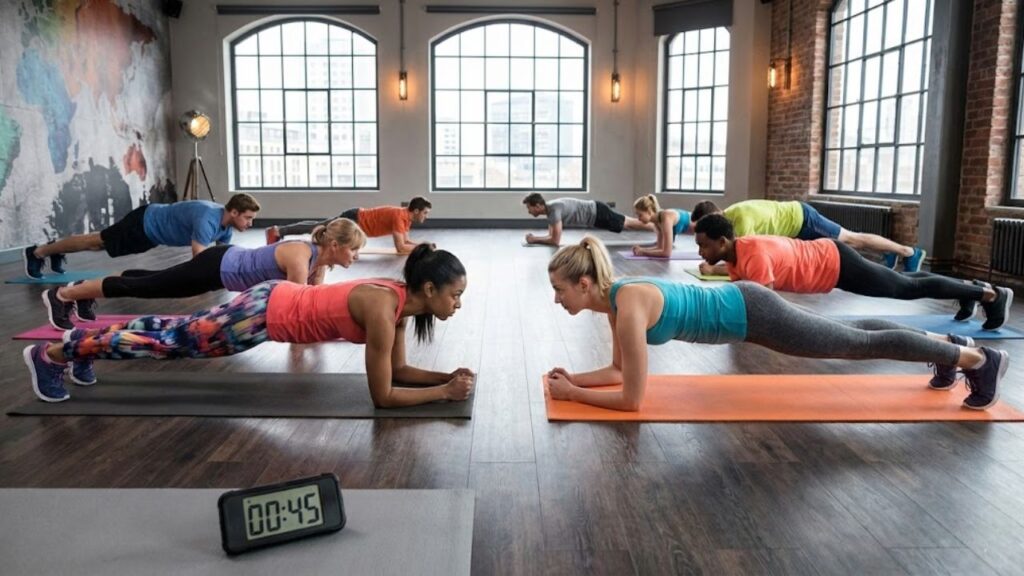
The floor feels cool beneath your forearms. Your toes press firmly into the mat, legs active, breath slow and controlled. As your core tightens and focus sharpens, a familiar question appears: how long should this plank last? Ten seconds, thirty seconds, or a minute that feels endless? The answer isn’t universal. Planks change with you. What feels effortless at 18 may feel demanding at 48 and require extra care at 68. Across every stage of life, however, the core remains essential—supporting the spine, protecting the back, and enabling smooth movement. The ideal plank duration begins with understanding where your body is today.
Plank Hold Timing: How It Really Works
The Quiet Power of the Core
Unlike loud, high-impact exercises, planks work in silence. Your body forms a long, steady line—shoulders aligned over elbows or wrists, heels reaching back, head relaxed. From the outside, it looks simple. Inside, a coordinated system activates. The transverse abdominis tightens like a natural belt, the multifidus stabilizes the spine, the diaphragm links breathing to effort, and the pelvic floor supports from below. These deep muscles respond best to calm, controlled tension repeated consistently.
This is why form outweighs time. A shaky, collapsing one-minute plank offers less benefit—and more risk—than a clean twenty-second hold with strong alignment. Time matters only while form remains solid. The moment alignment fades, the value drops.
Why Longer Isn’t Always Better
Modern fitness often celebrates extremes—two-minute holds, five-minute challenges, viral clips of bodies shaking under strain. The truth is more subtle. Beyond a certain point, longer planks train discomfort tolerance more than real strength. Research and experienced coaching consistently show that short, precise holds done regularly are more effective for core strength and spinal health than occasional marathon attempts.

Long planks aren’t automatically harmful, but their returns diminish as fatigue increases. Over time, the focus shifts from “How long can I last?” to “How well can I support my body?”
Age, Adaptation, and Core Strength
As years pass, the body adapts. Recovery slows, tissues stiffen, and balance demands greater attention. A plank that once felt effortless may now require intention. This isn’t weakness—it’s biology. Rather than fixed rules, flexible ranges based on quality and control are more useful.
Suggested Plank Hold Ranges by Age
- Teens (13–19): 20–40 seconds, 2–4 sets, 2–4 days per week
- 20s–30s: 30–60 seconds, 2–4 sets, 3–5 days per week
- 40s: 20–45 seconds, 2–4 sets, 3–4 days per week
- 50s: 15–40 seconds, 2–3 sets, 2–4 days per week
- 60s–70s+: 10–30 seconds, 2–3 sets, 2–4 days per week
These ranges are guidelines, not rules. What counts is the quality of each second you hold.
 Goodbye Hair Dye for Grey Hair: The Conditioner Add-In That Gradually Restores Natural Colour
Planking Through Different Life Stages
Your 20s and 30s: Power With Control
In these years, recovery is quick and tissues are resilient. Holds of 30 to 60 seconds often work well. The main concern is subtle form breakdown—hips dropping, shoulders creeping forward, or tension building in the lower back. Multiple shorter, controlled holds usually deliver better results than a single exhausting attempt.
Your 40s: Strength With Awareness
By your 40s, the body speaks more clearly. Old injuries, stiffness, or tightness show up sooner. Productive holds often fall between 20 and 45 seconds, repeated a few times. Some days allow more, others less. The priority becomes sustainability, posture, and long-term support.
Your 50s, 60s, and Beyond: Stable and Smart
Later decades invite a smarter approach to strength. Muscle mass may decrease, balance may shift, and recovery may take longer, yet planks remain highly effective. Short holds of 10 to 30 seconds with excellent alignment still deliver strong benefits. Modified options, such as knee or incline planks, are practical adaptations. Each well-supported second reinforces stability, posture, and confidence.
Knowing When to Stop
The body provides clear signals when a plank becomes unsafe: lower-back sagging, shoulder tension, breath-holding, or facial strain. Stopping at the first sign of form loss isn’t failure—it’s intelligent training. This approach reinforces efficient movement and protects the spine over time.
Turning Planks Into a Simple Habit
Planks don’t need drama. A short hold before coffee, another after work, one before bed—these small moments add up. Over time, consistent, modest efforts build real strength. The goal isn’t setting records. It’s standing taller, moving with ease, and supporting your body in everyday life. Hold while form stays honest. Rest. Repeat. That’s where lasting core strength is built.