Outside, traffic crept along in dull grey lines. Inside, a woman in a navy blazer studied her reflection, her fingers pausing in her hair. Her dark waves framed her face in a neat, familiar way. Safe. Predictable. She tucked one side behind her ear. Nothing changed. She tried again, more deliberately, pushing the hair just a little further back until a small triangle of cheekbone appeared.
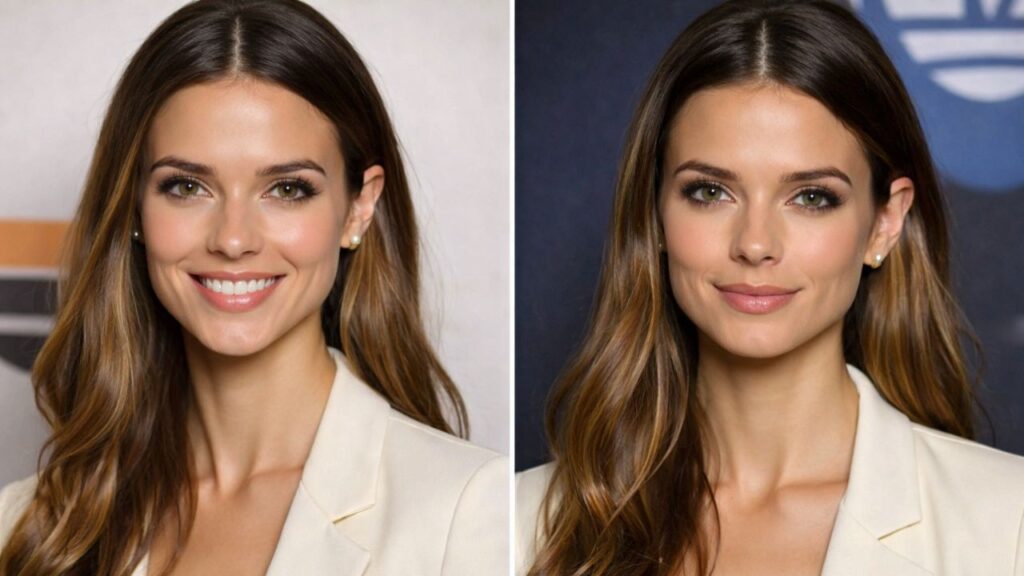
It was such a subtle motion that no one else noticed. Yet her entire expression shifted. The jaw looked cleaner. The eyes seemed more open. Her face felt less like a flat Zoom screen and more like someone who had actually rested. She took a photo, then adjusted the tuck on the other side. The contrast was striking. Same face, same hair, same light. Just a different placement.
Why a Two-Second Gesture Has So Much Impact
Most people tuck their hair behind their ears without thinking. It’s a nervous habit, something we do while listening, laughing, or scrolling. But that small action instantly redraws the face. It can open or close features, sharpen or soften the jaw, and reveal or hide cheekbones.
What feels like a casual fidget is actually a micro styling decision. Our brains register it almost immediately. Before the other person finishes speaking, your face can already appear brighter or more defined. Once you notice the difference in the mirror, it becomes almost impossible to ignore.
 Menopause Can Change Hair Texture Fast - Here Are Ingredients Experts Say You Should Avoid
The Backstage Secret Stylists Always Use
Ask any hairstylist working backstage at a fashion show and they’ll tell you the same thing: how hair frames the face is half the look. Right before models step onto the runway, stylists often make one final adjustment. They slide a section of hair behind the ear, then pull a few strands back out with precision.
It’s rarely a full, tight tuck. It’s controlled looseness. One ear visible, the other softly hidden. Just enough cheekbone revealed to catch the light. Under strong lighting, that small shadow creates instant structure. On camera, the effect is even stronger.
Makeup artists rely on the same principle. A perfectly highlighted cheekbone loses its impact if it’s buried under hair. Open the sides of the face, and the bone structure suddenly does the work on its own.
The Simple Geometry Behind the Effect
There’s a clear reason this works. When hair falls straight down beside the cheeks, it creates a vertical curtain that visually widens the face. The eye reads the outer edge of the hair as the boundary of the head, and the cheekbones disappear into that softness.
Move the hair behind the ears and that boundary shifts inward. The widest point becomes the cheekbone area instead of the hair. The jaw appears more defined. The temples look narrower. Shadows appear where none existed moments before.
It’s like reshaping a silhouette with nothing but your fingers. No scissors, no contour, no filters. Just a tuck that works with the natural lines of the face.
The Exact Tuck That Actually Opens the Face
This isn’t about pushing all your hair back. Stand in front of a mirror with your usual style. With one hand, imagine a line running from the arch of your eyebrow to the top of your ear. This is your cheekbone window.
Take the hair that falls behind that line and gently slide it behind your ear. Leave the front section near your cheek untouched. Then pinch a small strand from that section and let it fall so it lightly grazes the top of your cheekbone.
You’re aiming for a half-tuck. The upper part of the ear shows, the lower part stays softly framed. Look straight ahead. The face immediately appears lighter, more vertical, and more awake.
 Lip Definition Trick: The Strategic Liner Placement That Enhances Fullness Without Heavy Overlining
Adjusting the Tuck for Different Hair Types
This move doesn’t behave the same on everyone. Straight hair can look harsh if it’s over-tucked and pulled too flat. Wavy or curly hair can puff around the ears and hide the cheekbone again if the section isn’t refined.
Experiment. Try tucking just one side first. Left tucked, right loose. Notice how it changes your expression. One-sided tucks often create the natural asymmetry seen in candid photos. Switch sides and compare. You may find one profile feels more flattering.
Making It a Natural, Everyday Habit
Soyons honnêtes : nobody stands in front of the mirror every morning following a tutorial. You’re grabbing coffee, running late, moving through your day. The goal isn’t perfection. It’s finding one small gesture that feels natural enough to repeat without thinking.
“Think of the tuck as micro-sculpting,” says London hairstylist Amira Khan. “You’re not changing your hair. You’re changing the frame your face lives in for a moment.”
Her advice is simple. Work with how your hair naturally falls. Guide it instead of fighting it. Use the pads of your fingers so the movement stays soft. Avoid pressing everything flat against the scalp, which can erase definition and create a helmet-like effect.
- Trace your cheekbone window from brow to ear before tucking.
- Favor a half-tuck with the upper ear visible and the lower softly framed.
- Test one-sided versus two-sided tucks in natural light.
- Let a few strands fall free to avoid a strict, flat look.
- Use this gesture as a quick reset before photos, calls, or important moments.
A Small Move That Changes How You Show Up
Once you start playing with this, the habit stops feeling cosmetic and starts feeling useful. You may notice yourself doing a gentle half-tuck before turning on your camera, almost like a quiet reset. A way of saying, “This is my face.”
This isn’t about becoming sculpted or filtered. It’s about noticing how tiny choices shape what we project. The same hair, shifted just a few millimeters, can make you feel hidden or present. Softer or sharper.
In a crowded subway, on a first date, or right before your name is called, that small movement can act as an anchor. A moment to decide how you want to appear, rather than leaving it to chance.
Some people will try it once and forget it. Others will finally recognize themselves in photos they used to dislike. They’ll realize it wasn’t their face they struggled with, but how hair obscured their features.
That feeling when a candid photo finally matches how you see yourself at your best is rare. This specific way of tucking hair behind the ears is simply one tool toward that alignment. Not a rule. Not a standard. Just an option you can keep, adjust, or ignore.

| Point clé | Détail | Intérêt pour le lecteur |
|---|---|---|
| Cheekbone window | Tracer une ligne imaginaire du sourcil à l’oreille pour décider quelles mèches reculer | Comprendre où tucker les cheveux pour affiner visuellement le visage |
| Half-tuck | Laisser l’oreille partiellement visible, avec quelques mèches libres autour du visage | Obtenir un cadre plus naturel, moins strict, qui met en valeur les pommettes |
| One-sided tuck | Ne tucker qu’un seul côté pour créer une asymétrie douce | Donner du style instantané et éviter l’effet “photo de classe” |