
Just after sunrise, on a dusty track in Ethiopia’s Afar region, the ground looks still. Goats pick their way between dark volcanic rocks, kids shout, the air already shimmering with heat. Yet beneath those quiet footsteps, the planet is moving. The crust is stretching, cracking, very slowly breaking apart. A farmer watches a thin line in the soil that didn’t used to be there, like a scar that appeared after a bad storm. He shrugs, but the scientists who fly in and out of this remote corner don’t shrug at all.
They say we’re watching a continent die and a new ocean being born.
The wild part? They’ve got the video to prove it.
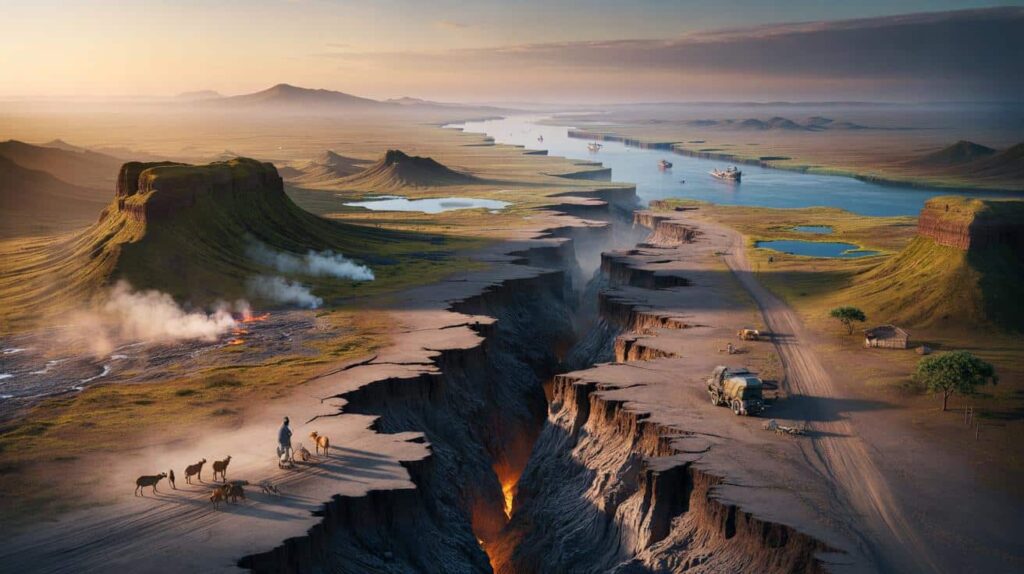
Africa is tearing at the seams: what the cameras and satellites are really seeing
In 2005, people in Afar woke up to something that looked like a movie effect. A crack in the ground had opened almost overnight, slicing across the desert for kilometers. From the air, it looked like the Earth’s skin had been ripped open. On the ground, people just saw a sudden trench where there had been flat land. No asteroid, no obvious earthquake, just a long dark wound in the rock.
Scientists rushed in with drones, cameras and seismometers. The images they brought back are still haunting.
On YouTube and in science explainers, you’ll see that famous drone shot: a narrow ravine, jagged walls of basalt, all framed by an empty horizon. It went viral as “Africa splitting in two,” shared with captions half awe, half panic. Geological teams later showed the full picture. That 60-kilometre-long crack was part of the East African Rift System, a giant fracture zone stretching thousands of kilometres from the Red Sea down toward Mozambique.
Seen from space, satellites trace it like a lightning bolt drawn across a whole continent.

The basic idea is simple and slightly terrifying. The African plate is slowly pulling apart from the Somali plate, two massive rafts of rock drifting in different directions above a hotter, restless mantle. GPS stations pinned into the ground show measurable motion every year, a few millimetres here, a few millimetres there. That doesn’t sound like much, yet over millions of years it reshapes coastlines. *Plate tectonics is slow enough to ignore in daily life, but relentless enough to redesign the map.*
What we’re seeing now in East Africa is the very early stage of a new ocean basin.
From crack to ocean: how a rift becomes a sea you could sail across
Geologists describe a kind of step-by-step method that the planet follows without asking us. First, a rift forms: the crust stretches, thins and fractures. Then small volcanic eruptions fill in the gaps with fresh rock, and deep valleys sink where the crust sags. Over long ages, those valleys can drop below sea level. At some point, ocean water from a nearby sea or gulf finds a way in. That’s when a rift stops being just a crack and becomes a newborn ocean basin.
In the East African Rift, all the early steps are already underway.
The Afar Triangle is the textbook example, except it’s real life, with real villages and roads crossing it. Lava sometimes bubbles up through new fissures and paints the landscape black. Lakes like Turkana or Tanganyika sit in long, narrow depressions formed by this stretching. People fish there, kids swim there, and yet the same valley floors are being pulled apart by deep forces. We’ve all been there, that moment when you realise the ground under your feet, literal or metaphorical, isn’t as solid as you thought.
Locals talk about tremors, about hot springs changing temperature, about fumaroles that seem a bit angrier than before.
On the scientific side, this isn’t guesswork. Seismic networks record small earthquakes as the crust fractures. Satellite radar measures the tiniest changes in elevation. Geochemical studies track magma rising under the rift. Put it all together and the story sharpens: the Arabian plate has already split away, giving us the Red Sea and the Gulf of Aden. The same process, shifted south, now grips eastern Africa. **Somalia, Ethiopia, Kenya and Tanzania may one day sit on the edge of a brand-new ocean**, separated from the rest of Africa by a long inland sea.
Let’s be honest: nobody really thinks about this when they book a safari.
The evidence, the viral video, and what headlines don’t tell you
When that dramatic crack in Kenya’s Mai Mahiu area made global headlines in 2018, the internet did what it always does. Photos of a gaping trench swallowing parts of a road went viral. “Africa splitting in two!” blared the captions. Some geologists quickly pointed out that part of that Kenyan crack was likely erosion from heavy rains carving through softer sediments. Yet deeper down, the tectonic story is still very real.
The surface drama can mislead, but the long-term forces don’t care about our headlines.

If you’ve watched one of those animation videos showing Africa splitting with a blue ocean flooding the gap, you’ve seen the simplified version. It’s catchy, perfect for Google Discover, and it does rest on solid science, even if the timeline gets lost. The real “video” scientists rely on is spread across decades of satellite images, ground measurements and seismic records. This is slow cinema. One frame every year, sometimes every few days for radar snapshots, building into a time-lapse of a continent stretching.
The tricky part is that our brains are not wired for millions of years; we think in election cycles and mortgage terms.
Researchers working in the rift are surprisingly gentle about our confusion. They know the headlines scare people, and they also know fear gets clicks. They repeat, again and again, that this is a process on a geologic clock, not a human one. Yet they also insist that paying attention matters, especially for those who live along the fracture zones.
“People ask me if Africa will split in their lifetime,” one rift specialist told a local reporter. “I tell them: not as a clean line on a map. What they will see are more quakes, more volcanism and more changes in the land they know so well.”
- Fact one: The East African Rift stretches over 3,000 km from the Red Sea down toward Mozambique.
- Fact two: GPS stations show parts of the rift moving apart by 2–5 mm per year.
- Fact three: The Red Sea and Gulf of Aden are earlier “siblings” of the same rift process.
- Fact four: New cracks like the famous Afar fissure are snapshots, not the whole story.
- Fact five: Any future ocean here would take tens of millions of years to fully form.
Living on a moving planet: what this slow breakup really changes for us
There’s something quietly humbling about knowing that a continent can split while people go on with school runs and market days. The East African Rift reminds us that “solid ground” is a bit of an illusion. For communities stretching from Ethiopia down to Mozambique, the breakup mostly shows up as more frequent small quakes, active volcanoes and hot springs that shift and flare. Those are not abstract. They crack houses, disrupt roads, and sometimes drive families off land their grandparents farmed.
Meanwhile, the rest of the world watches short clips and shares them with a shiver.
Geologists like to say that rifts are both destructive and creative. Old crust is torn apart, yet new crust forms as magma rises to fill the gaps. Seas and oceans are born in this violence. **Someday, far beyond our lifetimes, ships may sail where today there is only rock and dust.** That thought can feel strangely calming. Our human dramas, loud as they seem, unfold on a thin layer above a much older story. The continent will split. A new ocean will open. Not for us, not for our children, maybe not even for anything that looks like us at all.
The planet just keeps writing its slow script.

| Key point | Detail | Value for the reader |
|---|---|---|
| — | The East African Rift is a giant fracture where the African plate is slowly pulling apart. | Helps you understand what “Africa splitting in two” really means beyond the headlines. |
| — | Cracks like those in Afar and Kenya are visible signs of deep tectonic stretching and volcanism. | Connects viral videos and photos to the underlying, long-term geologic process. |
| — | A new ocean could form here, but only over tens of millions of years. | Reduces unnecessary fear while keeping a sense of awe for Earth’s slow transformations. |
FAQ:
- Question 1Is Africa really splitting into two separate continents?Yes, in geological terms. The African plate is separating into the Nubian plate (to the west) and the Somali plate (to the east) along the East African Rift. This process is very slow and will take millions of years to fully separate.
- Question 2Will a new ocean actually form in East Africa?Most geologists think so. As the rift widens and parts of the valley drop below sea level, water from the Red Sea or Indian Ocean could eventually flood in, creating a new ocean basin between eastern Africa and the rest of the continent.
- Question 3Is the viral video of the huge crack in Kenya proof of the split?It’s a striking example but not the whole story. Some of that trench was enhanced by heavy rain erosion cutting into soft ground, yet it sits above a region where the crust is indeed being pulled apart by tectonic forces.
- Question 4Should people living near the rift be worried right now?They don’t need to fear a sudden continental break, but they do live with real risks: earthquakes, volcanic eruptions and ground deformation. Those are already part of life in some rift regions and need local monitoring and planning.
- Question 5When could we realistically see an ocean there?We’re talking tens of millions of years. Human lifespans, and even human civilizations, are tiny compared with tectonic time. The “new ocean” is a way of saying this rift will eventually evolve into something like the Red Sea or the Atlantic, not a prediction for next century.
