
The kettle whistles softly in the tiny kitchen while sunlight pushes through thin lace curtains. At 7:00 a.m. on the dot, 101-year-old Margaret slides her feet into worn slippers and walks – steadily, slowly, stubbornly – to turn off the gas. Her back is curved, her hands are marked by time, but her voice is sharp as a pin. “I refuse to end up in care,” she says, pouring tea into a chipped floral cup. “I’ve buried most of my doctors. That must count for something.”
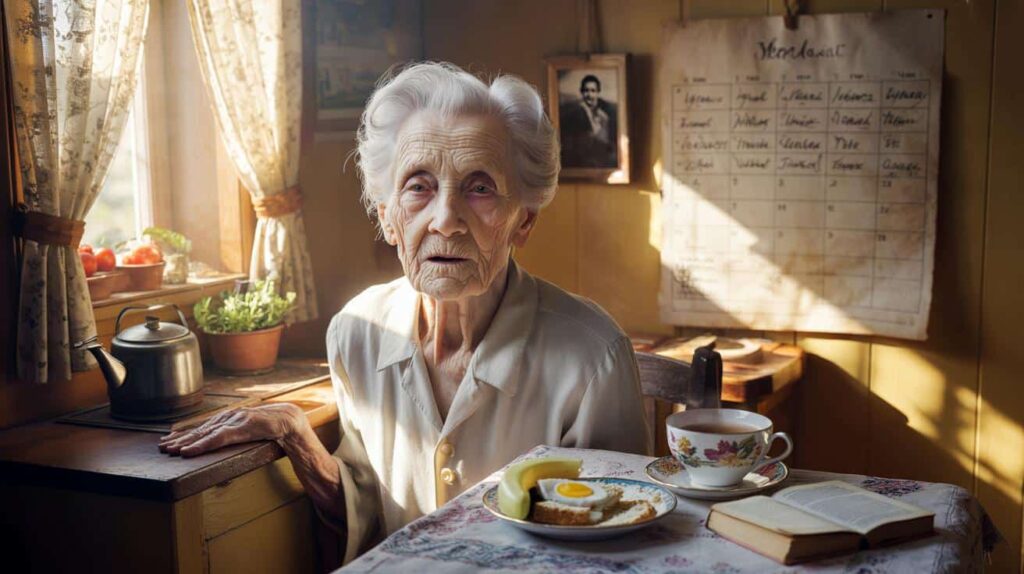
On the wall hangs a faded black-and-white wedding photo, next to a calendar full of pencil notes: “Walk with Joan”, “Library”, “Check tomatoes”. No big secrets. No miracle supplements lined up on the counter. Just small, almost boring gestures repeated every single day.
The kind of habits nobody notices… until you realise they’ve carried a woman past 100.

The quiet routine that keeps her out of care
Margaret starts her day the same way she has for decades: windows open, body moving, brain working. The first thing she does after tea is walk the length of her living room ten times, one hand grazing the sofa for balance. “I don’t sit down until my legs have remembered who’s boss,” she jokes.

She eats breakfast at the table, never in front of the TV. A slice of toast, an egg “if they’re cheap this week”, and half a banana. No special diet plan, just food she recognises and can pronounce. She reads a few pages of a book while she eats. “If I can follow the story, I know my mind’s still mine.”
Her doctor once suggested a care assessment at 95. “Statistically, most people your age…” he began, before she cut him off with a look that could freeze a boiler. She left the surgery, walked straight to the nearby park and did two laps, coat flapping in the wind. “I was furious,” she recalls. “Not at him. At the idea that I was now a number on a chart.”
Since then, she has kept her own “statistics”. One notebook per year, hidden in a biscuit tin. In it, she notes her daily steps, how often she sees friends, and any aches that linger more than three days. It’s not perfect data, just messy human scribbles. Yet the pattern is clear: the weeks she moves less are the weeks she feels older.
There’s no magic in this, only logic that most of us quietly avoid. Muscles that don’t move disappear. Brains that don’t get challenged lose sharpness. Friendships that aren’t nurtured fade. Margaret has simply refused to negotiate with these facts. She treats independence like a plant on the windowsill: if you don’t water it with small actions, it dies long before the birthday cake with 100 candles.
Let’s be honest: nobody really does this every single day. Even she doesn’t. Some mornings, she stays in bed an hour too long, annoyed at her own bones. Yet the overall rhythm holds. Not heroic effort, just relentless, unspectacular consistency.
The habits she swears by for staying independent
Ask Margaret for her “secret” and she laughs so hard she coughs. Then she lists three things. First: walk every day, even if it’s just to the end of the street and back. “If you can walk to the shop, you can argue with the shopkeeper about the price of apples. That’s freedom.”
Second: do something with your hands. She knits, peels vegetables, folds letters, waters plants. “Hands that work keep your brain honest,” she says, wiggling her fingers in the air.
Third: go to bed before you’re exhausted, not after. She’s in bed by 9:30 p.m., with a book or the radio. “Tiredness makes you clumsy. One silly fall… that’s when they start talking about ‘care options’.”

She’s gentle but blunt about the mistakes she sees in younger people. “You sit all day, then you sit all evening scrolling on your phone, and you call it relaxing,” she says, shaking her head. She’s not judging, more… puzzled. “You think moving is extra. For me, sitting is extra.”
Her advice isn’t about becoming a fitness saint at 70 or 80. It’s about shortening the gap between thinking “I should move” and actually standing up. When she feels herself drifting into the armchair too early, she bargains: three more laps of the corridor, then you can sit. Two calls to friends, then you can put the TV on. *Tiny negotiations that add up to a different future.*
One afternoon, as rain drums against the window, she sums it up in a sentence that sounds like a manifesto.
“I’m not fighting age,” Margaret says. “I’m just refusing to hand over the keys to my life before I absolutely have to.”
To keep those keys in her pocket, she focuses on a few daily anchors:
- Move your body before 10 a.m. so the day doesn’t slide into sitting.
- Eat at a table, without a screen, at least once; talk to someone if you can.
- Do one small task that future-you will thank you for – laundry, bills, a walk.
- Keep a simple notebook where you jot down sleep, movement, mood.
- Speak up at appointments: ask questions, say what you want, not just what they expect.
These aren’t dramatic changes. They’re quiet lines in the sand, drawn again each morning. And that persistence may be the boldest thing about her.
What her long life quietly asks us to rethink
Listening to Margaret, you start to realise the real story isn’t how to reach 100. It’s how to not feel quietly sidelined at 70, or 80, or even 55. Her habits aren’t about chasing immortality, they’re about hanging on to the right to choose your own breakfast, your own bedtime, your own front door key.
We’ve all been there, that moment when you think, “I’ll sort my health out later, when things calm down.” Her life is one long argument against that thought. Not through lectures, but through the way she moves around her little kitchen, the way she asks the bus driver about his mum, the way she writes “Laugh” on a sticky note and leaves it on the fridge.
Maybe the real question isn’t “How do I live to 100?” but “What small thing could I do today that my 80-year-old self would quietly thank me for?” The answer doesn’t have to be glamorous. It just has to be repeatable. **And repeated.** The rest, as Margaret might say, is just candles on a cake.

| Key point | Detail | Value for the reader |
|---|---|---|
| Daily movement | Short walks, simple indoor laps, keeping muscles and balance active | Shows how small, low-effort actions protect independence over time |
| Structured routine | Regular meals at the table, early bedtime, light mental activity | Offers a realistic template for a day that supports energy and clarity |
| Active self-advocacy | Tracking her own health, asking questions, refusing passive decisions | Encourages readers to take a stronger role in their care and choices |
FAQ:
- Question 1Do you have to walk long distances every day to age like Margaret?
No. Her walks are short and steady, often just loops around her living room or to the corner shop. What matters is daily movement, not distance.- Question 2Is her diet very strict or special?
Not at all. She eats simple, mostly home-cooked food, avoids overeating, and rarely snacks late at night. The consistency of her habits matters more than any specific “superfood”.- Question 3Can someone start these habits later in life and still benefit?
Yes. Her doctor told her at 85 that even small increases in movement and social contact would help. She noticed changes in sleep, mood, and balance within weeks.- Question 4Does she completely avoid medical care or medication?
No. She goes to her appointments and takes prescribed medicine when needed. Her goal is to stay engaged and informed, not to reject healthcare.- Question 5What’s the first habit to copy if your life feels very busy?
She would say: choose one anchor – a short walk after breakfast, or eating one meal at the table without screens – and guard it fiercely until it feels natural.
