
The first thing divers noticed wasn’t the ship. It was the silence. Forty meters below the surface, off a windswept stretch of Australia’s coast, their torch beams slid across a dark shape rising from the seabed like a memory that refused to sink. Ribs of timber, still curved and stubborn. Iron fittings, muted by centuries of salt. Then a carved figurehead, barely touched, staring back as if it had been waiting for someone to finally say: “There you are.”
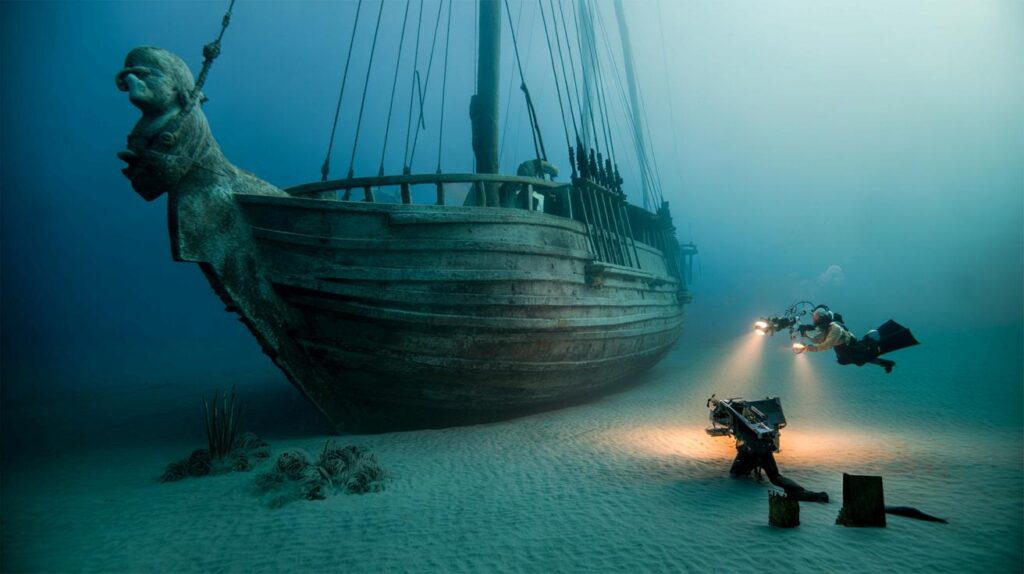
After 250 years missing from the map, an explorer’s vessel has surfaced again—without ever leaving the bottom of the sea. A wooden time capsule, almost perfectly preserved.
And suddenly, history doesn’t feel so far away.

The day a ghost ship turned back into a real one
On the morning the find was confirmed, the research vessel’s deck felt strangely quiet. No cheering, no champagne, just stunned faces pressed to monitors, tracing every contour of the wreck in grainy sonar. A few kilometers off the Australian coast, a shape that had haunted archives and sailors’ stories had finally taken on sharp, undeniable lines.

The hull lay canted to one side, the bow pointing roughly toward the route it never finished. You could almost picture the crew moving across the deck, the flurry of canvas, the smell of tar and sweat and fear. *For a moment, the 18th century didn’t seem that long ago at all.*
The ship, believed to be one of the long-lost vessels from an 18th-century exploration voyage, had been written off as “lost at sea” in a single dry line of an admiralty report. That was it—no bodies recovered, no cargo salvaged, no dramatic last sighting sketched by a surviving sailor. Just absence.
What changed was a quiet, stubborn project: years of cross-checking old logbooks with modern current models, scanning rectangles of seafloor that mostly produced nothing but sand. Then last year, a sonar pass revealed a shape too symmetrical to be natural. A follow-up dive showed intact planking, copper sheathing, and a design that matched surviving plans almost plank for plank. One archaeologist later described it as “like opening a sealed trunk in your grandparents’ attic and finding everything still folded.”
The preservation borders on eerie. The cold, low-oxygen waters created a kind of protective cocoon, slowing the usual rot and hungry marine life. Much of the hull remains upright. The masts are gone, but the mast steps, gunports, and stern galleries are still sharply defined. Even decorative carvings have survived, shielded by sediment.
To scientists, it’s more than a picturesque ruin. It’s raw data. Every nail, every repair, every improvised fix by an exhausted ship’s carpenter is still there to be read. **This isn’t just a wreck, it’s a frozen moment in a dangerous experiment called global exploration.** The ship was once cutting-edge technology; now it’s a question posed to the present: what were we willing to risk to redraw the world’s map?
A 250-year-old time capsule… and what to do with it
Finding a ship like this is only half the story; deciding how to touch it is the other. The team’s first move wasn’t to grab relics, but to create a digital twin. Rows of cameras, laser scanners, and remotely operated vehicles circled the wreck with the patience of a satellite mapping a planet. Every angle, every crack, every piece of fallen rigging was recorded in high resolution.
Back on shore, those files became a 3D model you can rotate with a mouse. A ghost you can zoom into. It’s the new frontline of underwater archaeology: disturb as little as possible, learn as much as possible.
The temptation, of course, is to haul everything up—chests, bottles, instruments, anything that whispers of another era. We’ve all been there, that moment when curiosity bulldozes patience. Yet the record of past wreck recoveries is full of rushed decisions: iron that crumbles when it hits air, textiles that dissolve in the lab sink, artifacts that end up in storage boxes no one opens for decades.

So this time, the plan is slower. Sample, don’t strip. Take one navigational instrument, not seven. Lift a single cannon to understand corrosion patterns. Leave much of the fabric of the ship where it is, shielded by the water that kept it safe for so long. Let’s be honest: nobody really does this every single day. Even the experts are learning as they go.
The wreck has also forced a different kind of conversation: who does this history belong to, and how should it be told? The explorer’s name is well-known. The crew list, patchy but partly preserved. The Indigenous coastlines the ship sailed past, or wrecked near, have much deeper stories that rarely entered those European logs.
“Every time we dive this site, we’re not just visiting the past of one nation,” one Australian maritime historian said during a press briefing. “We’re stepping into the overlap between worlds that didn’t meet on equal terms. The ship is intact, but so are the silences around it. Our job is to surface both.”
- Ship as time capsule – Preserved structure, cargo traces, and daily tools
- Human stories – Crew routines, fears, ambitions reconstructed from objects
- Shared coastlines – European exploration set against 60,000+ years of First Nations sea knowledge
- Modern mirror – How we explore today, from oceans to space, with different ethics
What this discovery quietly says about us
There’s something strangely comforting about knowing a wooden hull can sleep for 250 years and still hold its shape. It suggests our attempts to understand the world leave sturdier traces than we think. At the same time, standing in front of the wreck’s first 3D render, several researchers admitted to a flicker of guilt. The ship is a symbol of courage and of intrusion, of science and of empire, all nailed together into the same frame.
You can celebrate the seamanship and still question the mission. Both can be true at once, sitting side by side like cargo in the hold.
For coastal communities nearby, the discovery has already become a sort of floating mirror. Local fishers who’d grown up hearing vague stories of “old timbers” now know there was a specific ship under their boats all along. School groups are visiting pop-up exhibits. Elders from Indigenous groups along the coast are being invited to share sea knowledge that predates the wreck by millennia. **The narrative is widening, quietly, measured in meetings and long conversations instead of dramatic headlines.**
This is where the find stops being just an archaeological event and becomes something more ordinary and more powerful: a shared story people argue over, protect, reinterpret.
The wreck will likely stay on the seafloor. Most of it, at least. Digital replicas will travel instead—into museums, classrooms, maybe even VR headsets where you can “walk” the deck that never made it home. The real ship will rest in its cold cradle, slowly giving up details as science invents kinder ways to ask questions.
And that might be the most 21st-century part of the whole adventure. Instead of dragging the past into our world until it breaks, we’re learning to visit it on its own terms. The ship is no longer lost, yet it’s still out there, just beyond everyday reach. A reminder that not everything needs to be raised to be seen.

| Key point | Detail | Value for the reader |
|---|---|---|
| Time capsule ship | 250-year-old explorer’s vessel preserved off Australia’s coast | Offers a vivid, tangible window into the age of exploration |
| Gentle archaeology | Digital twins, selective recovery, long-term preservation plans | Shows how modern science balances curiosity with responsibility |
| Shared history | Collaboration with local and Indigenous communities around the site | Invites readers to see shipwrecks as living stories, not just relics |
FAQ:
- Question 1Which explorer’s ship has been found off Australia’s coast?
- Question 2How can a wooden ship remain preserved for 250 years underwater?
- Question 3Will the ship be raised and displayed in a museum?
- Question 4What kinds of objects are researchers hoping to find on board?
- Question 5Can the public “visit” the wreck, physically or virtually?
