The Seattle-based carrier has just placed its largest aircraft order ever, handing Boeing a badly needed commercial win and reshaping the rivalry with Airbus on some of the most profitable routes in global aviation.
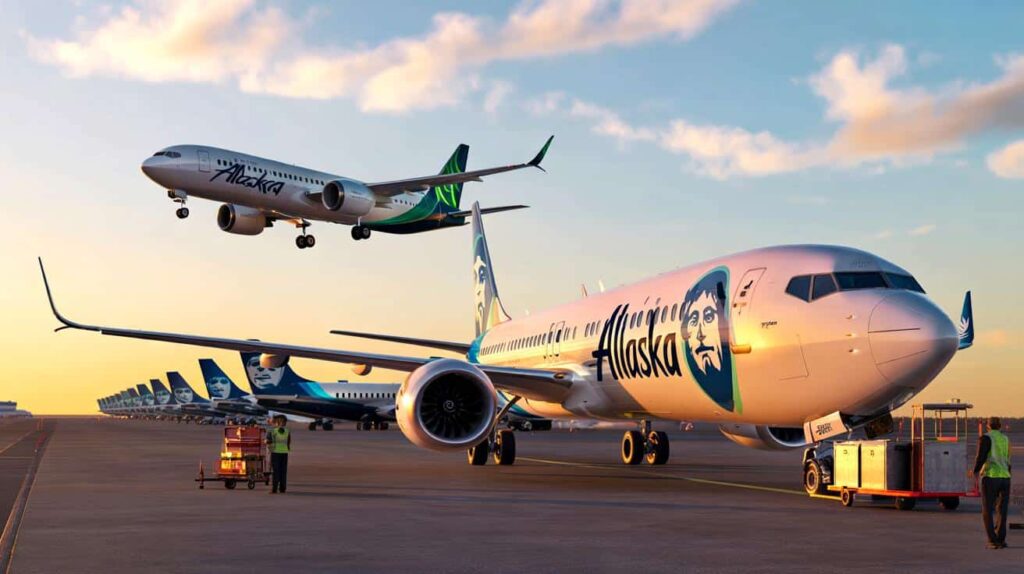
Alaska’s record Boeing order that changes the game
Boeing and Alaska Airlines have confirmed a blockbuster deal built around the 737 MAX family and the long-haul 787 Dreamliner.
The order includes:
 France moves to lock in control of a crucial battery material Europe’s carmakers can’t live without
- 105 Boeing 737-10 aircraft (the largest version of the 737 MAX)
- Options for 35 additional 737-10s
- 5 extra Boeing 787 Dreamliners for long-haul routes
Alaska’s fixed order alone is valued between $7 and $8 billion, or at least €6 billion, once industry-standard discounts are factored in.

On paper, catalog prices look huge. The 737-10 lists at around $135 million per aircraft and the 787 at roughly $250 million. In reality, large, long-term customers like Alaska pay far less through deep discounts, especially when they commit to a single manufacturer across decades.
Analysts estimate Alaska will pay closer to $60 million per 737-10 and about $140–150 million per Dreamliner, putting the deal firmly into mega-contract territory even before any options are exercised.
A bet on a single-type short-haul fleet
Alaska Airlines already runs one of the most uniform fleets in North America. The backbone of its operation is the Boeing 737, with 248 aircraft in service and 174 737 MAX jets already on order before this latest deal.
The fresh batch of 737-10s pushes that strategy even further.
- Lower training costs – pilots can move between aircraft variants with minimal extra checks.
- Maintenance efficiency – spare parts inventories shrink, and engineers focus on one family of systems.
- Scheduling flexibility – aircraft can be swapped quickly between routes as demand shifts.
The 737-10 will gradually replace older jets while opening up busier or slightly longer domestic routes. Think heavy West Coast trunk lines, high-density leisure flights and potentially deeper pushes into Mexico or Hawaii with more seats and better fuel economics.
Dreamliners signal a bigger international push
The most strategic part of the deal sits in the widebody segment. By adding five new 787 Dreamliners to the five it already operates, Alaska is quietly building a genuine long-haul platform.
The 787 allows the airline to connect medium-sized cities directly across oceans, skipping mega-hubs like Los Angeles or Chicago. That could mean future nonstops from Seattle, Portland or even Anchorage to European or Asian destinations with enough premium and tech traffic to sustain them.
The Dreamliner gives Alaska the tools to think beyond North America and position itself as a Pacific and transatlantic challenger.
The aircraft’s composite structure and modern engines bring lower fuel burn per passenger and quieter cabins, both key for communities near airports that increasingly resist night flights and heavier noise footprints.
How the money breaks down
Estimated value of Alaska’s mega-contract
| Aircraft type | Quantity (firm) | Estimated net price per unit* | Estimated total value |
| Boeing 737-10 | 105 | ~$60 million | ~$6.3 billion |
| Boeing 787 Dreamliner | 5 | ~$140–150 million | ~$700–750 million |
| Total (firm) | 110 | – | ~$7–8 billion (€6–6.85 billion) |
*Based on typical large-order discounts, not official figures.
On top of this, the 35 optional 737-10s could add roughly another $2–2.5 billion ($1.7–2.14 billion in euros) if Alaska chooses to exercise them as demand grows.
Boeing vs Airbus: the rivalry behind the contract
The deal lands at a delicate moment for Boeing. Its 737 MAX programme has worked through grounding, certification delays and intense regulatory scrutiny. Airbus has taken advantage, particularly with its high-capacity A321neo family.
On high-capacity single-aisle jets, the numbers speak clearly:

| Aircraft | Manufacturer | Service entry | Cumulative firm orders | Notes |
| 737-10 | Boeing | Awaiting certification | ≈ 1,100 | Key customers: United, Alaska, major lessors |
| A321neo (family) | Airbus | 2017 | ≈ 5,700 | Backbone of many European and Asian fleets |
| A321XLR | Airbus | 2025–2026 | ≈ 600 | Long-range narrow-body, no direct Boeing rival yet |
Alaska’s choice looks almost conservative when set against that backdrop. Airbus’s A321neo and A321XLR offer more range and flexibility for thin long routes. Boeing’s 737-10, by contrast, focuses on dense short and medium sectors with commonality as its big selling point.
Alaska is not trying to buy the most flexible jet on the market. It is trying to buy the most coherent fleet for its business model.
On the long-haul side, the picture flips slightly. Boeing’s 787 Dreamliner and Airbus’s A350 compete head-on, with roughly 1,650 orders for the American jet versus about 1,100 for its European rival, which arrived later to market. Alaska siding with the 787 keeps it squarely in Boeing’s camp for both short and long-haul flying.
A six-decade partnership reinforced
This contract also has an emotional and industrial dimension. Boeing and Alaska Airlines have worked together for roughly 60 years, starting with early 727 deliveries in the 1960s. Both are rooted in the US Pacific Northwest, and they share suppliers, talent pools and infrastructure.
For Boeing, the order is a public vote of confidence from a long-standing customer at a time when each major deal sends a signal to markets and regulators. For Alaska, sticking with Boeing means fewer surprises and a manufacturer whose operations it knows almost aircraft by aircraft.
Executives frame the deal as part of “Alaska Accelerate,” the airline’s growth plan. The aim is not rapid expansion at any cost, but a controlled ramp-up that avoids the trap of overordering and then struggling to fill seats or crew flights.
Environment, regulation and why new jets matter
There is also a regulatory angle. New-generation jets like the 737 MAX and 787 burn less fuel per seat and emit less CO₂ than the aircraft they replace. They are quieter, too, a growing requirement around noise-sensitive airports.
For airlines, environmental performance has shifted from a marketing argument to a condition for operating in certain regions and time slots.
As climate rules tighten and carbon pricing spreads, older, thirstier jets risk becoming uneconomic, especially on marginal routes. By locking in deliveries of modern aircraft, Alaska gives itself more breathing space against future emissions rules and potential taxes on aviation fuel.
What this could mean for passengers and prices
For travellers, a larger 737-10 and a growing 787 fleet can translate into more nonstops and fewer connections. Seattle–Europe routes with Dreamliners, more seats on peak West Coast flights, or new direct services to secondary cities in Asia are all realistic scenarios over the next decade.
On the pricing side, a more efficient fleet tends to lower unit costs. Airlines sometimes use that margin to compete harder on fares, sometimes to pad profits, and often a bit of both. The real impact on ticket prices will depend on rival carriers’ responses and broader demand trends in North America and the Pacific.
Key terms and risks behind the headlines
A few concepts help decode deals like this:
- Firm order – an aircraft order that is contractually binding, with agreed delivery slots and payment terms.
- Options – the right, but not the obligation, to buy extra aircraft at pre-negotiated conditions, giving airlines flexibility if demand grows.
- Certification – regulatory approval that an aircraft type is safe to operate; delays here can disrupt airline fleet plans.
There are also clear risks. The 737-10 still awaits full certification, and any further regulatory delay could push deliveries back, forcing Alaska to keep older jets longer. Demand shocks, such as a recession or new health crisis, could make such a large order look heavy. At that point, options, delivery deferrals and resale to leasing firms become pressure valves.
For now, though, the contract sends a sharp message: Boeing is not out, Airbus does not have the US market to itself, and a once mostly regional player on America’s northwest fringe is quietly gearing up to play on a much bigger stage.